
Feeling Confident About a Relationship’s Future May Be Linked to Romantic Attachment
Fri, Oct 9, 2026-
Tags
Feeling Confident About a Relationship’s Future May Be Linked to Romantic Attachment
Study finds differences in perceived relationship stability, attachment anxiety, and attachment avoidance between gay and heterosexual men
Feeling confident that a romantic relationship will remain stable may be important for how people experience their relationships, finds a study by researchers at Waseda University and Nagoya University. Comparing gay and heterosexual men, the researchers found higher levels of attachment anxiety and avoidance and lower perceived relationship stability among gay men. The study suggests that differences in attachment may be linked not only to experiences within relationships, but also to the surrounding social environment.
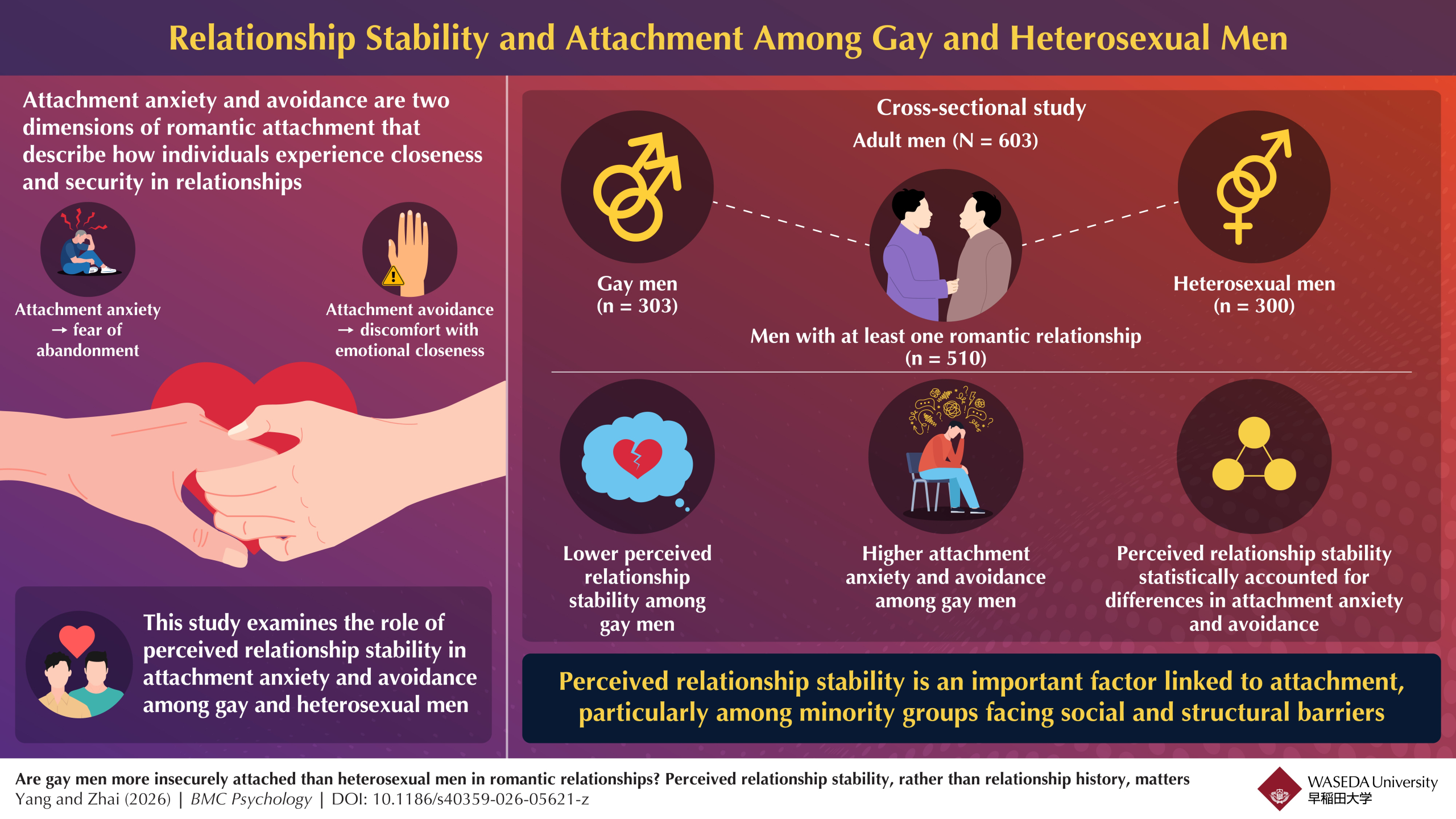
Image title: Examining romantic attachment and relationship stability among gay and heterosexual men
Image caption: The study found that perceived relationship stability was associated with differences in attachment anxiety and avoidance between gay and heterosexual men, highlighting the potential importance of feeling confident about a relationship’s future.
Image credit: Assistant Professor Fan Yang from Waseda University, Japan
License type: Original content
Usage restrictions: Cannot be reused without permission.
Feeling secure in a relationship is not only about how people connect with their partners today. It may also depend on how confident they are that the relationship will continue into the future. Feelings of closeness, trust, and connection, together with a sense that the relationship is stable and has a future, can shape how people experience their romantic relationships.
For people with diverse sexual identities, these expectations may be shaped not only by their relationship but also by the wider social environment. Concerns about whether a relationship will be accepted by family and society, for example, may affect how secure people feel about maintaining their relationships over time.
Assistant Professor Fan Yang from the Faculty of Letters, Arts and Sciences, Waseda University, Japan, and Mr. Zichen Zhai from the Graduate School of Education and Human Development, Nagoya University, Japan, investigated whether gay and heterosexual men differ in how they experience romantic attachment and whether perceived relationship stability would help explain these differences. The study was published online in the journal BMC Psychology on September 16, 2026.
The researchers focused on two aspects of attachment: anxiety, which can involve worrying about being abandoned or being unsure about a partner’s feelings, and avoidance, which can involve discomfort with emotional closeness or relying on a partner.
“Our findings highlight the critical role of relationship stability in shaping adult attachment patterns, particularly within sexual minority populations,” says Yang.
The researchers collected questionnaire data from 603 men aged 20–29 years living in Shanghai, China. The participants included 303 gay men and 300 heterosexual men. They completed questionnaires measuring attachment anxiety and avoidance, perceived romantic relationship stability, and their romantic relationship history.
Among the 510 participants who had experienced at least one romantic relationship, the researchers assessed perceived relationship stability by asking how stable they considered their romantic relationships to be, with responses ranging from “very unstable” to “very stable.” Attachment anxiety and avoidance were assessed using a nine-item questionnaire designed to measure these two dimensions of romantic attachment.
The findings showed that gay men reported higher levels of both attachment anxiety and attachment avoidance than heterosexual men. These differences remained after accounting for economic and occupational statuses.
The researchers found little difference between gay and heterosexual men in their relationship histories. The groups reported similar numbers of romantic relationships and similar durations for their shortest relationships. The researchers found a clearer difference when they asked participants how stable they considered their relationships to be. Gay men reported lower perceived stability than heterosexual men, and perceived relationship stability statistically accounted for the differences in attachment anxiety and avoidance between the groups.
“The feeling that ‘this relationship has a future’ may be an important part of romantic security,” explains Yang.
Overall, the study suggests that romantic security may depend not only on how people experience their relationships, but also on how confident they feel about their relationships continuing into the future.
For people with diverse sexual identities, this sense of stability may also depend on whether their relationships feel accepted and supported by their families, communities, and wider social environment.
“These findings may be relevant to relationship counseling, mental health support, and services for sexual minority individuals. Support may need to consider not only communication between partners, but also concerns about whether the relationship can be accepted, supported, and maintained over time,” says Yang.
Title of original paper:Are gay men more insecurely attached than heterosexual men in romantic relationships? Perceived relationship stability, rather than relationship history, matters
Journal: BMC Psychology
Authors:Fan Yang1 and Zichen Zhai2
Affiliations:
1Faculty of Letters, Arts and Sciences, Waseda University, Japan
2Graduate School of Education and Human Development, Nagoya University, Japan
DOI:
10.1186/s40359-026-05621-z
About Assistant Professor Fan Yang from Waseda University, Japan
Dr. Fan Yang is an Assistant Professor at the Faculty of Letters, Arts and Sciences, Waseda University, Japan. He leads the Kayo Psychology Seminar with international students. He is also a committee member of the Public Relations Committee of the Japanese Psychological Association and a reviewer for SSCI journals. His recent research interests include AI attachment and attachment security priming.