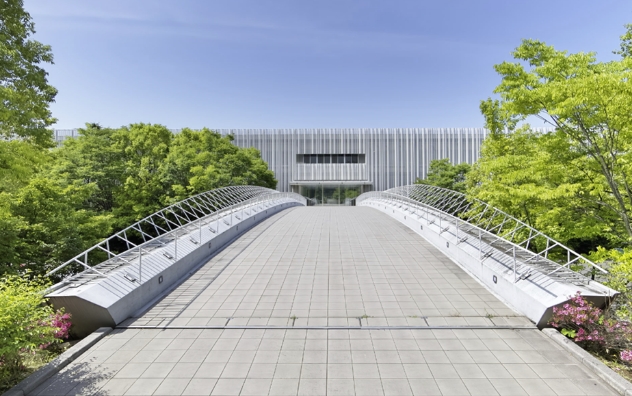
Taking Sheets to the Streets: Student-Led Learning Outside the Classroom With the Space And Image Research Seminar
Tue, Jul 21, 2026-
Tags
On 23 June, students of the Space and Image Research Seminar headed by School of Social Sciences Dean, Professor Yoichi Sato, spent their weekly seminar meeting running around the university campus clutching 6B pencils in one hand and loose sheets of PM Pad Paper White in the other. The task for the day was urban frottage, from the French word frotter, which means to rub– the process of rubbing a pencil over a sheet of paper in order to transfer the texture below onto the page. A pile of blank paper and setting spray were left on a table at the first floor of Building 11 before everyone took off in their own direction in search of interesting textures.
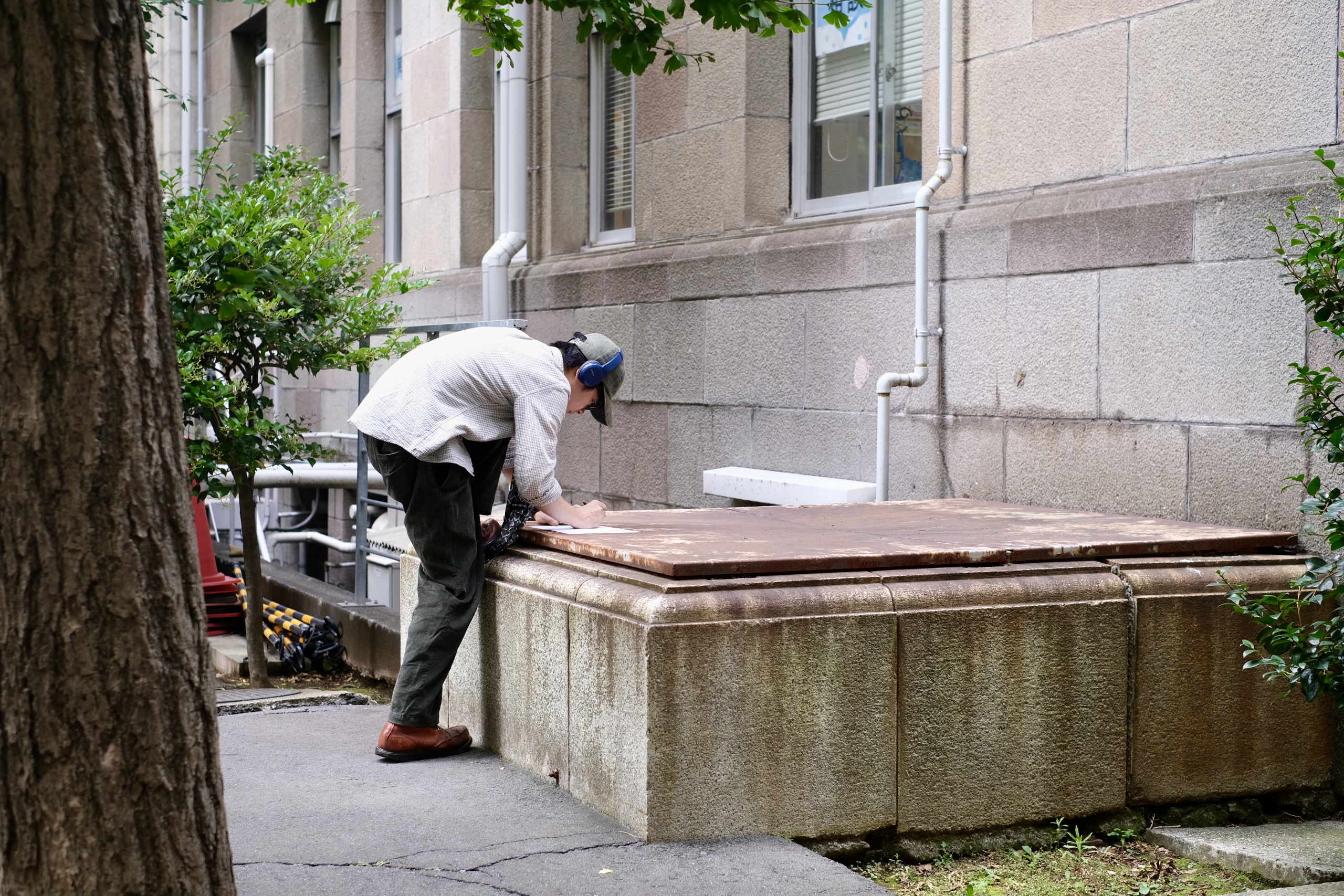
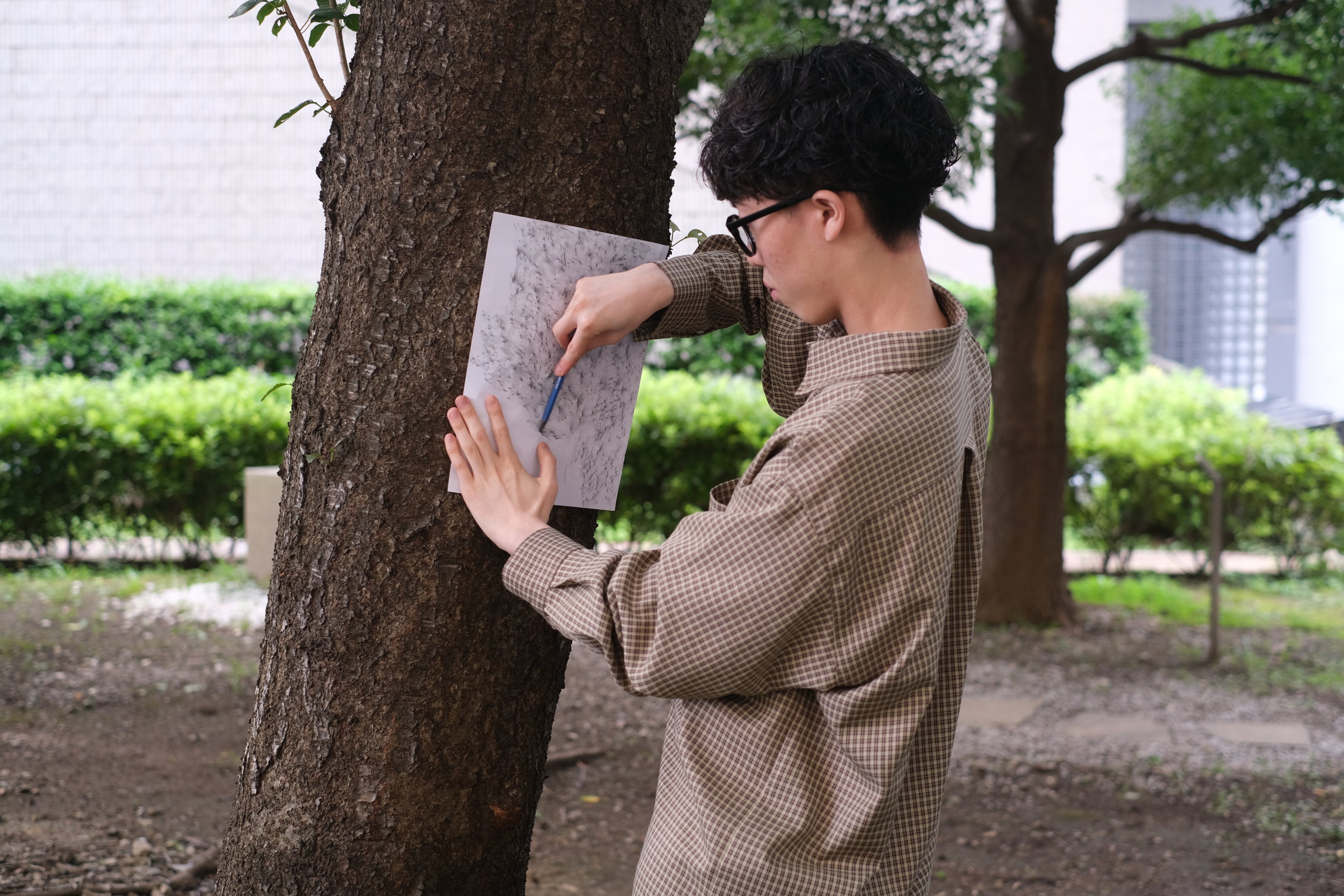
Students of the Space and Image Research Seminar tracing textures around Waseda Campus
The seminar, also known in Japanese as the zemi, is a unique feature of Japanese universities: a research class in which students work together on a common research topic under the guidance of a professor, and is characterised by student initiative and intensive project-based learning.
As a student of the Space and Image Research Seminar, the opportunity for hands-on learning outside the classroom has been one of the most valuable aspects of being a part of this seminar. Though what exactly we do as a seminar can be hard to discern from the name alone, our seminar takes an interdisciplinary lens to media studies and spatial studies, with many but not all activities focusing on interactions between visual media (such as photography and videography) and the physical space. Drawing on Professor Sato’s background in architecture, urban studies and archival photography, students in the seminar explore a wide range of issues, ranging from subcultures in Tokyo, to rest areas in public spaces, culminating in exhibitions once (or more) a year.
The day’s task of urban frottage brought an artistic angle to the project of exploring space, giving students the chance to learn outside the classroom while deepening our understanding of the surrounding environment. In my own search, I would occasionally run into classmates hunched over a sign, crouched on the floor, or trying to press a sheet of paper to the wall against the wind. What is the ideal amount of pressure to apply? Is it better to run the pencil over the page lightly many times or just once with more pressure? As with the learning of any new skill, there was plenty of technical trial, error and learning. But many larger questions and observations came up as well about the subjectivity of each individual’s experience of space.
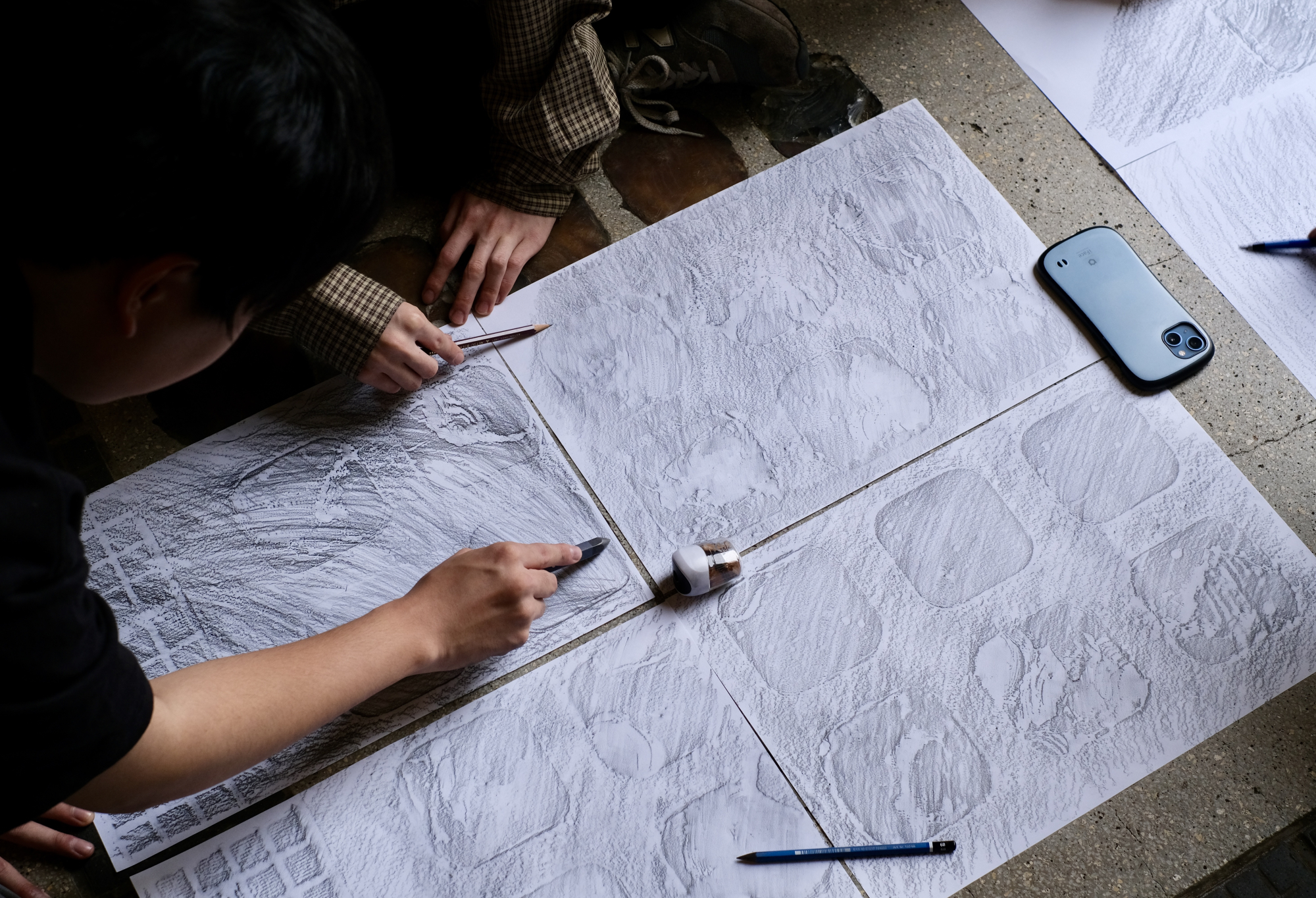
How do different people capture the same texture? Two different people using the same paper and the same pencil used in the same place could yield widely different results with different strokes, pressure and attention to detail. What can we learn about how people interact with their environment by translating the subjective experience of space onto a sheet of paper? This was tested directly with a collective piece, where myself, Professor Sato and a handful of other classmates began an impromptu collaboration under the arch of Building 6.
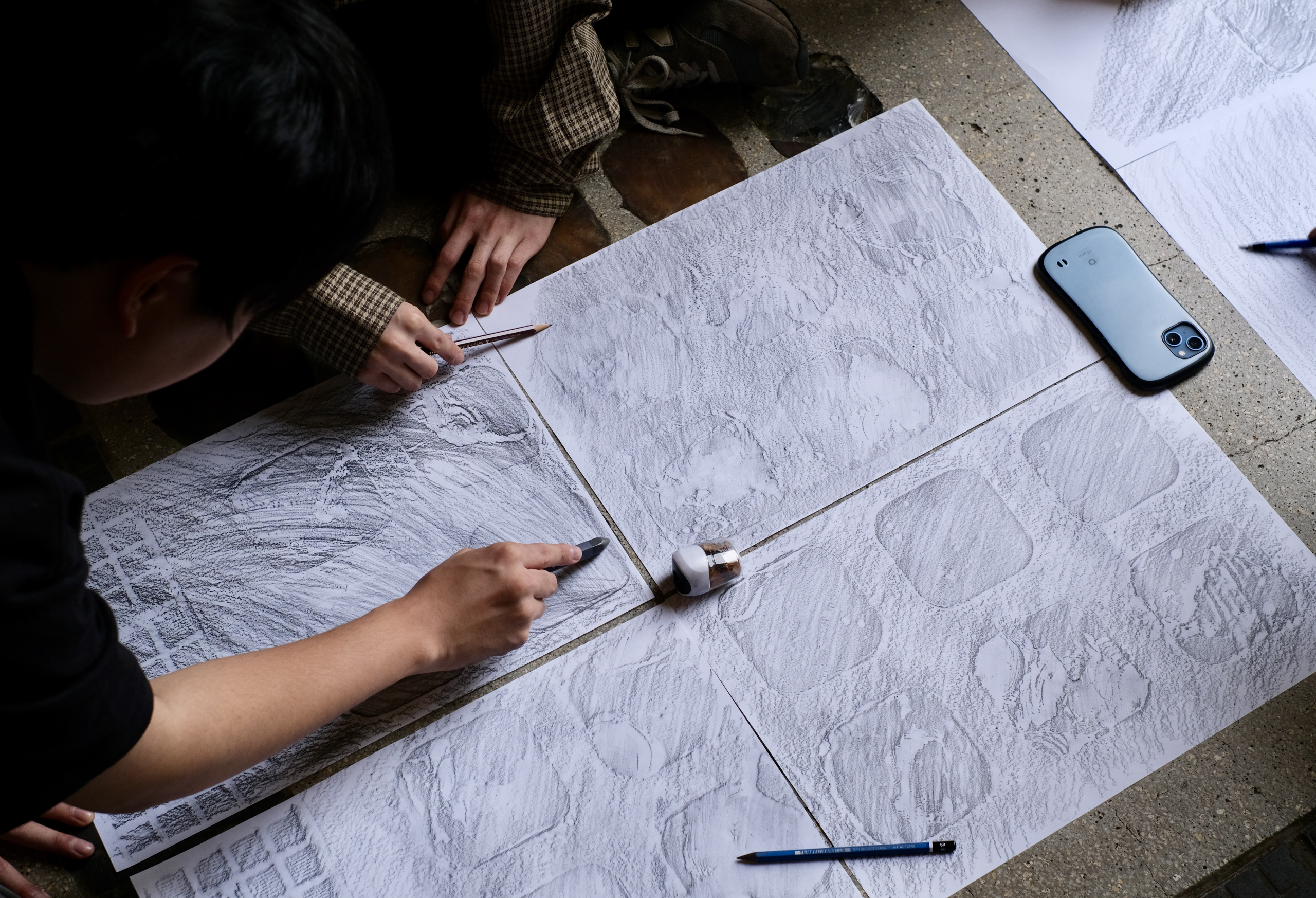
Collaborative work between myself and two classmates.
Armed with different pencils, we tested how different tools and different people captured the texture of the ground differently. After finishing my work on one sheet of paper, a classmate came over to join and we traded tools. He passed me a 6B pencil and I passed him my graphite stick– a writing instrument that is essentially just the lead portion of the pencil with no wood casing around it. Two sheets of A2 paper lay side by side, the texture of the ground beneath each captured with different tools. The same hands worked over both sheets of paper, yet the different tools lifted the texture differently. The thinner 6B pencil created more distinct strokes, translating the movement of each swipe of pencil onto the paper on the left, whereas the thicker graphite pencil resulted in thicker, less distinct strokes, drawing attention to the texture itself lying below the paper on the right. We also saw how the same tool produced different results in different hands; the thicker body of the graphite pen producing sharper lines under the focused pressure of one classmate and broader shadows under the lighter touch of another.
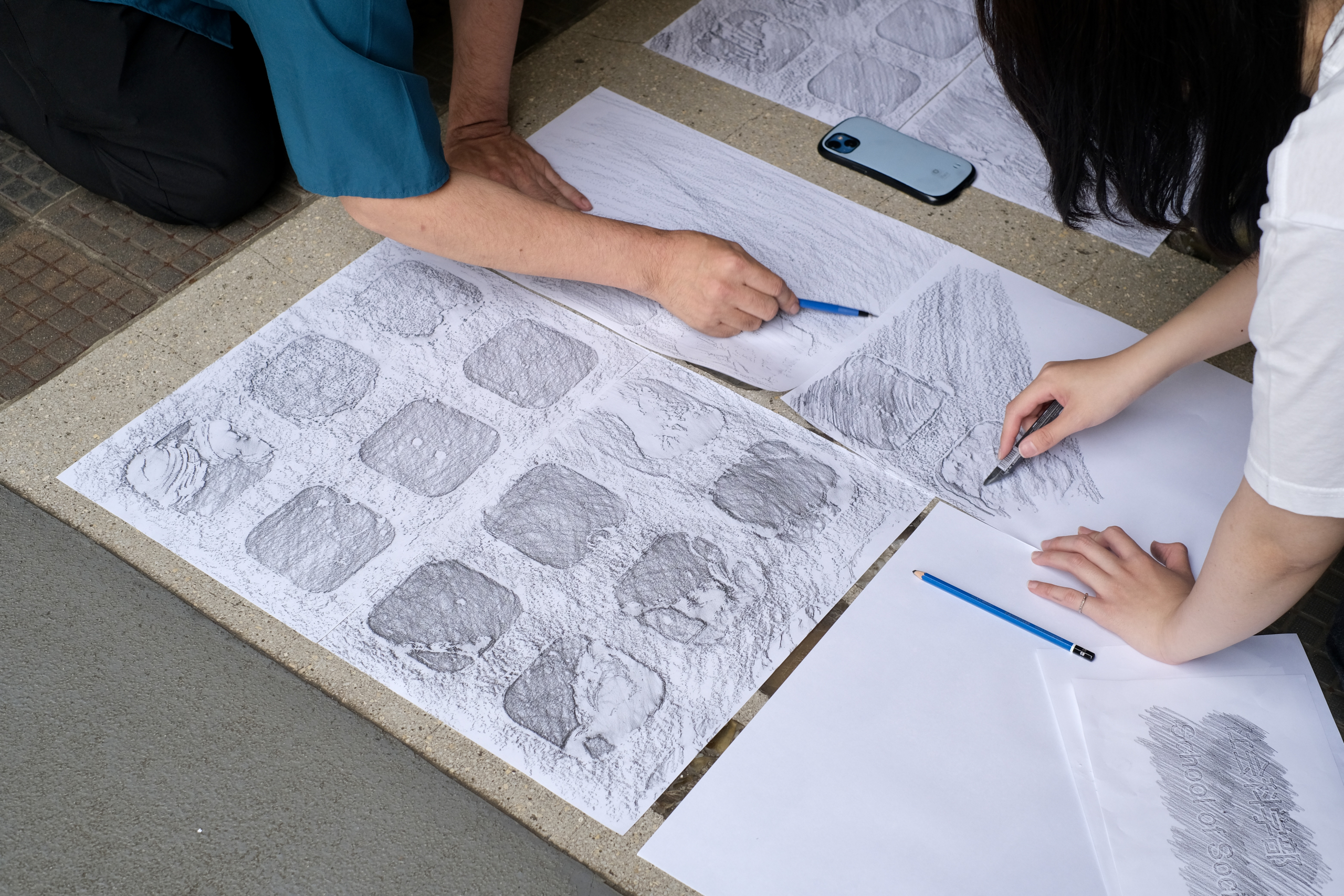
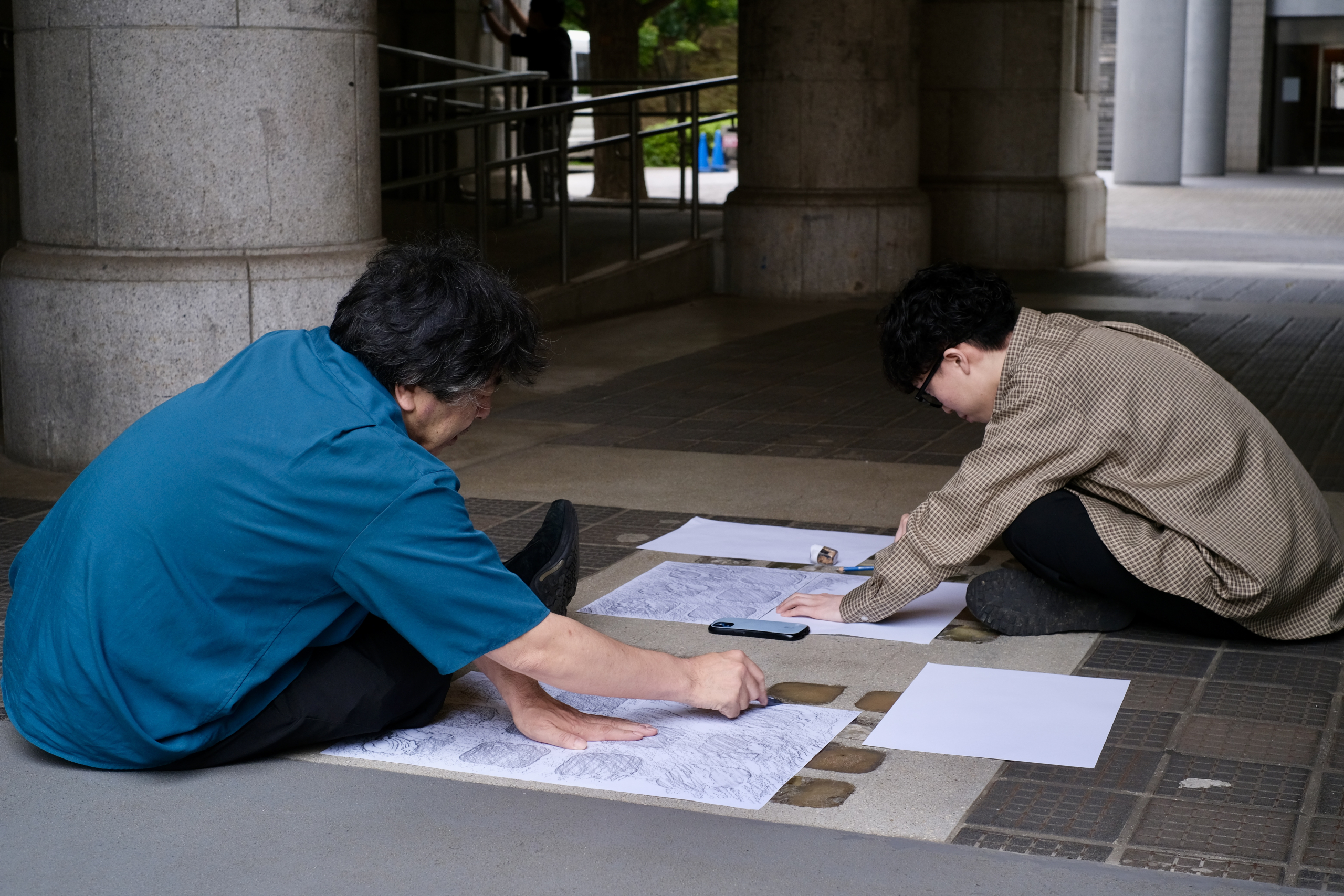
Professor Sato and students doing urban frottage outside Building 6 of Waseda University
Though weeks have passed, urban frottage has become a mainstay sub-activity of the seminar, with students (and Professor Sato) pursuing it either on their own or in small groups in and around Tokyo. Despite how many pencil emojis get sent into the seminar Slack channel, urban frottage had not actually been listed on the semester schedule handed out to students at the beginning of the term. It had not been part of the plan for seminar activities, this semester or any semester before, as a matter of fact. The entire experience came as a result of two key reasons: opportunities for hands-on, experiential learning outside the classroom, and a learning environment that encourages proactive learning and fosters a safe space to experiment with new things.
For the spring semester of 2026, the 19th of May and 23rd of June had been set aside for “an event” left up to the students to decide what they wanted to work on. The first session on the 19th of May had been a portrait photography session with a makeshift studio set-up erected in the classroom the day before, giving students a chance to explore the “image” aspect of the Space and Image Research Seminar. The idea for urban frottage, however, came from one of the 3rd Year Walking Tours, an optional activity where Professor Sato spends a few hours on the weekend taking the 3rd year students on a walking tour somewhere in Tokyo, giving students a chance to explore the spatial aspect of the Space and Image Research Seminar.
The first of three such tours was conducted on May 31st, attended by only myself and one other student The tour started in the historical district of Kagurazaka, taking us through Koshikawa Korakuen, and all the way to Ochanomizu over about 5 hours total. While observing a spray-painted message on a wall under a bridge near Tokyo Dome, my classmate remarked that he wanted to try his hand at urban frottage, saying that it seemed fun, referencing the the 生きられた新宿1975 (Ikirareta Shinjuku 1975, trans: Lived Shinjuku 1975) exhibition we had attended as a seminar the year before. After some enthusiastic discussion between the three of us, the Space and Image Research Seminar’s had its first hands-on experience with urban frottage at the next 3rd Year Walking Tour on June 14. Thus, at the end of a day spent experimenting and a brief reflection session, it was decided that the free period on the 23rd of June would be set aside for more frottage, giving the other students a chance to try their hands at it as well.
This experience has given me a renewed sense of gratitude for the learning environment here at Waseda, where professors and classmates encourage us to explore our interests and assist us in turning our ideas into reality. Not only are we given the encouragement to set forth and explore, but also the support to seek out and realise whatever we envision. Exposure to real-life examples of what kinds of projects exist outside the walls of this University, such as the Ikirareta Shinjuku 1975 exhibition, provides an idea of what’s out there and presents us with possibilities. The next step is to then take that idea of what’s possible and make it into something of our own. One thing this experience has driven home for me as a student is just how much of our learning is in our own hands, and also how rewarding it can be to watch an idea become reality.
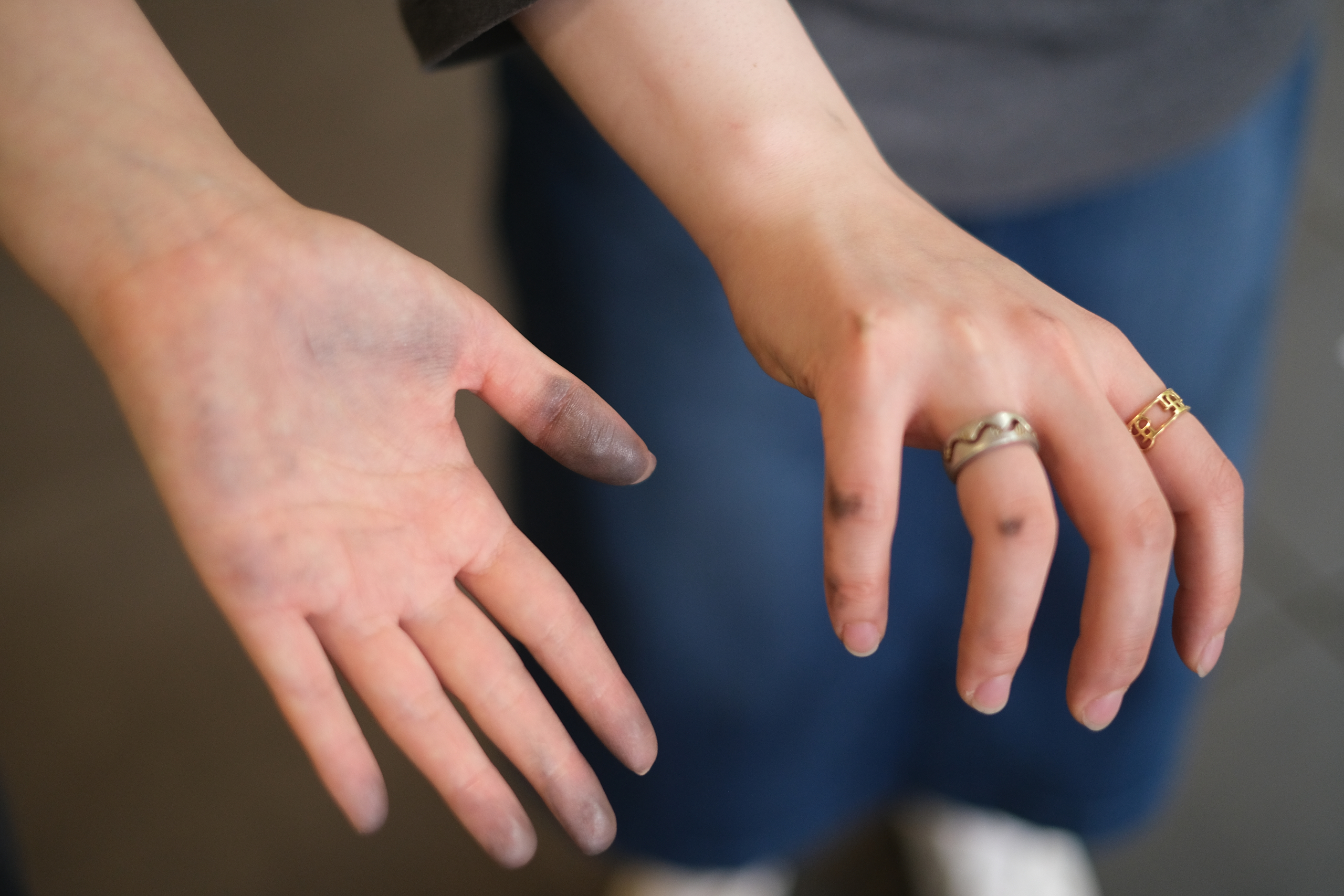
Hands stained by pencil lead in the aftermath of the session
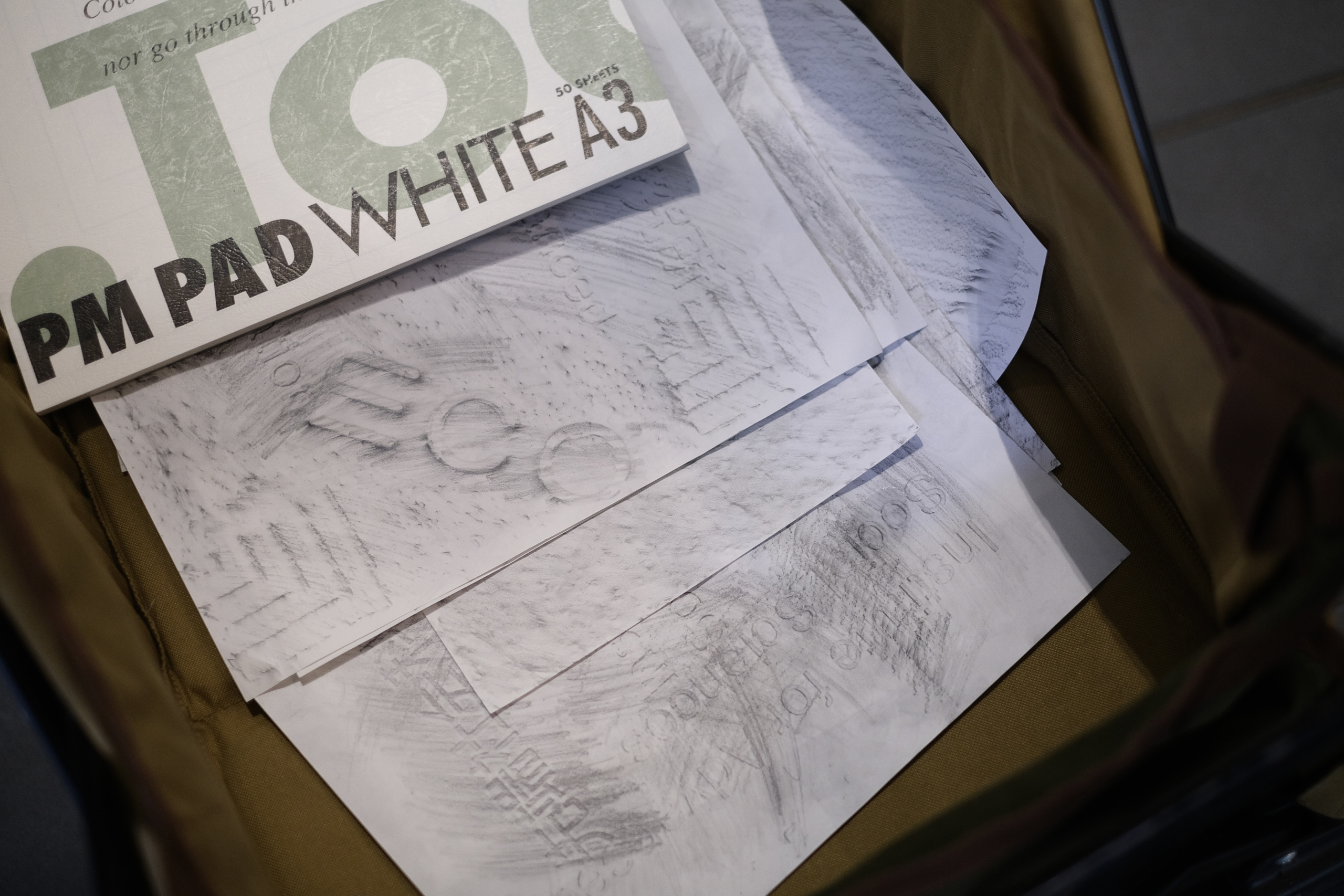
The completed projects loaded onto a cart
About the Author: Sung Yushin
Hi everyone! My name is Sung Yushin, and I am currently an undergraduate student at the School of Social Sciences here at Waseda University studying with the Space and Image Research Seminar. Since moving to Tokyo for university, I’ve discovered the joy in taking directionless, meandering walks around the city, deciding where to go based on what looks most interesting on the horizon. I also like taking photos and finding new places to eat, two hobbies that pair well with my newfound love for walks.