![[Podcast Column] Rethinking Language Through Sociolinguistics and Translanguaging](https://www.waseda.jp/top/en/assets/uploads/2026/06/2026.6.24-brain-screenshot-for-podcast-column-1.jpg)
[Podcast Column] Rethinking Language Through Sociolinguistics and Translanguaging
Thu, Jun 25, 2026-
Tags
In this podcast column, we introduce the first episode of Season 2 of Waseda University’s English podcast “Rigorous Research, Real Impact”. Associate Professor Theron Muller (Faculty of Human Sciences) served as the guest expert for “Translanguaging and Identity: Research in the Japanese Context.” He expertly defines sociolinguistics and translanguaging in a way even someone without a background in linguistics can understand in the excerpt below.
All eight episodes of Season 2 are currently streaming for free on Spotify, Amazon Music, Apple Podcasts, and YouTube.
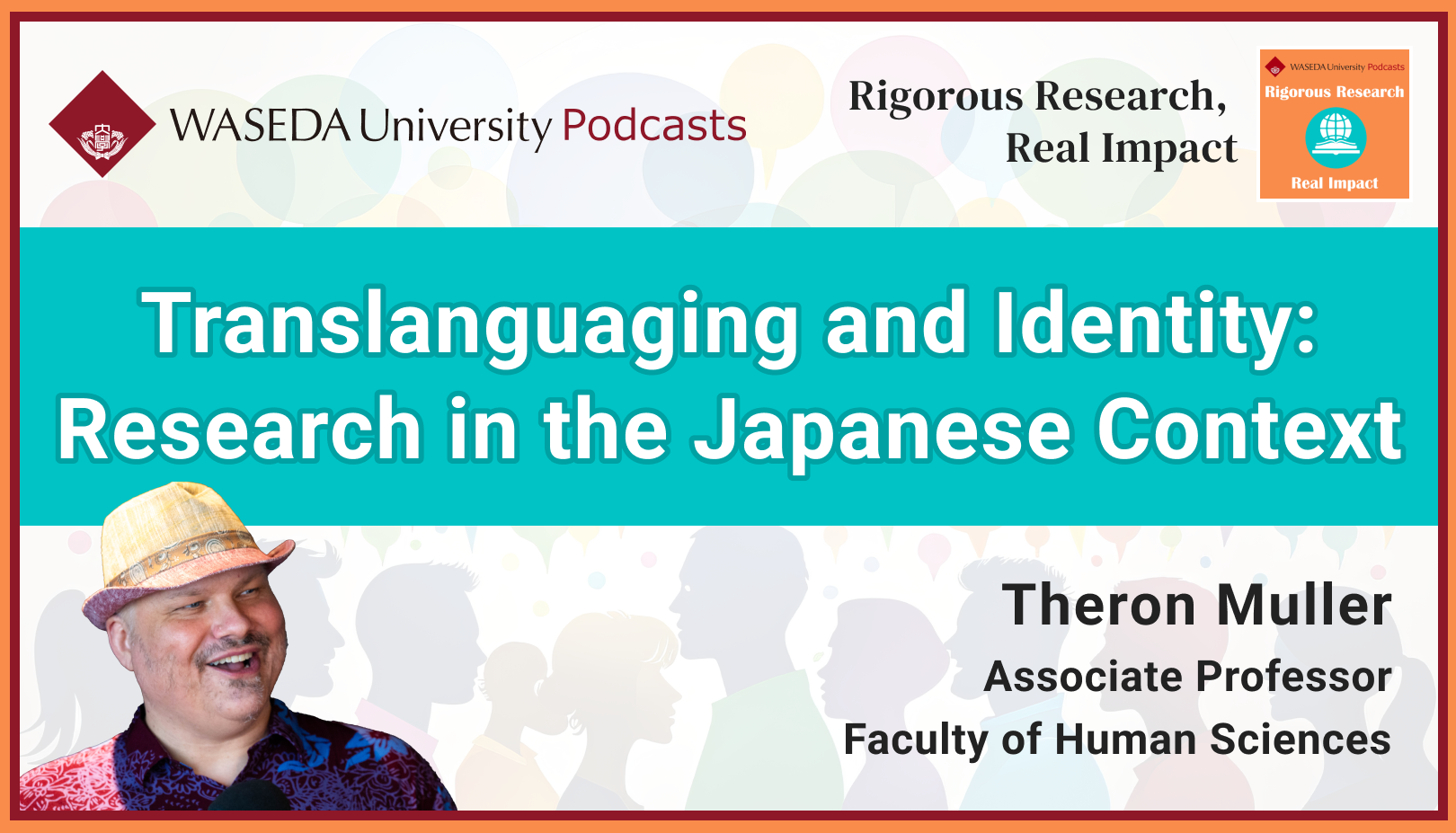
You can read the full transcript by clicking the above episode banner.
Question: What do the terms “sociolinguistics” and “translanguaging” mean?
Professor Muller (1:24):
…So basically, in a very short nutshell, linguistics is interested in describing the structure of language. So, you might have heard that English is subject-verb-object, whereas Japanese is subject-object-verb. So, thinking about how languages are put together or combined.
Applied linguistics is interested in how language is actually used in the world. And then, as a part of applied linguistics, sociolinguistics is interested in the intersection of how people use language and society. So, from a very broad perspective, how society shapes language, and then also how language shapes society in turn.
Inside that, translanguaging is actually quite specific, and it’s a relatively new term in sociolinguistics. It used to be, like in language teaching research, there was something called code-switching, which means switching from one language to another.
And then later on, there became this description of multilingualism, or people being able to speak multiple languages and switching between multiple languages. And one criticism of multilingualism is that it looks at languages as separate things.
But neuroscience research has basically found that there aren’t separate language locations in the brain. If you speak English and you speak Japanese, you’re using the same parts of the brain to speak both. And so, translanguaging talks about how a translanguaging perspective views languages as interconnected and synchronously working together, as opposed to being separate things that people switch back and forth between.
About the Guest:

Associate Professor Theron Muller
Dr. Theron Muller is an associate professor in the Faculty of Human Sciences, Waseda University. He has lived in Japan, including Nagano, Toyama, and Saitama, since 2000. Prof. Muller is an applied linguist and his interests include sociolinguists and English language teaching, specifically the interaction of language, society, and identity.