Taking a Step Back Changes Group Discussions in Virtual Environments
Thu, Jun 25, 2026-
Tags
Taking a Step Back Changes Group Discussions in Virtual Environments
Third-person avatar perspectives in virtual environments may reduce intragroup conflict and improve consensus-driven decision-making
In group decision-making, discussing from an overarching perspective is often difficult. Imagining oneself from a third-person perspective during group discussions may significantly change how people communicate and make decisions together. In this context, researchers investigated the effect of third-person perspective and first-person perspective in a virtual environment on group decision-making. They found that participants using a third-person perspective in virtual reality showed better consensus, improved understanding of others’ opinions, and reduced conflict.
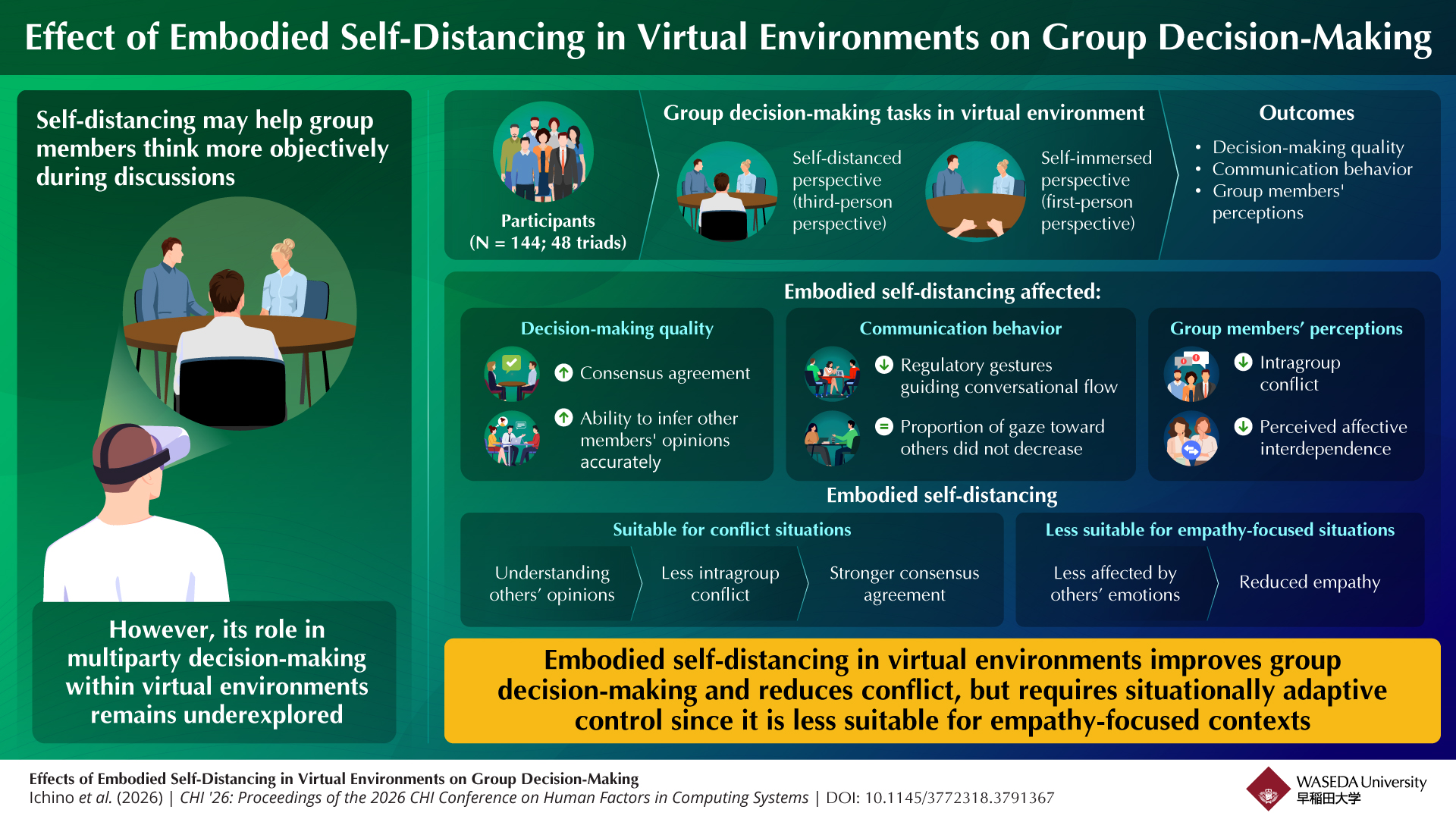
Image title: Embodied self-distancing in virtual reality improves group decision-making
Image caption: Researchers reveal that adopting a third-person perspective in a virtual environment can help improve collaborative decision-making while reducing intragroup conflict.
Image credit: Professor Junko Ichino from Waseda University, Japan
License type: Original content
Usage restrictions: Cannot be reused without permission
In group decision-making, it is critical for each member to engage in discussions with a broader perspective and without fixating on personal values and knowledge. While self-distancing or stepping back and viewing oneself from a third-person perspective has been associated with more objective thinking, its role in multiparty decision-making within virtual environments remains underexplored. As virtual meetings and metaverse platforms become increasingly common, researchers are beginning to explore how virtual environments influence human behavior and decision-making.
In a new study, a research team led by Professor Junko Ichino from Waseda University, Japan, along with Doctoral student Masahiro Ide from Tokyo City University, Japan, Professor Hitomi Yokoyama from Okayama University of Science, Japan, Professor Hirotoshi Asano from Shibaura Institute of Technology, Japan, Professor Hideo Miyachi from Tokyo City University, and Professor Daisuke Okabe from Tokyo City University, investigated whether discussing from a third-person perspective in a virtual environment influences group decision-making, in comparison with a first-person perspective. Their findings were published online in the journal of CHI ’26: Proceedings of the 2026 CHI Conference on Human Factors in Computing Systems on April 13, 2026.
“Although many previous studies have applied third-person perspectives in virtual environments, they have primarily focused on their effects on individual-level activities, such as single-player games and sports. Consequently, their effects on group decision-making have remained largely unexplored,” says Ichino.
To investigate this effect, the researchers recruited 144 participants aged 20–49 years and divided them into 48 groups of three people each. Participants completed two different group decision-making tasks in virtual reality. In one condition, they experienced discussions through a standard first-person perspective, seeing the virtual world through their avatar’s eyes. In the second condition, participants viewed their avatars from behind, similar to watching themselves from the perspective of an outside observer. This was referred to as the third-person perspective condition.
They found that participants using the third-person perspective demonstrated significantly stronger consensus agreement and improved accuracy in understanding the opinions of other group members. They also reported lower levels of intragroup and task-related conflict during discussions. These findings suggest that observing oneself from a slight psychological distance may help people avoid becoming overly attached to their own opinions, leading to calmer and more cooperative conversations.
Interestingly, the study also revealed changes in communication behavior. Participants in the third-person perspective condition displayed more “regulating gestures,” such as movements that help manage conversational flow by signaling when to speak, pause, or yield turns to others. At the same time, they used fewer gestures that substituted for verbal expression. According to the researchers, this indicates that the altered perspective may subtly reshape the way people coordinate and interact during discussions.
However, the study also identified an important trade-off. While the third-person perspective improved cooperation and reduced conflict, it also decreased “affective interdependence,” meaning participants felt less emotionally connected to one another. In other words, discussions became more objective and consensus-driven, but slightly less empathetic.
“Our study demonstrates that perspective design in virtual environments can greatly influence people’s social behavior and decision-making processes, going beyond mere usability and immersion. Therefore, it is important to consider not only how realistically environments are reproduced, but also what kinds of psychological states and communication styles should be encouraged through avatar experiences and perspective design in future virtual reality and metaverse applications,” concludes Ichino.
Authors:
Junko Ichino1, Masahiro Ide2, Hitomi Yokoyama3, Hirotoshi Asano4, Hideo Miyachi2, and Daisuke Okabe2
Affiliations:
1Waseda University, Japan
2Tokyo City University, Japan
3Okayama University of Science, Japan
4Shibaura Institute of Technology, Japan (Affiliation at the time of paper acceptance: Kogakuin University, Japan)
Title of original paper:
Effects of Embodied Self-Distancing in Virtual Environments on Group Decision-Making
Journal:
CHI ’26: Proceedings of the 2026 CHI Conference on Human Factors in Computing Systems
DOI:
10.1145/3772318.3791367
About Professor Junko Ichino
Dr. Junko Ichino is a professor at Waseda University, Japan. Her research interests include human–computer interaction, human interface, virtual reality, and human–robot interaction. She has authored 63 publications with over 200 citations, contributing extensively to research on immersive communication, social interaction, and virtual reality-based collaboration systems.