Terahertz Biophotonics: Understanding the Path Towards Practical Applications
Fri, Jun 5, 2026-
Tags
Researchers summarize the recent developments and future research directions toward the broader implementation of terahertz biophotonics
Biophotonics refers to the development and application of light-based technologies to study biological systems. The application of terahertz (THz) frequency range in biophotonics is considered a promising avenue for advancing biological research. However, several challenges still limit practical adoption, although recent developments show strong potential. In a new study, researchers present a comprehensive review of recent advancements and emerging applications of THz biophotonics, highlighting promising areas and future research directions that can expand its adoption.
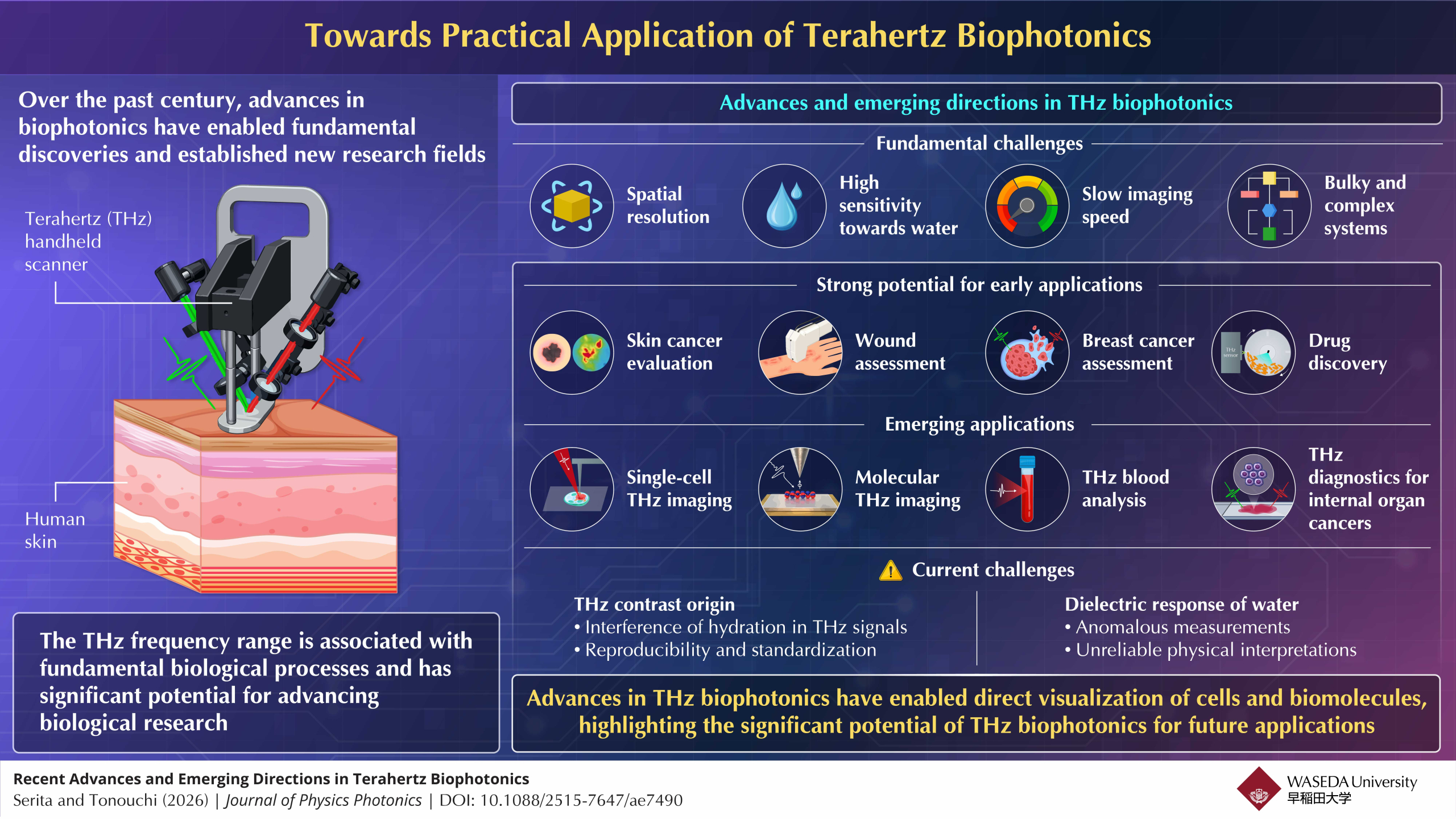
Image title: Advances in terahertz (THz) biophotonics
Image caption: Researchers highlight the potential of THz biophotonics as an emerging interdisciplinary research field and present a technological roadmap toward its broader implementation.
Image credit: Dr. Kazunori Serita from Waseda University, Japan
License type: Original content
Usage restrictions: Cannot be reused without permission
Biophotonics is a multidisciplinary field that involves the development and application of light-based technologies to study, monitor, and treat biological systems. The ability to directly image cells and molecules has led to many fundamental discoveries in the past century. More recently, the terahertz (THz) region of the electromagnetic spectrum has attracted growing interest as a promising frontier for advancing biological research.
The THz frequency range is associated with several fundamental biological processes. Although THz radiation is strongly absorbed by water, traditionally viewed as a limitation, this property can enable sensitive characterization of hydration states and water content. Compared to visible light, THz waves can also penetrate certain biological tissues more effectively. However, despite steady advancements, the adoption of THz biophotonics still lags behind visible light-based techniques in directly observing cellular and molecular dynamics. This is largely due to several challenges, including relatively low spatial resolution (a consequence of the longer THz wavelengths), high sensitivity to water that complicates measurements, slower imaging speeds, and bulky instrumentation. Fortunately, recent developments suggest strong future potential.
To highlight these advancements, Associate Professor Kazunori Serita from the Graduate School of Information, Production, and Systems, Waseda University, Japan, together with Special-Appointment Professor Masayoshi Tonouchi from the Research Institute for Interdisciplinary Science, Okayama University, Japan, presented a comprehensive review summarizing current efforts to address limitations and improve the adoption of THz biophotonics. The study was published in the Journal of Physics Photonics on May 28, 2026.
“THz biophotonics is a fascinating research area for next-generation biomedical technologies. Currently, THz biomedical applications are restricted to a few niche domains with many technical limitations. Recent developments in emerging THz technologies have greatly increased the potential for overcoming these technical limitations,” says Serita.
In their review, the researchers first outline how THz radiation interacts with biological processes, highlighting key advantages such as sensitivity to molecular fingerprint spectra and the ability to enable non-invasive, non-destructive, and label-free measurements. They also discuss the strong dielectric dispersion and absorption of water. Next, they trace the historical development of key THz technologies, including THz time-domain spectroscopy, the evolution of THz imaging techniques, and the emergence of THz metamaterial biosensors that can be used to probe complex and small biological samples.
A major focus was on fields that show strong potential for early application. For example, THz imaging is gaining attention in skin cancer diagnosis due to its sensitivity to tissue composition and is progressing toward clinical trials. Wound assessment is another field where THz imaging is being increasingly applied. Margin assessment in breast cancer is also a key area where THz technology has high potential for practical clinical application, offering a pathway to simplify current procedures. The review also highlights applications in drug discovery and pharmaceutical analysis.
Beyond these areas, the review identifies emerging directions such as single-cell THz imaging, molecular-scale THz studies, diagnostics for internal organs (including the gastrointestinal and respiratory systems), and THz-based blood analysis. In addition, it highlights future technologies that can enable THz observation of cells and molecules under physiological conditions, including the recently developed “point-terahertz source” technology by Serita and colleagues.
“THz measurement technologies can benefit not only medicine, but also a wide range of industries, including drug discovery, food inspection, environmental monitoring, semiconductor evaluation, and biotechnology,” says Serita.
Finally, the researchers presented the main areas for future research, including identifying the precise origins of THz contrast in biological samples and improving the understanding of water dynamics to improve reliability.
“Our study provides a roadmap of emerging approaches that could help transform the field of THz biophotonics from proof-of-concept studies to practical biomedical applications,” concludes Serita.
Authors:Kazunori Serita1 and Masayoshi Tonouchi2
Affiliations:
1Graduate School of Information, Production, and Systems, Waseda University
2Research Institute for Interdisciplinary Science, Okayama University
Title of original paper: Bifurcated Impact of Neutrino Fast Flavor Conversion on Core-Collapse Supernovae Informed by Multiangle Neutrino Radiation Hydrodynamics
Journal:Journal of Physics Photonics
DOI:10.1088/2515-7647/ae7490
About Dr. Kazunori Serita from Waseda University
Dr. Kazunori Serita is an Associate Professor at the Graduate School of Information, Production, and Systems, Waseda University, Japan. He earned his Doctor of Engineering degree from Osaka University. With over a decade of research experience, Dr. Serita has authored 83 research articles. His research interests encompass terahertz technology, nonlinear optics, electromagnetic field analysis, and metamaterials. Notably, he has contributed to the development of ultrasensitive terahertz microfluidic chips and reflective terahertz point-source metasensors for high-sensitivity biosensing applications.