Transient Pauli Blocking for Broadband Ultrafast Optical Switching
Fri, Feb 27, 2026-
Tags
Transient Pauli Blocking for Broadband Ultrafast Optical Switching
Researchers demonstrate this novel mechanism in degenerate InN thin films, advancing photonic technology
The transient Pauli blocking effect is a promising way to achieve ultrafast optical switching in semiconductors. Recently, a research team from Japan successfully demonstrated broadband ultrafast optical switching in InN thin films by leveraging pump-probe transient transmittance measurements with multicolor probe lasers. They also developed a theoretical model to explain the underlying mechanism. These findings might pave the way for next-generation ultrafast optical modulators, shutters, and photonic devices in optical computing or optical communication.
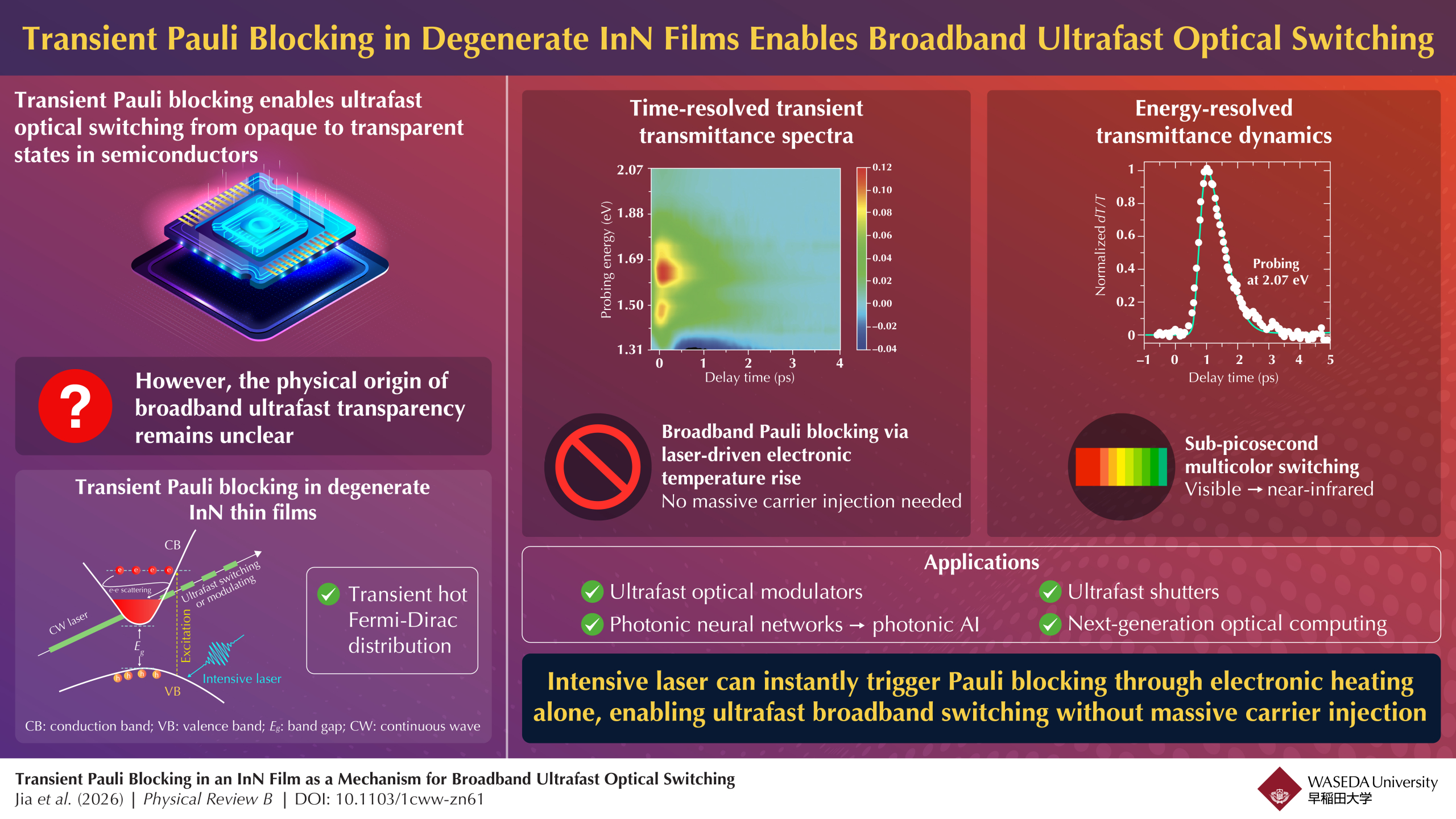
Image title: Broadband Ultrafast Switching via Transient Pauli Blocking
Image caption: Femtosecond laser pulses trigger temperature-driven Pauli blocking in degenerate InN films, enabling rapid opaque-to-transparent switching across visible-to-near-infrared wavelengths for next-generation photonic devices.
Image credit:Junjun Jia from Waseda University
License type: Original content
Usage restrictions: Cannot be reused without permission.
Recent decades have witnessed rapid advancements in high-intensity laser technology. The combination of laser irradiation and novel materials is opening exciting avenues for the design of functional materials and devices. Semiconductors are ideal platforms for generating laser-driven functionalities because they can exhibit novel features such as ultrafast optical transparency. This effect arises from electronic occupation redistribution driven by ultrafast excitation, which manifests as a phenomenon called transient Pauli blocking.
In a new development, a team of researchers in Japan, led by Professor Junjun Jia from the Global Center for Science and Engineering and the Graduate School of Advanced Science and Engineering at Waseda University, has examined the transient Pauli blocking effect in an InN film. The study utilized pump-probe transient transmittance measurements with multicolor probe lasers, alongside first-principles electronic band-structure calculations. Their findings were published in Volume 113, Issue 4 of the journal Physical Review B on January 20, 2026.
The team also included Yuzo Shigesato from the Graduate School of Science and Engineering, Aoyama Gakuin University; Satoshi Kera from the Institute for Molecular Science; Toshiki Makimoto from the Graduate School of Advanced Science and Engineering, Waseda University; and Takashi Yagi from the National Metrology Institute of Japan (NMIJ), National Institute of Advanced Industrial Science and Technology (AIST).
This work demonstrates that a femtosecond laser–induced rise in electronic temperature alone can transiently block optical absorption, even when the number of photoexcited carriers is negligible compared to the background electron density. This overturns the common assumption that broadband Pauli blocking requires massive carrier injection. The switching spans from the visible to the near-infrared and can exhibit multiple spectral “switching centers,” enabling multicolor modulation from a single material platform.
“Our findings enable all-optical switching on femtosecond–picosecond timescales, far exceeding the speed limits of electronic transistors. Such ultrafast switching is particularly relevant for on-chip photonic circuits, where speed and ultra-low latency dominate system performance; for example, in optical interconnects used in high-performance computing,” remarks Jia.
Notably, most existing optical modulators are inherently narrowband and optimized for a single wavelength. In contrast, this work demonstrates broadband transparency windows arising from transient Pauli blocking across multiple interband transitions, enabling optical modulation over a wide spectral range from the visible to the near-infrared. This capability is well-suited for adaptive photonic systems and wavelength-division multiplexing technologies used in optical communication which must handle multiple laser colors simultaneously.
Furthermore, the ultrafast transient Pauli blocking nonlinearity revealed in the present study may offer a physically robust route toward sub-picosecond optical activation and gating. Such functionalities are often regarded as critical—and currently limiting—elements in scalable optical neural networks. In this context, the transient Pauli blocking effect provides a promising physical mechanism for optical activation functions, enabling ultrafast, energy-efficient, and all-optical nonlinear responses that are highly desirable for next-generation photonic neural network architectures and, ultimately, future photonic AI systems.
“Overall, our research addresses a fundamental limitation in modern information technology: how to switch signals faster and with less energy. By demonstrating that a laser can instantaneously control a material’s transparency, this work opens a new pathway toward ultrafast, broadband, and energy-efficient photonic devices,” concludes Jia.
Reference
|
Title of original paper: |
Transient Pauli Blocking in an InN Film as a Mechanism for Broadband Ultrafast Optical Switching |
|
Authors |
Junjun Jia1,2, Minseok Kim3, Yuzo Shigesato3, Ryotaro Nakazawa4, Keisuke Fukutani4,5, Satoshi Kera4,5, Toshiki Makimoto2, and Takashi Yagi6 |
|
Affiliations |
1 Global Center for Science and Engineering (GCSE), Faculty of Science and Engineering, Waseda University, Japan |
| Latest Article Publication Date: |
20 January 2026 |
|
Journal: |
Physical Review B |
|
DOI: |
About Professor Junjun Jia
Dr. Junjun Jia is a full-time Professor at Waseda University, Tokyo, having earned his Ph.D. from the University of Tokyo in 2011. His research focuses on functional solid-state materials, aiming to uncover and control emergent functionalities in laser-driven solids. More broadly, his work explores nonlinear optics and nonequilibrium physics, with an emphasis on the ultrafast dynamic behavior of photoexcited electronic and phononic states, investigated through pump–probe time-resolved experiments and time-dependent first-principles calculations. Dr. Jia has published extensively in high-impact, peer-reviewed journals. He has received several distinctions, including a Materials Research Society (MRS) paper award, and serves on committees like the Materials Research Society of Japan.