
Impact of China’s “Wolf Warrior Diplomacy” on Public Opinion in East Asia
Tue, Apr 28, 2026-
Tags
Researchers show aggressive diplomatic messaging lowers China’s favorability across East Asian democracies, often triggering backlash against China
China’s “Wolf Warrior Diplomacy,” known for its confrontational tone, may be counterproductive in East Asia. However, its impact on public opinion in Japan, South Korea, and Taiwan remains unclear. Now, researchers have found that exposure to such messaging reduced favorability toward China, especially in South Korea. While some perceptions of the United States also declined, these effects were inconsistent. In addition, participants were reluctant to share such messages, suggesting limited persuasive power.
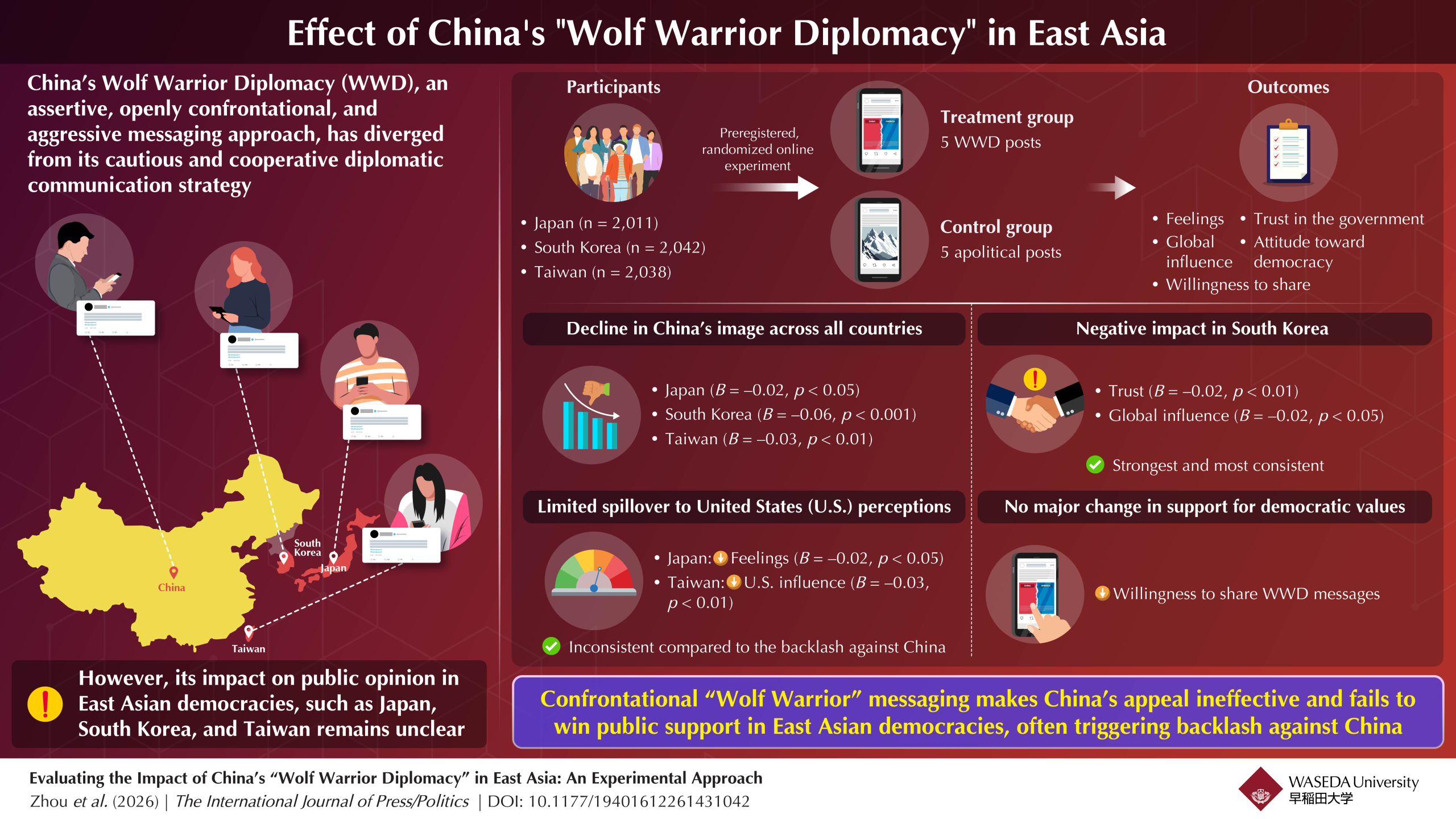
Image title: Impact of China’s “Wolf Warrior Diplomacy” in East Asia
Image caption: Researchers show that aggressive diplomatic messaging by China reduces favorability and fails to win public support in the East Asian democracies.
Image credit: Prof. Tetsuro Kobayashi from Waseda University, Japan
License type: Original content
Usage restrictions: Cannot be reused without permission
China’s increasingly assertive “Wolf Warrior Diplomacy”—a communication style marked by sharp criticism of other countries and strong nationalist rhetoric—has drawn global attention in recent years. However, less is known about its impact on public opinion in democratic countries, which significantly influences foreign policy-making processes. While widely visible on social media, a key question remains: How these populations interpret and respond to China’s aggressive diplomatic messaging and does it actually persuade them?
To answer this, a research team led by Professor Tetsuro Kobayashi from the Faculty of Political Science and Economics, Waseda University, Japan, along with Dr. Yuan Zhou formerly from the Graduate School of Law, Kobe University, Japan, and currently from the Graduate School of Humanities and Social Sciences, Okayama University, Japan, and Mr. Lungta Seki from the Graduate School of Social Sciences and Humanities, Koç University, Turkey, conducted preregistered online survey experiments in Japan, South Korea, and Taiwan. The study was published online in the journal of The International Journal of Press/Politics on April 2, 2026.
“We were intrigued by the growing international visibility of China’s “Wolf Warrior Diplomacy,” which had attracted major media, and wanted to test how it affects public opinion in East Asian democracies, especially in Japan, South Korea, and Taiwan, where public opinion can shape foreign policy,” says Kobayashi.
Using preregistered online survey experiments with over 6,000 participants across the three countries, the team examined how people responded to social media posts resembling real-world diplomatic messaging. Participants were randomly shown either a set of five neutral, apolitical posts about China or five “Wolf Warrior” posts that praised China while criticizing the United States.
The findings reveal a clear pattern: rather than improving China’s image, exposure to these posts significantly reduced favorability toward China in all three countries. The strongest and most consistent backlash was observed in South Korea, where participants reported declines not only in overall sentiment but also in trust toward the Chinese government and perceptions of its global influence. In contrast, any negative effects on perceptions of the United States were weaker and less consistent, appearing only in specific contexts.
“Our results show that “Wolf Warrior” messaging may fail to win public support and can even damage the sender’s reputation. In addition, it highlights that democratic values in East Asia remain resilient, even when exposed to forceful anti-democratic rhetoric,” says Kobayashi.
Importantly, the study also tested whether such messaging could influence deeper political attitudes or spread widely through social networks. It was found that support for democratic values remained stable across all three countries, despite explicit criticisms of democracy in the messages. At the same time, participants showed low willingness to share “Wolf Warrior” content, suggesting limited potential for organic dissemination.
These findings have practical implications for policymakers, journalists, and communication professionals navigating today’s complex information environment. The study sheds light on how comparative narratives that glorify one country while attacking another are received by democratic audiences, offering insights relevant to public diplomacy, misinformation research, and strategic communication. Moreover, it underscores that not all influence attempts are successful—and that, in some cases, they may produce the very opposite of their intended effect.
“Overall, our study addresses a pressing global challenge: how authoritarian states attempt to influence public opinion beyond their borders. In an era of heightened geopolitical competition, understanding the effectiveness of aggressive foreign messaging is crucial. Thus, it highlights that Wolf Warrior Diplomacy is ineffective and may also damage a country’s image abroad,” concludes Kobayashi.
Authors: Yuan Zhou1, Tetsuro Kobayashi2, and Lungta Seki3
Affiliations:
1Graduate School of Humanities and Social Sciences, Okayama University
2School of Political Science and Economics, Waseda University
3Graduate School of Social Sciences and Humanities, Koç University
Title of original paper: Evaluating the Impact of China’s “Wolf Warrior Diplomacy” in East Asia: An Experimental Approach
Journal: The International Journal of Press/Politics
DOI: 10.1177/19401612261431042
About Professor Tetsuro Kobayashi
Dr. Tetsuro Kobayashi is a Professor at Waseda University’s Faculty of Political Science and Economics. He earned his Ph.D. in Social Psychology from The University of Tokyo in 2009. Before joining Waseda University, he held positions at the National Institute of Informatics in Japan and the City University of Hong Kong. His research interests encompass political communication, political psychology, and public opinion. Kobayashi’s research has been published in prestigious peer-reviewed journals, spanning the fields of political science, communication, and psychology.