


International Symposium on MigrationーーBodies in Motion: Humanizing Migrant Journeys in Derli Romero’s Rostros migrantes (Migrant Faces) and Mujeres en tránsito (Women in Transit)(2026/5/28)Report
2026.06.24

Written by SATO, Yuka (Research Associate, The Waseda International House of Literature)
The Waseda International House of Literature (The Haurki Murakami Library) held an international symposium on migration, “Bodies in Motion: Humanizing Migrant Journeys in Derli Romero’s Rostros migrantes (Migrant Faces) and Mujeres en tránsito (Women in Transit),” on May 28, 2026. The symposium featured Mexican artist Dr. Derli Romero, Dr. Kimberle López, a scholar of Latin American literature at the University of New Mexico, and Dr. Megan Saltzman, a scholar of Hispanic culture at Mount Holyoke College, who served as discussant. Together, they discussed the experiences of migrants traveling through Mexico toward the United States and the ways Romero’s artworks seek to humanize those experiences.
The symposium opened with remarks by Dr. Shigeko Mato, Associate Director of the International House of Literature. Dr. Mato emphasized that the experiences of migrants are not abstract concepts, statistics, or merely subjects of political debate, but realities lived by actual people. Rather than displaying Romero’s artworks in frames as conventional museum pieces, the installation allowed the audience to touch the artworks directly. The symposium thus began with a declaration that its purpose was to sense, recognize, and engage with the lived experiences of migrants.
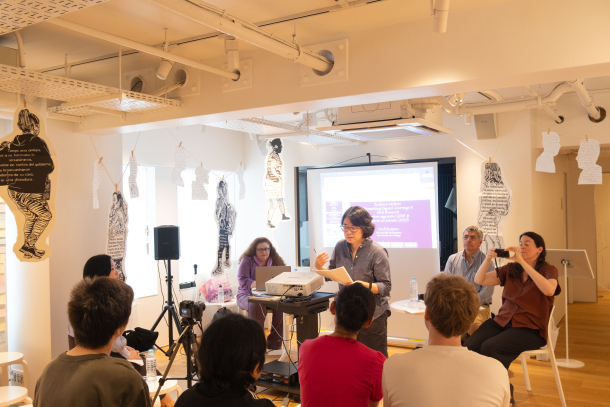
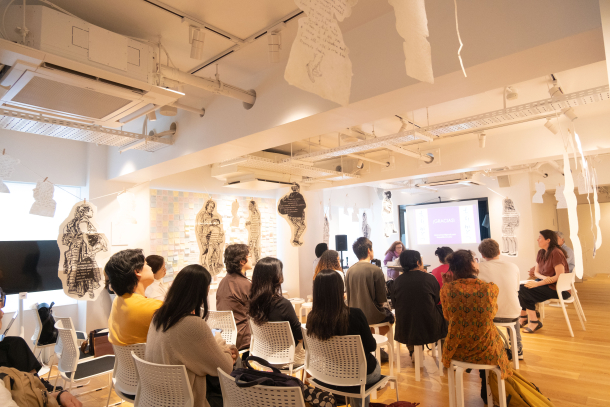
Romero’s artworks hanging in the laboratory were installed mainly by students in the School of International Liberal Studies the day before the symposium. The students collaboratively discussed how the works could best be displayed in the laboratory space, referencing a video from a previous symposium on Romero’s works held in the U.S. that Dr. López had brought.
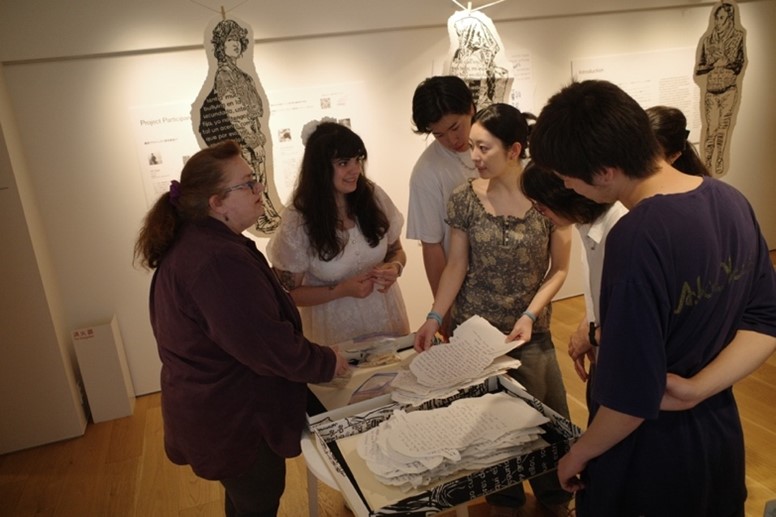
Each artwork was contained within a box, differing in shape and bearing its own words and narratives. The students picked up each piece, read the words, and then chose where to install them. They also considered the balance between the two projects, Rostros migrantes (2019) and Mujeres en tránsito (2025), as they completed the installation for the symposium.
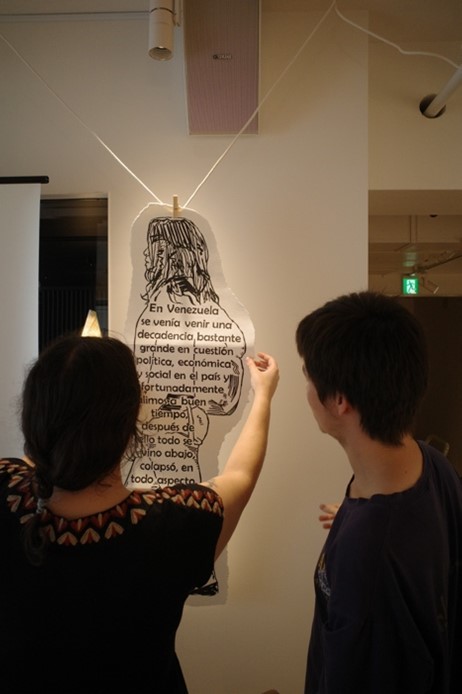
The symposium next featured a presentation by Dr. López. Dr. López explained the historical relationship between migration and America. Migration from Latin America for political and economic reasons has been shaped historically by the U.S. government. For instance, two hundred years ago, territories that are now part of the United States of America once belonged to Mexico. Furthermore, in the mid-20th century, the U.S. government actively accepted braceros, Mexican guest workers mainly in agriculture. Mexican families were usually separated because only the father and eldest son moved back and forth between Mexico and America, while the mother and children could not accompany them. Against this historical background of legally accepted migrant labor, undocumented migration has increased after 1970, including women and children from Guatemala and other Central American countries to avoid political violence and economic hardship. Also, family reunions after migration do not always lead to happy endings following such severe experiences. Dr. López introduced several books and movies depicting migrant experiences such as Sonia Nazario, Enrique’s Journey: The Story of a Boy’s Dangerous Odyssey to Reunite with His Mother (2006) and El Norte (1983). As a recent concern, Dr. López mentioned the U.S. government’s inhumane behaviors, such as depriving migrants of water during their journeys and separating children from their parents in detention centers.
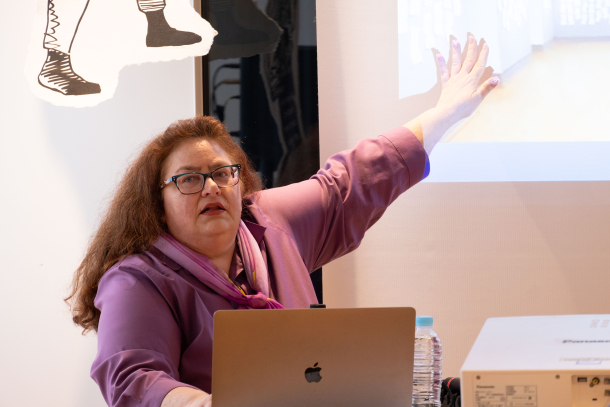
Based on this historical background, Dr. López introduced Romero’s artistic concepts and production process behind the projects. Derli Romero’s art projects, Rostros migrantes (2019) and Mujeres en tránsito (2025), combine oral history, photography, and printmaking. In Rostros migrantes, Romero interviewed more than 100 migrants from Central America and South America passing through Mexico on their way north, recording their testimonies and photographing their profiles. He then exchanged their old clothes for new ones and made paper from the fabric. Using the photographs, he created profile silhouettes on the handmade paper and printed each migrant’s narrative on them. While Rostros migrantes features face silhouettes, Mujeres en tránsito focuses specifically on women migrants, presenting full-body silhouettes and testimonies that reveal the specific forms of violence and vulnerability women experience during migration. Both projects illuminate the lived experiences often obscured in mainstream media representations of migration. In Dr. López’s presentation, the audience watched videos documenting Romero’s process of creating artworks through lithography and woodcut printmaking, as well as the personal testimonies and migration experiences of the interviewees. Moreover, Dr. López addressed harsh realities such as kidnapping and migrants losing their limbs during migration journeys, forcing people seeking better lives into inhumane situations.
After Dr. López’s presentation, Dr. Saltzman offered comments as discussant. Dr. Saltzman warned against the global rise of xenophobia and emphasized the difficulty Latin American people face in migrating legally. She also argued that the violence migrants experience is deliberately produced through U.S. policies, referring to Achille Mbembe’s concept of necropolitics. Furthermore, Dr. Saltzman pointed out that the personal experiences shared by migrants gain social and political power by being transformed into artistic expression through Romero’s works. She also emphasized the importance of sharing such works and knowledge beyond academic circles.
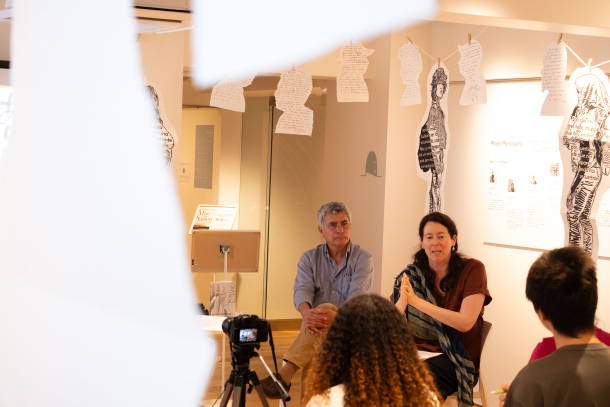
Finally, the audience raised many questions regarding the production process and concepts behind Romero’s artworks, leading to an active and engaging discussion. The texture and materiality of Romero’s tangible artworks transformed the exhibition space itself into a site where the audience could imagine migrant experiences and engage in dialogue with others.
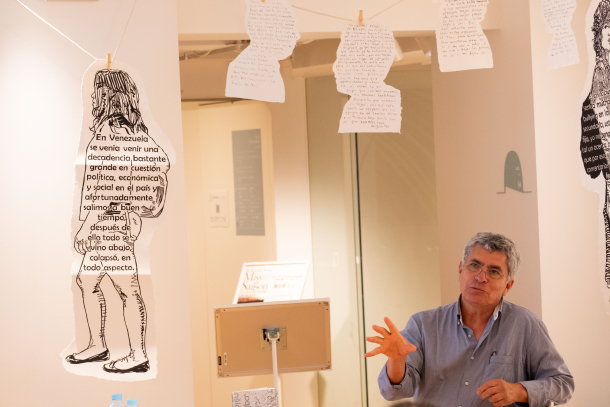
Dr. Derli Romero is a professional artist, printmaker and bookmaker with a bachelor’s degree in Engraving from “La Esmeralda” National Academy in Mexico City and a PhD from the University of Guadalajara, Mexico. He teaches Art at the University in Michoacán, Mexico. His artwork has been exhibited in Mexico and internationally in individual and collective exhibits in the United States, Russia, and now Japan. His current work focuses on the theme of Central American and South American migration through Mexico.
Dr. Kimberle López has a PhD from the University of California, Berkeley and is an Associate Professor of Spanish at the University of New Mexico in Albuquerque, United States. She is the author of the book Latin American Novels of the Conquest: Reinventing the New World on the connection between history and fiction. Her research focuses on the representation of race, class, and gender in Latin American Literature with a current focus on the topic of migration.
Dr. Megan Saltzman teaches courses in Hispanic Cultural Studies at Mount Holyoke College (Massachusetts, US) and is currently a visiting researcher at Sophia University. She is the author of the book Public Everyday Space: Cultural Politics in Neoliberal Barcelona.
Day & Time: May 28, 2026
Venue: 2nd floor of the Waseda International House of Literature
Organized by: the Waseda International House of Literature
Collaborator: The Waseda Institute of Latin American Studies
※For the original event announcement, please see here.
Related
-
Authors Alive! ~Meet the Author~ Rebecca Brown × Kumi Kimura(2025/6/25) Report
2026.05.22
- Arts
- Culture
-
Authors Alive! ~Meet the Author~ Camilla Grudova (2025/5/28) Report
2026.02.13
- Arts
- Culture
-

Authors Alive! ~Meet the Author~ Session Two: Haruki Murakami and Kaori Muraji
2022.07.29
- Events
-
Authors Alive! ~Meet the Author~ Session One: Haruki Murakami and Yoko Ogawa
2022.06.27
- Events
-
Jazz and Literature: Scoring Sound/Cutting Language
2022.05.20
- Events
-
Creators of an Unprecedented World # 5 Bringing the design office and artisans together—interior renovations
2021.08.19