


Authors Alive! ~Meet the Author~ Camilla Grudova (2025/5/28) Report
2026.02.13
- Arts
- Culture

Written by SATO, Yuka (Research Associate, The Waseda International House of Literature)
“Waseda International House of Literature Translation and Exchange Project” aims to cultivate translators, promote the development of translated literature, and encourage international exchange among translators worldwide. Now in its second year, the project has expanded beyond its ongoing translator residency program to include the invitation of authors and editors from abroad, who participate in lectures and workshops in Japan. As the first invited guest of the program, we welcomed Camilla Grudova, a Canadian-born writer currently based in Scotland, for a two-week stay from May 22 to June 6. On May 28, Grudova took part in a talk and reading at the Waseda International House of Literature. The event was moderated by Motoyuki Shibata, an advisor to the House and the Japanese translator of Grudova’s work, including “Agata’s Machine,” (MONKEY, Vol. 23). Mayuko Ueda, the translator of Grudova’s first Japanese short story collection, The Doll’s Alphabet (Kawade Shobo Shinsha, 2025), also joined the event, and the two read “Unstitching” from the collection.
At the beginning of the event, Grudova talked about how she became a writer. As a child, she began creating stories collaboratively with her mother, an artist, and her mother’s writer friend, and described grotesque storytelling as the origin of her creative imagination. Grudova also spoke enthusiastically about writers who have influenced her work, including Angela Carter, Roald Dahl, Barbara Comyns, Barbara Pym, Leonora Carrington and Mary Norton. Emphasizing the importance of reading to her development as a writer, Grudova described herself as “a reader before a writer.” Shibata noted that many of those she mentioned were women who had been oppressed by society, but Grudova responded that she was drawn less to their social positions than to their imagination or style. She further reflected that while she doesn’t write with a specific political intention, all writing is open to political interpretation. Rather than conveying a particular message, she focuses on creating images that allow readers to interpret her work in various ways.
Then, Shibata pointed out that the degree of grotesqueness in Grudova’s work has steadily intensified across her three books: The Doll’s Alphabet, Children of Paradise, and The Coiled Serpent. Grudova explained that grotesque elements in her fiction—such as depictions of a dirty toilet—are not intended merely to shock readers but are closely connected to issues of class. Grudova also suggested that the grotesqueness of her work may reflect the places where she lived and wrote. While her first collection was written in Toronto, Canada, the subsequent two were written in Edinburgh, UK. In this context, she spoke about Edinburgh as a beautiful city and with a rich literary artistic heritage, referring to Muriel Spark, Stevenson’s Strange Case of Dr Jekyll and Mr Hyde and Trainspotting.
Furthermore, they also discussed specific works included in The Doll’s Alphabet. When Shibata asked how “Agata’s Machine” came into being, Grudova spoke about her many sources of inspiration, including Lotte Reiniger’s 1920s silhouette animation films, Maria Warner’s biography, a Ukrainian clown dressed in inverted colors, and a novel by Elsa Morante. Grudova also explained that the way unwanted images suddenly enter the reader’s field of vision in “Agata’s Machine” is connected to the experience of encountering a variety of images online, often accidentally. She suggested that the story may also be linked to experiences such as daydreams. Shibata noted that it is precisely this incorporation of everyday experiences into non-realistic fiction that gives Grudova’s work its distinctive sense of realism.
Later in the event, Japanese translator Mayuko Ueda took the stage and spoke about the pleasure of translating Grudova’s fiction during Ueda’s stay in the UK. She also mentioned the challenges of rendering Grudova’s simple and pared-down prose into Japanese. Ueda noted that it took time to tune herself to the density of Grudova’s more intense stories, such as “The Sad Tale of the Sconce” and “The Moth Emporium,” which Shibata described as works driven by a “rampaging imagination.” By contrast, she explained that she could more smoothly immerse herself in Grudova’s quieter, more restrained pieces.
The event also featured a pleasant surprise, with illustrator Jun Tada, who created the cover artwork for the Japanese edition of The Doll’s Alphabet, joining the stage to explain the image used on the book’s cover. Finally, Grudova and Ueda took turns reading passages from the original text and its Japanese translation. After the audience enjoyed the short story “Unstitching,” Grudova explained that while she encourages readers to pay attention to images and details, the story itself grew out of the way women have often been treated as if they had no inner life.
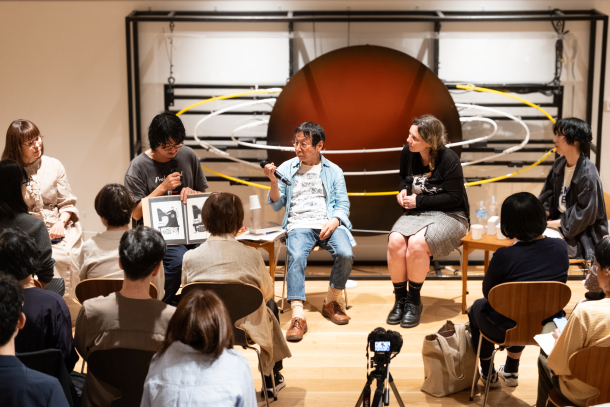
The event then moved on to a Q&A session with the audience, during which Grudova spoke about translation and its creative aspects, her everyday writing practices, and her impressions of Japan. She also shared some of her favorite Japanese films and writers, mentioning Akira Kurosawa’s Seven Samurai, Yasujirō Ozu, Kōbō Abe, and Yukio Mishima’s Confessions of a Mask.
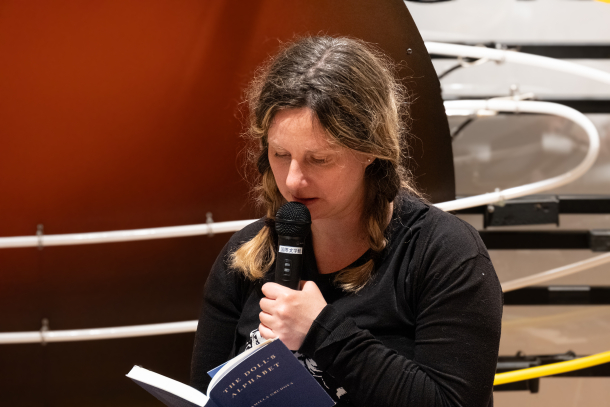
Camilla Grudova lives in Edinburgh. She holds a degree in Art History and German from McGill University, Montreal. Her fiction has appeared in The White Review and Granta. Her critically acclaimed debut collection, The Doll’s Alphabet, was published in 2017. Her first novel, Children of Paradise, was longlisted for the Women’s Prize. Her most recent book is a second collection, The Coiled Serpent. In 2023 she was named one of Granta’s Best of Young British Novelists, a once-in-a-decade accolade.
Date: May 28, 2025
Venue: The Waseda International House of Literature
Organized by: The Waseda International House of Literature
Related
-
International Symposium on MigrationーーBodies in Motion: Humanizing Migrant Journeys in Derli Romero’s Rostros migrantes (Migrant Faces) and Mujeres en tránsito (Women in Transit)(2026/5/28)Report
2026.06.24
-
Authors Alive! ~Meet the Author~ Rebecca Brown × Kumi Kimura(2025/6/25) Report
2026.05.22
- Arts
- Culture
-

Authors Alive! ~Meet the Author~ Session Two: Haruki Murakami and Kaori Muraji
2022.07.29
- Events
-
Authors Alive! ~Meet the Author~ Session One: Haruki Murakami and Yoko Ogawa
2022.06.27
- Events
-
Jazz and Literature: Scoring Sound/Cutting Language
2022.05.20
- Events
-
Creators of an Unprecedented World # 5 Bringing the design office and artisans together—interior renovations
2021.08.19