


Authors Alive! ~Meet the Author~ Rebecca Brown × Kumi Kimura(2025/6/25) Report
2026.05.22
- Arts
- Culture

Asa YONEDA(Research Associate, the Waseda International House of Literature)
The WIHL welcomed Rebecca Brown from Seattle, USA as an author-in-residence during June 2025.
Brown’s public event took place on June 25 in the form of a conversation with Kumi Kimura, whose Bunkamura Deux Magots Prize-winning novella Anata ni Anzen na Hito (Someone to Watch Over You) was recently published in English. WIHL advisor Motoyuki Shibata, Rebecca’s translator into Japanese, hosted the conversation, with Yuki Tejima, Kumi’s translator into English, also doing double duty as interpreter.
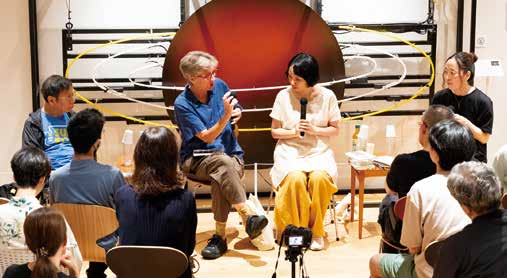
The authors began by acknowledging the mutual impact of reading each other’s work: Kimura first read Brown’s Katei no Igaku (Excerpts from a Family Medical Dictionary) many years ago while holding down an office job through her grandmother’s illness, and Brown was recently recommended Someone to Watch Over You by Shibata and immediately became a fan. Shibata, who had “pointed out a lot of simpatico” between the writers, mentioned that the evening’s event was a happy occasion, as while it’s common for Japanese writers to have read their overseas contemporaries, the reverse is still rare.
Establishing one of the major themes of the conversation, Brown touched on the shared significance of work, including paid employment and unpaid caregiving, connecting it to the endurance both she and Kimura have needed in order to continue writing throughout their careers. Kimura wrote Anata at her family home while helping to care for her nephew, while her whole family read Katei no Igaku, Brown’s memoir of caring for her dying mother. Kimura revealed that Brown’s depictions of relationships between people has been an important influence, and something she aimed to emulate. Brown responded that that was a major impetus for her writing, defining the task of art as bringing what’s most important inside of us into conversation with someone else, or to capture something about human reciprocity and what’s deepest within us.
The two writers discussed the sense of danger in Kimura’s book, from the quiet menace of the title to the specifics of life during the covid pandemic. Asked whether she felt driven to make a record of certain things in the book, Kimura shared her experience of being manhandled at a sit-in against the US military base at Henoko, and wanting to explore the experience of perpetrating violence. Brown expressed admiration for how she took that experience and turned it into a broader, compassionate view in her work.
Kimura in turn described Brown’s style as overflowing with love, but at a slight remove — like reading her mother’s emotional state through details like her sweat or body odor — and something she aspired to. When she pressed Brown on the specifics of how she achieves this, her answer was “Revise, revise, revise”! Brown mentioned making 40 drafts of an eight-page story, writing a few hundred words a day only to cut half of them, and feeling “like the weather” — changeable and full of doubt. This answer seemed to make a profound impression on Kimura, confirming or validating some of her own experience and struggles as a writer.
The event moved on to readings. Kimura and Tejima read a section from Anata/Someone toward the beginning of the book. Brown, who selected the passage, described the scene as an encounter in which Tae, the main character, pictures a near-stranger having “a life of his own”, leading to her becoming a caregiver to his body.
Then Brown and Shibata read from a story about an encounter with a migrating goose, which Brown wrote and published as a zine in the form of a folded booklet through a class she took at a local printshop. Shibata’s translation was also done on the move as the pair traveled together on a Shinkansen.
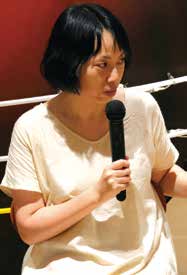
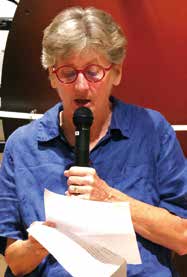
The two translators then spoke about some of the decisions they encountered in working on their respective authors. Tejima cited the connotations of bush warbler’s cry as a symbol of spring, as well as her strategy of using Japanese words for food-related terms. Kimura expressed surprise and appreciation at the Tejima’s work on unexpected points of difficulty, while Brown chimed in that as a reader, she was able to look up specific words like senbei and izakaya to understand what they referred to.
Meanwhile, Shibata talked about the word “miss” — as in to miss someone — and how a full translation into Japanese is too long to use every time, meaning he needed to vary how he translated references to the feeling. He discussed the ends of phrases as being especially important, not only to the emotional tone, but also to the physical sound of a sentence. Brown drew a parallel between the care that Shibata takes in writing with her own practice, remarking that she is often aware of whether sounds move toward completion or interruption.
The event wrapped up with a Q&A session with questions from the audience. To the question of whether they study to write or write from learning, Kimura said she writes mainly from imagination, not research. Often, a new idea will spark material that has been on her mind; luckily, the ideas have kept pace with her desire to keep writing. Brown also said that much of what she writes is personal, based on experience. She noted that she doesn’t know where the pieces come from, but she had an urgency to write fifteen years ago that she no longer has.
To the question of how they write care as the opposite of violence, both authors mentioned relying on a kind of felt sense, with Brown calling it “intuitive” and Kimura talking about how she doesn’t map out plots beforehand, relying on revision to see where a story goes. Kimura also expressed admiration for some of Brown’s more experimental work, which Brown then described as violent, not careful, noting that different pieces of writing involve different language, emotions, and intentions.
To the question of how they balance personal input into a translation and working closely with the authors, Shibata compared any traces of himself as a book’s translator to lingering body odor, while Tejima said Anata’s main characters were like two gloomy strangers living in her head, and that the translation contained nothing of herself.
The evening was another one-of-a-kind encounter through literature — of Rebecca Brown and Kumi Kimura, made possible through the sympathetic translating and inspired interpreting of Motoyuki Shibata and Yuki Tejima, and catalyzed and witnessed by the evening’s audience — emblematic of the WIHL’s spirit of resonance, collaboration, and celebration.
Rebecca Brown is a writer based in Seattle. Her works translated into Japanese include The Gifts of the Body, The End of Youth, The Dogs, Excerpts from a Family Medical Dictionary, Not Heaven, Somewhere Else, and Woman In Ill-Fitting Wig (with paintings by Nancy Kiefer). Her acclaimed work The Gifts of the Body was reissued by Twililight on June 20, 2025.
Date: June 25, 2025
Venue: the basement floor of the Waseda International House of Literature
Organized by: the Waseda International House of Literature
Related
-
International Symposium on MigrationーーBodies in Motion: Humanizing Migrant Journeys in Derli Romero’s Rostros migrantes (Migrant Faces) and Mujeres en tránsito (Women in Transit)(2026/5/28)Report
2026.06.24
-
Authors Alive! ~Meet the Author~ Camilla Grudova (2025/5/28) Report
2026.02.13
- Arts
- Culture
-
Authors Alive! ~Meet the Author~ Session Two: Haruki Murakami and Kaori Muraji
2022.07.29
- Events
-
Authors Alive! ~Meet the Author~ Session One: Haruki Murakami and Yoko Ogawa
2022.06.27
- Events
-
Jazz and Literature: Scoring Sound/Cutting Language
2022.05.20
- Events
-
Creators of an Unprecedented World # 5 Bringing the design office and artisans together—interior renovations
2021.08.19