WIAS Top Runners’ Lecture Collection
“We’re Still Here: What Shrinking Cities Teach Us About Urban Futures” (7/14)
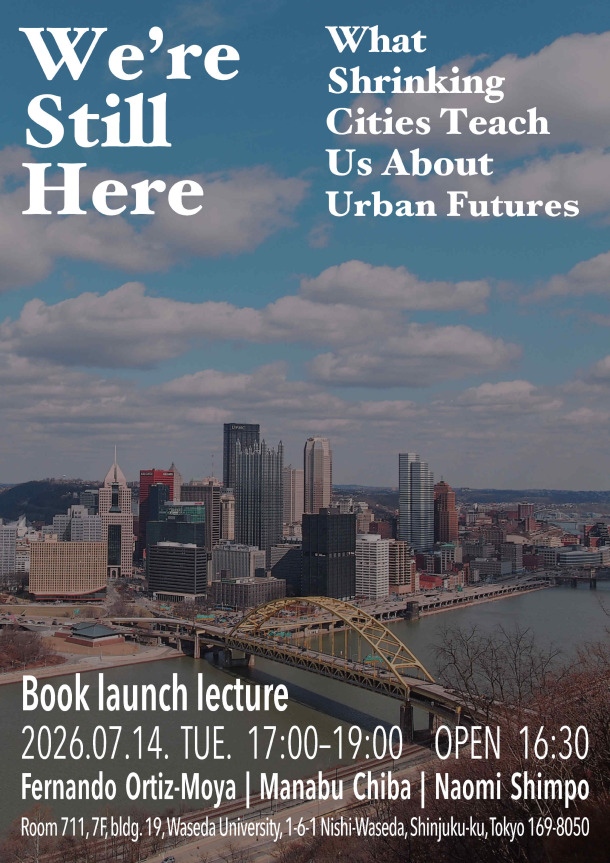
主 旨 / Abstract
In a world that expects cities to increase in size, expand their footprint, and fuel global economic growth, there’s something unnerving about the phrase “shrinking cities.” But thousands of cities worldwide are getting smaller, leaving behind vacant homes, abandoned factories, and oversized infrastructure. Local governments typically respond by deploying a standard toolkit designed for expansion. They implement extensive, top-down urban regeneration programmes—erecting flagship projects, subsidizing economic environments, and rebranding themselves into a new image—all to lure back capital and people. Yet, this forced regrowth has proven elusive.
In this lecture introducing the book We’re Still Here: Regenerating Shrinking Cities from the Ground Up, Fernando Ortiz-Moya addresses a critical paradox for contemporary planners: how to manage the transition to fewer residents with frameworks devised to manage and foster urban growth. Instead of chasing a return to past peaks, could cities embrace their smaller size and build on their unique character and history to enhance life for those who remain?
Drawing on comparative research from Pittsburgh, Manchester, and Kitakyushu, We’re Still Here contrasts official responses to shrinkage with spontaneous bottom-up actions led by traditionally marginalized residents. These stories show how urban decline can become a springboard for social and physical (re)construction and justice-driven urbanism, revealing both the limits of pro-growth planning and the seeds of a new approach to urban interventions called “(Re)City-Making.” At its core, (Re)City-Making empowers communities to transform the liabilities of urban blight into collective assets. It advances four core principles—the radical reappropriation of spaces, bottom-up planning, collective regeneration, and non-normative planning—to shift the focus away from rigid, profit-driven development toward flexible, everyday improvements that prioritize current residents.
In Japan, where UN projections estimate a population decline of more than 18 million between 2025 and 2050, the question of how to plan in declining communities is no longer hypothetical. Far from a cautionary tale, We’re Still Here asks whether the answer to shrinkage is to chase growth again, or to plan differently.
プログラム / Program
17:00–17:05 Opening remarks (ORTIZ-MOYA Fernando)
17:05–17:50 Lecture: We’re Still Here: What Shrinking Cities Teach Us About Urban Futures (ORTIZ-MOYA Fernando)
17:50–19:00 Panel Discussion: What Comes After Growth? Architecture, Community, and Japan’s Urban Future (Chair: Prof. CHIBA Manabu; Panelists: Assoc. Prof. SHIMPO Naomi and Dr. ORTIZ-MOYA Fernando)
登壇者 / Speaker
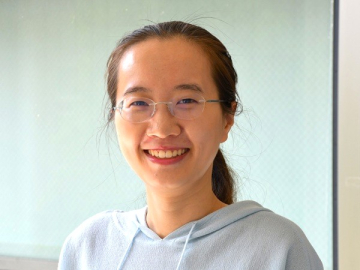
ORTIZ-MOYA Fernando — Assistant Professor, Waseda Institute for Advanced Study, Waseda University
Fernando Ortiz-Moya is Assistant Professor at the Waseda Institute for Advanced Study, Waseda University. His research focuses on shrinking cities and post-growth urbanism. He is the author of We’re Still Here: Regenerating Shrinking Cities from the Ground Up (University of California Press, 2026). His work has appeared in journals including Journal of Urban Affairs, npj Urban Sustainability, and Sustainable Cities and Society. He holds a Ph.D. in Architecture from the University of Tokyo.
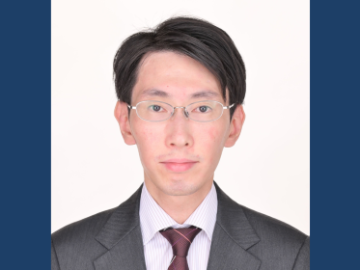
CHIBA Manabu — Principal, Chiba Manabu Architects; Former Professor, Department of Architecture, Graduate School of Engineering, The University of Tokyo
Manabu Chiba is one of Japan’s leading architects. He received his architectural education at the University of Tokyo (B.Arch, M.Arch) and worked at Nihon Sekkei Inc. and Factor N Associates before establishing Chiba Manabu Architects in 2001. He served as Associate Professor (2001–2013) and Professor (2013–2026) in the Department of Architecture at the University of Tokyo, was a Guest Professor at ETH Zurich (2009–2010), and served as Vice-President of the University of Tokyo (2016–2018). His work explores the relationship between architecture, urban open space, and natural environment. He has received numerous awards including the Japan Architectural Institute Prize, the Yoshioka Prize, and the JIA Newcomer Award, and his projects include the Japan Guide Dog Center (2006) and Otaki Town Hall (2012), which received the UNESCO Asia-Pacific Heritage Award of Merit.
SHIMPO Naomi — Associate Professor, Center for Spatial Information Science, The University of Tokyo
Naomi Shimpo is Associate Professor at the Center for Spatial Information Science, The University of Tokyo. Her research applies spatial information science (GIS, participatory mapping) to questions of green and agricultural urban development, with a focus on social inclusion, community resilience, and well-being at the neighbourhood and city scale. She holds a Ph.D. from the Graduate School of Frontier Sciences, The University of Tokyo, and has held positions at the University of Tsukuba and the University of Hyogo.
日 時 / Date&Time
2026年7月14日(火)17:00 – 19:00 / July 14, 2026 (Tue.) 17:00 – 19:00
会場 / Venue
早稲田キャンパス19号館7階711教室 / Room 711, 7th Floor, Building 19, Waseda Campus, Waseda University
対 象 / Prospected Audience
学部生、大学院生、教員、研究者、一般
Students, Graduate students, Faculty members, Research members, General participants
言 語 / Language
英語 / English
主 催 / Organizer
早稲田大学 高等研究所 / Waseda Institute for Advanced Study (WIAS)
申 込 / Registration
要事前申込み。以下のリンクよりご登録ください。/ Pre-registration required. Please register via the link below.
https://forms.gle/JFMLnct6DMrK6unt7
関連リンク/ Related website
We’re Still Here by Fernando Ortiz-Moya – Paper – University of California Press