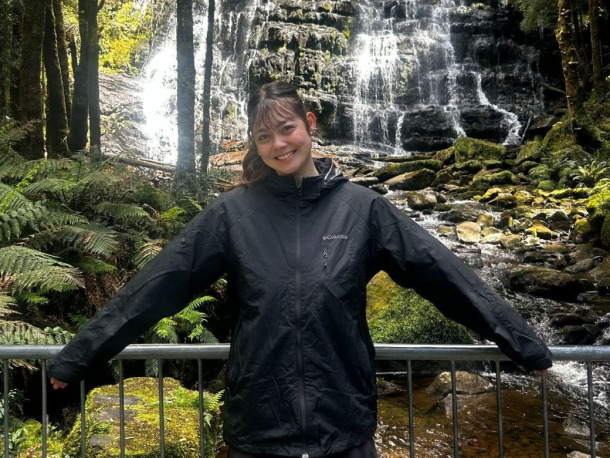
December 2025, at a waterfall near Queenstown, western Tasmania.
The "Waseda Hometown Ambassadors" column brings together students from across Japan and around the world to introduce their hometowns. This time, Masuda, originally from Australia, will share the charms of her hometown.
A thousand natural wonders on one island
Miisha Masuda, 4th year student, School of International Liberal Studies
Are you familiar with Tasmania? Perhaps some of you might think of Tasmanian beef sold in supermarkets, or the Tasmanian devil, which is found only in Tasmania.
Tasmania is an island located south of mainland Australia. While Australia has an image of being a "hot country," Tasmania has a pleasant climate year-round, with an average high temperature of around 12°C in winter and around 23°C in summer. In fact, it is said to be "one of the places with the cleanest air in the world," and this island, which is about two-thirds the size of Hokkaido, is covered in abundant nature. When I was in middle and high school, I thought this island, where there was nothing but nature, was boring and longed for life in Tokyo. However, the longer I spent in Tokyo, the more I missed the environment of "nothingness." This time, I will introduce just a small part of the charm of Tasmania's nature.
Approximately 40% of Tasmania's land is protected as national parks or World Heritage sites. The island boasts a diverse range of natural landscapes, including deep rainforests, crystal-clear blue seas, pristine white sand beaches, and vast sand dunes. At night, the sky is filled with stars, and occasionally, the aurora borealis can be seen.
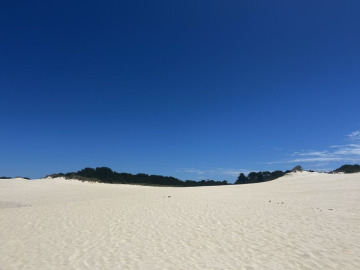
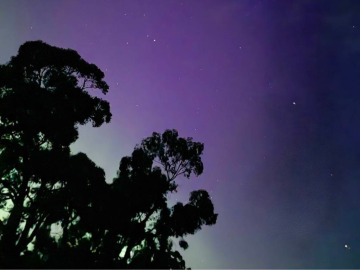
Photo on the left: Sand dunes near Queenstown in western Tasmania. You can enjoy sliding down the sandy slopes on a bodyboard.
Photo on the right: The aurora borealis as seen from the balcony of my parents' house.
For those who want to enjoy rainforests and waterfalls, Mount Field National Park, a World Heritage Site, is highly recommended. If you're lucky, you might even spot platypuses, wombats, or Tasmanian devils. While Wineglass Bay is a famous beach destination, my personal favorite is Bruny Island in southeastern Tasmania. In addition to its pristine white beaches and blue waters, you can also enjoy gourmet delights such as wine, honey, cheese, and oysters.
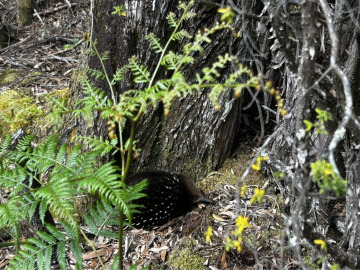
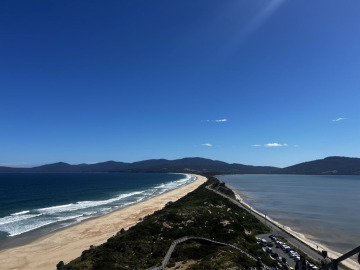
Photo on the left: A wild echidna encountered in Mount Field National Park.
Photo on the right: Truganini Lookout, an observation deck on Bruny Island. Truganini is the name of a woman from the Palawa tribe, an indigenous group of Tasmania, who is known for surviving the hardships of colonization.
As you can see, Tasmania, surrounded by abundant nature, offers a wide variety of outdoor activities. There are numerous campgrounds on the island, and the campground on the shores of Burbury Lake, which my family and I recently visited, was particularly impressive with its view of the lake stretching out before us like a mirror.
Tasmania is also an irresistible environment for hiking enthusiasts. There are a variety of trails, from beginner-friendly courses that can be enjoyed in about 20 minutes to challenging trails that take four days to complete. The Cape Huay Track, which I recently visited, is a round-trip hike that takes about four hours. The scenery created by the sheer cliffs and the sea is breathtaking, and if you're lucky, you might even spot whales from the top of the cliffs.
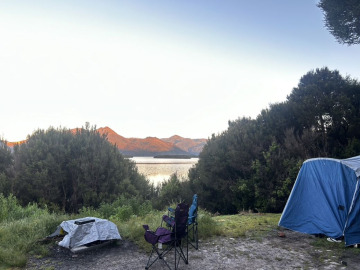
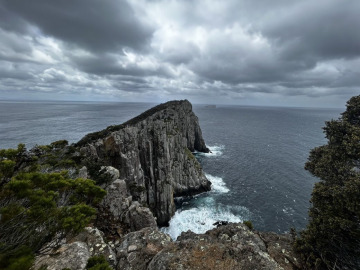
Photo on the left: A campsite on the shore of Lake Barbery. It has facilities such as toilets and campfire areas, and you can enjoy the beautiful lake view.
Photo on the right: Hoy Point Track in southeastern Tasmania. "It's not just tacos! Introducing lesser-known Mexican dishes" (to be released in July 2025)When my friend Shimizu, who is the author of this book, visited Tasmania, we enjoyed this hike together!
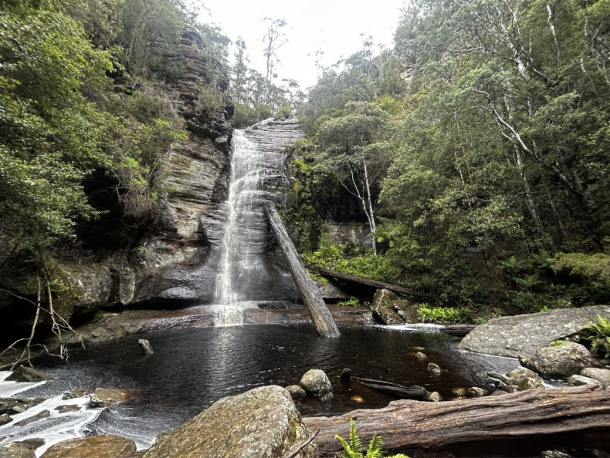
Snug Falls. I've visited it more than 20 times because it's about an hour's walk round trip from my parents' house. The brown water isn't dirt, it's a natural phenomenon caused by tannins.
Furthermore, schools in Tasmania have a subject called "Outdoor Education." It was one of my favorite classes, where you could learn about hiking, fire-starting, surfing, kayaking, stand-up paddleboarding (SUP), activities like visiting checkpoints using paper maps and compasses, and navigation.
Tasmania is truly the "most rural of rural areas." There are no trains on the island, and public transportation like buses is limited, so renting a car is essential for sightseeing. However, the natural beauty more than makes up for the inconvenience. When visiting Australia, popular cities like Melbourne and Sydney are certainly attractive, but I highly recommend venturing further afield to Tasmania. You'll surely find scenery and experiences you can only encounter there!
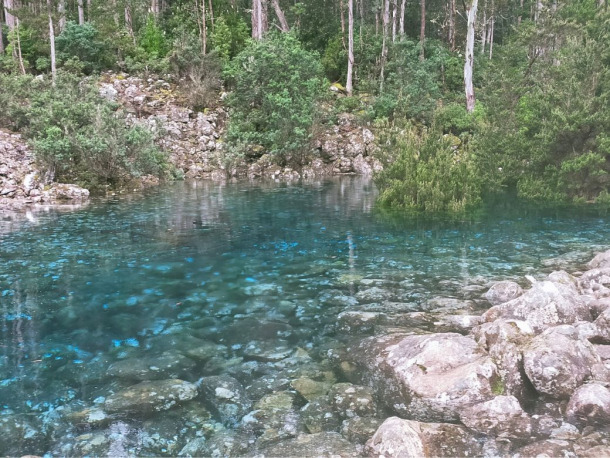
During a class in my second year of high school, I visited the "Disappearing Lake" on Mount Wellington (known as Kunanni by the Tasmanian indigenous people). It's called the "Disappearing Lake" because its crystal-clear blue color is a phenomenon that can only be seen after heavy rainfall.
◎ What Tasmania, Australia is like ◎
Tasmania is one of the states of Australia. It consists of the island of Tasmania, located southeast of the Australian mainland, and surrounding islands such as King Island and the Farneau Archipelago. The state capital is Hobart, the largest city on Tasmania. Tasmania covers an area of approximately 68,000 square kilometers, about 80% of the size of Hokkaido. It has a west coast oceanic climate and, being the southernmost region of Australia, is cooler than other areas. The time difference with Japan is +1 hour.





![[Save version] Map of the four main campuses](https://www.waseda.jp/inst/weekly/assets/uploads/2026/06/110d605cfac40346aad1d2df464a6586-940x705-1-1-610x457.jpg)