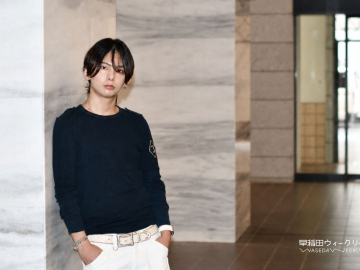
"I enjoy making things, so I could do it endlessly."
Reika Kidana, 4th year student, School of Creative Science and Engineering

At Building 51 on Nishi-Waseda Campus. With knitted items made using the app.
Reika Kidana developed a "knitting pattern creation app (*1)" inspired by the inconveniences she encountered while doing handicrafts in junior and senior high school. On March 13, 2026, at the "1st WASEDA DEMO-DAY" (hereinafter referred to as "Demo Day") hosted by the Waseda University Center for Entrepreneurship at Ono Auditorium, she presented her knitting pattern creation app and won the top prize.
When Kidana first entered Waseda University, she simply enjoyed making things. However, her participation in the "WASEDA Monozukuri Workshop Monozukuri Program (*2)" (hereinafter referred to as "MonoPro") and "WASEDA Monozukuri Program ADVANCED" (hereinafter referred to as "MonoPro Advanced"), both organized by the WASEDA Monozukuri Workshop, transformed her hobby of handicrafts and manufacturing into something with social significance. We spoke with Kidana, who enjoys developing things with the same enthusiasm as a hobby, about her journey so far, what inspired her to start developing, and her outlook for the future.
*1 A blueprint outlining the steps for creating a knitted item.
*2 A joint project based on a comprehensive cooperation agreement between Waseda University and Shimizu Corporation. A program that challenges value creation with a view to "social implementation" through "manufacturing" that fuses technology and creativity.
—How did you end up participating in MonoPro Advanced and Demo Day?
I participated in MonoPro Advanced as an extension of MonoPro, which I had taken part in during the summer of my third year of high school after being invited by a friend. I've loved making things ever since I was little. I was invited to try Demo Day as an extension of my activities in MonoPro Advanced.

Some of the knitted items that Kidana has knitted as a hobby in the past.
The first program I participated in was a hands-on project program for students in the Faculty of Science and Engineering, designed to promote manufacturing. Participants create tangible objects of their choice. Progress reports and meetings were held regularly, allowing participants to interact with each other, and they received advice and lectures from technical staff at Nishi-Waseda Campus. Here, I created a controller with many sensors called the "Sensor-Mashimashi Controller" and a game that uses it, together with a friend. I really appreciated being able to receive practical technical guidance within a set timeframe and having the production costs covered by the program.


Photo on the left: Certificate of award received from MonoPro and "Sensor Mashimashi Controller."
Photo on the right: The water level sensor is showing the water level on the screen, and the gyroscope sensor is showing how the screen's tilt is changing.
--So, could you tell us about your activities at MonoPro Advanced?
Unlike previous MonoPro programs, MonoPro Advanced has a clear theme of "social implementation." It provides an opportunity to consider whether things we've created for our own satisfaction are "useful to society." For example, we received feedback from users and other forms of evaluation from others. Seeing things through the eyes of others allowed us to gain perspectives we hadn't noticed on our own, which was a valuable opportunity.
During this project, I developed a knitting pattern creation app. Here, I used the app to create knitting patterns that matched the actual moving parts, and then created a three-dimensional Waseda Bear.

Waseda Bear parts created with MonoPro Advanced

This photo was taken at the final results presentation meeting for the MonoPro Advanced course held in March 2026. Kidana is the third person from the left in the front row.
—What inspired you to create a knitting pattern creation app?
The reason I took action was because of the organization I belong to. My professor Hiroyuki Ishii (Faculty of Science and Engineering) gave me an assignment: "Develop application software that contributes to the well-being of humankind." To address this assignment, I began creating a tool for a knitting pattern creation application.
The inspiration for this came from an experience I had while knitting a camera case as a hobby. I struggled to knit it to match the camera's contours and ended up giving up halfway through. At that time, I thought that if I had a knitting pattern, I might not have given up. So I decided to create a tool that could scan an object and generate a corresponding knitting pattern.

A photo from the Ishii Laboratory's 10th anniversary party (Kidana is second from the left, and Professor Ishii is third from the left).
--Could you tell me more about the knitting pattern creation app?
A knitting pattern creation app is a web application for crochet, where you input 3D data or images of what you want to knit, and it will create a knitting pattern for you.
In reality, when creating three-dimensional knitted items, you knit in a circular motion, but by increasing or decreasing the number of stitches, you can create a variety of shapes. However, doing this freely on your own is extremely difficult. Beginners and intermediate knitters need a knitting chart, which is like a roadmap for knitting.
For people like that, this knitting pattern creation app allows you to input data such as photos of the item you want to make, and get the most suitable knitting pattern each time.

Kidana has an object scanned with an app and a knitted item made from it.
Since I had no knowledge of app development, I used generative AI during development. I used a generative AI that is strong in app development, and based on the core algorithm of the app that I came up with, I gave specific instructions to the generative AI, pointed out any flaws in its operation, and so on... I completed it through a lot of trial and error. There were many times when I was busy balancing it with my studies, but I love making things, so I could have done it endlessly!
--What are your plans for the future?
I want to make knitting popular. My current knitting pattern creation app still has many bugs, and there are many features I want to add, so there are a lot of challenges to overcome before I can implement them. However, I hope that through this app, I can give young people in particular the excitement of thinking, "You can make this with knitting too!?" Furthermore, I'm thinking about how I can automate the knitting process as well, so that it can be easily used at home. After graduation, I plan to go on to graduate school, but even after that, I want to focus on developing the knitting pattern creation app for a while.
Since participating in MonoPro Advanced and Demo Day, I've come to see my hobby of creating things as something with social significance. Even after finishing app development, I want to develop and provide new tools to help reduce the number of people who are unable to take the first step or who fail to succeed because they feel the hurdles are too high when they want to do something.

Kidana shows a gentle smile. In front of Building 59 on Nishi-Waseda Campus where her research lab is located.
926th
Interview, text, and photography by: Waseda Weekly Reporter
Chikara Wada, 2nd year student, School of Political Science and Economics
【Profile】

The Waseda Bear, brought to life by Kidana
Born in Tokyo. Graduated from Toshimagaoka Joshigakuen High School. In her free time, she enjoys playing indie games with friends and taking short trips. She belongs to Rikoten Liaison Committee. Her recommended Waseda cuisine is the fried horse mackerel bento box from "Himawari". She expresses her desire to work in a field related to manufacturing throughout her life.

![[Save version] Map of the four main campuses](https://www.waseda.jp/inst/weekly/assets/uploads/2026/06/110d605cfac40346aad1d2df464a6586-940x705-1-1-610x457.jpg)