Waseda WeeklyWaseda Weekly

News

News

With love for Waseda in his heart, the captain of the cheerleading squad

"I never felt lonely. There was always someone there for me"

Waseda University Cheerleading Club Captain
Yu Toyoshima, 4th-year student, School of Education

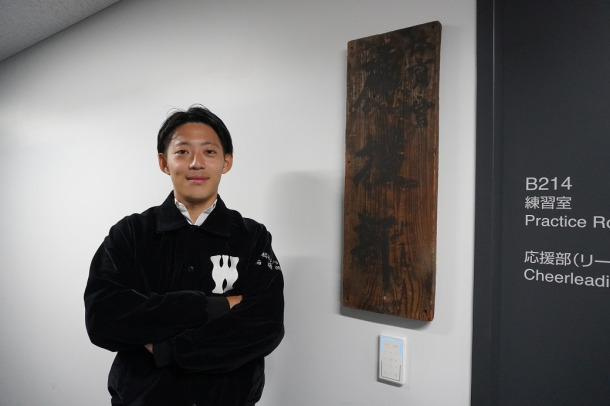
In front of the Waseda University Cheerleading Club room in the Waseda Arena Building No. 37, Toyama Campus

The Tokyo Big Six Baseball League is celebrating its 100th anniversary. Leading the Waseda University Cheerleading Club on this memorable occasion is Toyoshima, who has been the only leader* in his academic year for four years. Even in difficult times, he has supported his teammates and continued to cheer with all his might, demonstrating the true value of cheering. We spoke to Toyoshima about what attracted him to the cheerleading squad and his beliefs as captain.

*The cheerleading club consists of three roles: the leader, the brass band, and the cheerleaders. The leader plays an important role in leading the university's cheering, holds the right to hoist the school flag, and directs the cheering.

--Please tell us what made you decide to join the cheerleading club.

It all started when I participated in cheerleading practice in June of my first year of university. I enrolled in 2022 amid the COVID-19 pandemic and joined a few student club, but I couldn't quite put my finger on it, thinking, "Is this really what I want for my one and only university experience?" I was looking for something I could be more passionate about, and while searching for on-campus club activities that even beginners could participate in, I was drawn to the Waseda University Cheerleading Club. I felt the atmosphere of the cheerleading club, where everyone overcomes difficult times together and supports each other, and I joined with a strong desire to devote my college life to the cheerleading club.

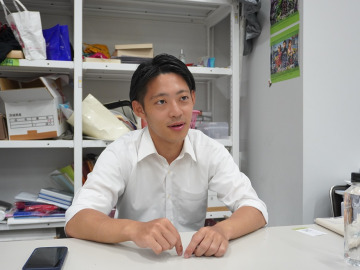
Toyoshima during an interview in the cheerleading club room

-What was your time as a rookie like?

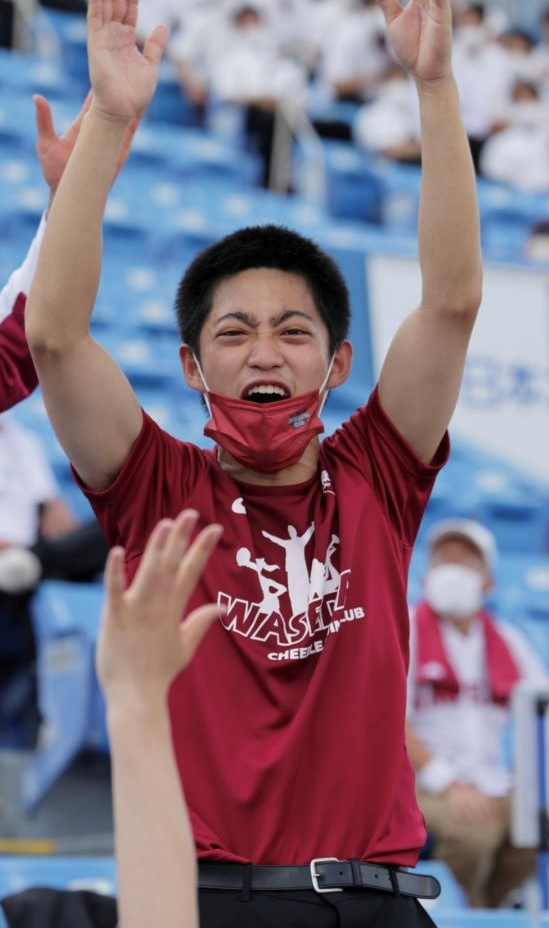
Toyoshima as a rookie. At the time, the effects of the COVID-19 pandemic were still being felt, and he even wore a mask while cheering.

As a rookie, every day was tough. In the cheerleading club, you're considered a "rookie" until around December of your first year. After that, you're promoted to full club member, but during that time, I kept thinking, "Oh, there's practice again today..." (laughs). Daily practice starts with learning how to clap and shout, and then we learn ways to get the crowd involved in cheering, as well as how to shout for long periods of time using our whole bodies. We train a wide range of skills, even to the point of having the mental strength to motivate ourselves when we're struggling. In addition, I work hard to build up my physical strength through running and strength training so that I can cheer on Waseda University's strong athletic clubs.

I think the reason I was able to persevere through those times was because my personality was suited to persevering in the tough environment of the cheerleading club. I'm insensitive, in a good way, and even if I experience hardship or hurt, I can reset myself with a night's sleep and think, "I'll do my best tomorrow too." Even so, those three years as a junior were tough, but I motivated myself by thinking about what kind of view I would see as a fourth-year student who had overcome it.

--I heard that you are the only fourth-year student in charge of the group. Was there anything difficult about that situation?

Since I was a rookie, I was always alone, so I never felt pressured by the number of people. In fact, because I was alone, I wasn't bound by the rotation system of cheer practice, where students take turns within their grade, and it was an environment where it was "natural to do it." I think that as I gained more and more experience, my nervousness about standing in front of people naturally faded away.

I'm also often asked, "Why are you able to continue even though you're alone?" But the truth is, I'm not alone. Even though I'm not in the same year as my classmates, I have strong bonds with my seniors and juniors. When I was a rookie, a senior student who was a year older than me would often take me out to for “Wase-meshi” (budget-friendly food available at restaurants around Waseda) after practice and listen to my worries about club activities. When I was having a hard time, my clubmates helped me and supported me. So, I've never felt lonely.

--Is there any moment in your cheerleading club's activities that particularly stands out in your memory?

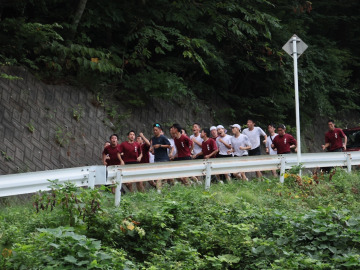
That would be the summer training camp that I took part in as a fourth-year student in September 2025. Every year, the cheerleading club holds a training camp for the entire club for 10 days and 9 nights in Iwate Prefecture and includes a practice session for leaders that goes from morning until night called the "Journey through Hell" .

This year's practice time was much longer than usual, and it was really tough, but I will never forget the view we saw when we overcame it. After it was over, we all cried together, congratulating each other on our hard work, and basking in the afterglow. Currently, the club has 11 members from second to fourth year, and 11 new recruits. I was especially inspired by the underclassmen who gave it their all and worked so hard. They showed us the most amazing view.

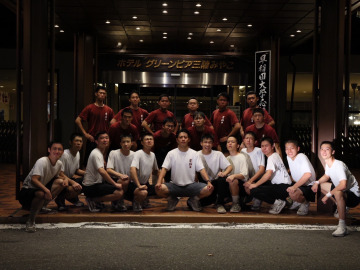
Left: Group photo of leaders at the 2025 summer training camp. Toyoshima is in the center.
Right: Running, the main practice for the "Journey through Hell." He said he was deeply moved by the sight of club members who followed him, regardless of their grade level.

--What about the games, which are the main events for cheering?

I can't forget the frustration of the games we lost, much less the joy of the games we won. One particularly memorable game was the match against Rikkyo University in the Tokyo Big Six University Baseball Spring League on May 5, 2025. After extra innings, there was a hit in the final run and we suffered a 10-11 walk-off loss. I believe the cheers of support always reach the players, so the frustration of that moment was even more intense.

By the way, regardless of whether they win or lose, the cheerleading club holds a debriefing session at the venue after the game. It usually takes about two hours. Upperclassmen make one comment after another, saying things like, "This cheering section lacked excitement," "The drumming part was disorganized," or "The arm movements weren't precise enough." Even if the words are harsh, it's all an important time for them to create better cheering.

--What is the "origin of cheering" for you? What are the thoughts and beliefs that you hold most dear as captain?

It all started with the attitude of fourth-year students I met at a practice session in my first year, who said, "Follow me!" They had a distinctly different aura from those around them, and the way they powerfully led their juniors was really cool, and it has always been a great motivation for me.

The most important thing about cheering is to convey our feelings to the players. We never know if they actually get it, but if we don't try to convey it, it's impossible for them to get it. That's why I give it my all, and I tell the younger students, "If you're going to do it, do it with all your might." When our full-hearted cheering resonates with the players and leads to victory, there's no greater joy than that.

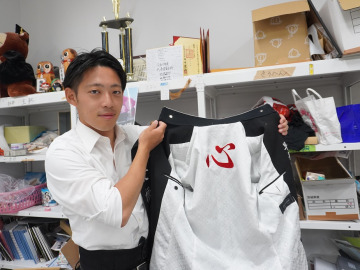
Left photo: The cheerleading club's slogan for 2025 is "Kokoro" (heart). Apparently, Toyoshima came up with it himself, and it's embroidered on the school uniforms. The colors of the embroidery also reflect the passion they have for cheering on the athletes, pouring their heart into every choreography and performance.
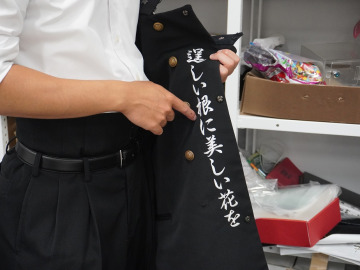
Photo on the right: Embroidery can be added as students become senior students. The "strong roots" represent the cheerleading club members, and the "beautiful flowers" represent the students and athletes. These words have been passed down from generation to generation as the pillars of the cheerleading club.

--Finally, as the representative captain of the cheerleading club, please give a message to Waseda students!

I want to cheer along with everyone! What's important for the cheerleading club is how much cheering we can get out of everyone. We started this season by having the cheerleading club respond to the names and words of the players they shout, and the response has been great, so we'll continue this in the future. We want to deliver a loud, unified cheer to the players, rather than scattered cheers.

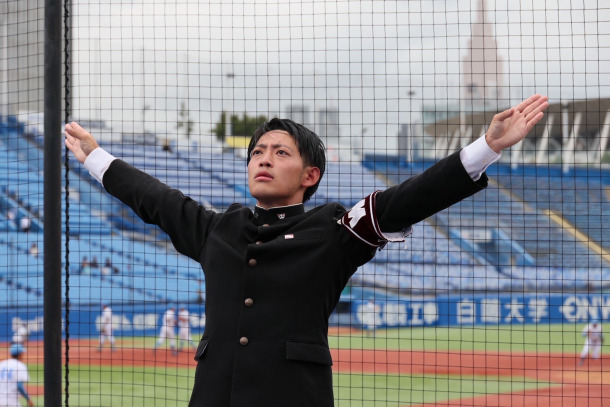
Toyoshima uses his whole body to lead the cheering and inspire the baseball supporters. His outstretched arms and serious gaze exude his unwavering passion for cheering.

It's really fun to shout with all your might. Sometimes we get so excited that the audience smiles wryly and says, "That cheerleader is amazing," but I tell the members that the important thing is to go all out and go crazy, even if it means they'll laugh at us. I want to get people who aren't used to cheering involved and make the cheering section an explosive sound. And by the time I graduate, I'll definitely create the "full-power cheering section" that I envision!

908th

Interview, text and photography: Waseda Weekly Reporter (SJC student staff)
Nagisa Nishimura, 3rd year, School of Culture, Media and Society

【Profile】

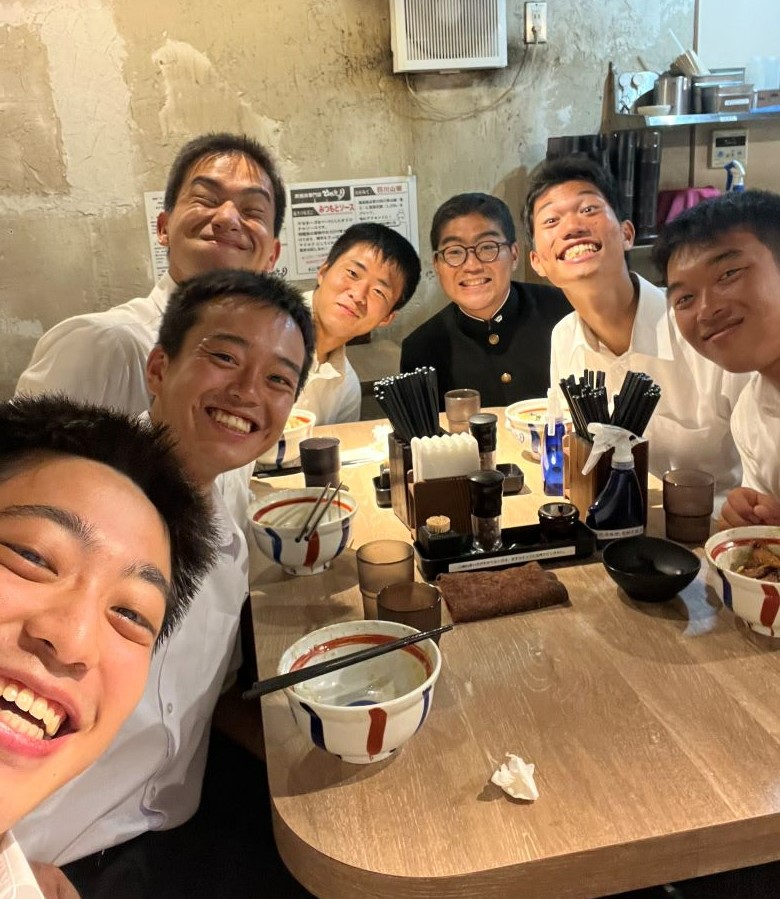
Now that he is a senior, he eats Wase-meshi (food from restaurants around Waseda Campus) with his juniors. Toyoshima is on the far left. The cheerleading club has a culture of switching gears, "When it's time to work, we work hard, and when it's time to rest, we rest together."

Originally from Kanagawa Prefecture, he graduated from the private Toin Gakuen High School. His favorite Wase-meshi is the oil soba noodles at Zuboshi. He says the hearty menu is appealing and he finds himself heading there all the time. His latest hobby is saunas. Apparently, the sauna he visited during training camp didn't have a good temperature control, so he's excited to "get his mind and body in order in a well-equipped sauna." He said he'd like to cheer on the Tokyo Big Six University Baseball team, which is aiming for its fourth consecutive championship, as well as Waseda's exciting sports teams, such as American football and lacrosse!

Waseda Weekly is the official web magazine for Waseda University Student Affairs Division. It is updated daily on weekdays during the academic term! It features introductions to active Waseda students and alumni, as well as information student club Waseda cuisine, and more.

Page Top
WASEDA University

早稲田大学オフィシャルサイト(https://www.waseda.jp/inst/weekly/)は、以下のWebブラウザでご覧いただくことを推奨いたします。

推奨環境以外でのご利用や、推奨環境であっても設定によっては、ご利用できない場合や正しく表示されない場合がございます。より快適にご利用いただくため、お使いのブラウザを最新版に更新してご覧ください。

このままご覧いただく方は、「このまま進む」ボタンをクリックし、次ページに進んでください。

Continue

対応ブラウザについて

close