Nokura: Public Health Nurse, Mental Health Clinic, Health Support Center
Many people are busy with their college life, with their studies, student club activities, part-time jobs, etc., and may not have time to pay attention to their health. This time, we will focus on stress and tell you how to notice illness early on, rather than waiting until you get sick.
What is stress?
Stress refers to the mental and physical reactions that occur due to external stimuli. External stimuli that affect the mind and body are called stressors, and when our bodies encounter stressors, they launch a defense reaction to try to eliminate them. If we are unable to respond well to stressors, various reactions appear in the mind, body, and behavior, which are called stress responses.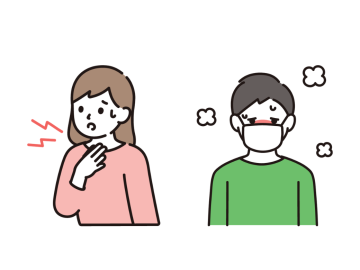
Understanding stressors and the stress response
Let's take a look at the main stressors and stress responses that college students are susceptible to.
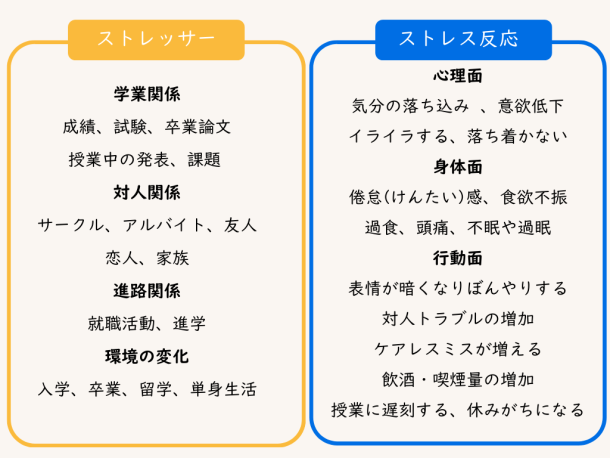
Stressors are not only negative but also include happy events such as entering school, graduating, and receiving a job offer, and can be either good or bad depending on how an individual perceives them. If stress reactions are left untreated, symptoms may worsen, so it is important to know which reactions you are prone to and deal with them early.
Self-monitoring to recognize stress responses
It is important to understand your own condition in order to notice when you are not feeling well. Start self-monitoring by recording the balance between sleep and activity and your mood for the day using a sleep diary or app that will help you understand your general sleep patterns by recording your bedtime, wake-up time, and daily activities. If you keep a record and notice that your sleep time is decreasing or your daily rhythm is becoming disrupted, it may be a sign of illness. Look back on your life and make sure you are not overscheduled or under too much stress, and make a conscious effort to ensure that you are getting enough sleep and rest.
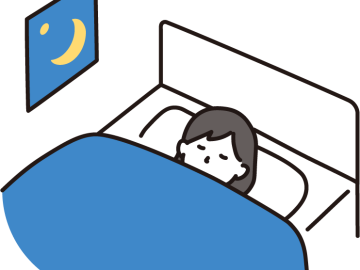 Stress is unavoidable in life, so it is important to deal with it while the stress response is still small, by taking time to rest and relax. If symptoms do not improve and you feel that it is interfering with your studies or daily life, you may need professional support. Please make use of Health Support Center, where you can receive health consultations, such as whether treatment is necessary and guidance on medical and support organizations.
[References]
・ Mental self-care (Tokyo Metropolitan Mental Health and Welfare Center)
・"Health Guide for University Students: Health Management for Campus Life" by Mayumi Yamamoto (Gifu Shinbun, 2016)
・ Stress reduction know-how | Kokoro no Mimi: Mental health portal site for workers (Ministry of Health, Labor and Welfare)

![[Save version] Map of the four main campuses](https://www.waseda.jp/inst/weekly/assets/uploads/2026/06/110d605cfac40346aad1d2df464a6586-940x705-1-1-610x457.jpg)