"I want to continue researching one aspect of the complicated relationship between Turkey and the Kurds."
Hoshima Kazuki, 1st year master's student, Middle Eastern and Islamic Studies Graduate School of Letters, Arts and Sciences Graduate School of Letters
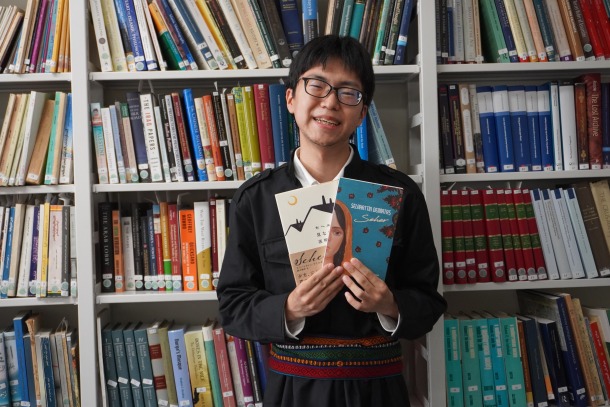
At the Middle Eastern and Islamic Studies Course Room in Building 39, Toyama Campus
Azusa Ono Memorial Award is the most honorable award for Waseda University students. Kazuki Hoshima conducted research at university on the politics of Turkey's Kurdish region, and was awarded the prize in March 2024 during Hoshima's fourth year at the School of Humanities and Social Sciences for Hoshima's research topic, "Transformation of pro-Kurdish parties under the Erdogan administration: HDP's inclusion and expansion and YSP's decline in the 2023 presidential and parliamentary elections." We spoke to Hoshima, who is expected to have a bright future, about what motivated him to start Middle Eastern studies, what he learned in his seminar, and his future prospects.
--Congratulations on receiving the OnoAzusa Memorial Award. First of all, please tell us how you felt when you received the award.
In my research, I received a lot of advice from my seminar professors, Middle Eastern and Islamic Studies course professors, professors from other universities, many seniors, juniors, and classmates, so my first honest impression is that I am happy to be able to give back to those who helped me. I was also happy that my Kurdish friend who helped me so much when I first went to Kurdistan was happy about it. In fact, I am the second person from the Komatsu seminar to receive Azusa Ono Memorial Award, but that senior, who received the award more than 10 years ago, is someone who is now a researcher and is truly respected by all the seminar students, including me, so immediately after receiving the award, I felt a little uneasy about whether it was okay for me to receive such an honorable award (laughs).
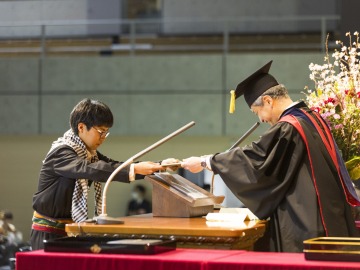
At the March 2024 Convocation, Hoshima is presented with Azusa Ono Memorial Award on stage.
However, I don't want this award to be the peak of my career as a researcher. I think that this award will increase the expectations and pressure from those around me, but that is exactly why I want to use this opportunity to aim even higher as a researcher, and first of all, I want to write Master's Thesis.
--The title of your winning thesis was "Transformation of Pro-Kurdish Political Parties under the Erdogan Administration." What made you become interested in this topic?
I belong to the Middle East and Islamic Studies course, and originally conducted a wide range of research on Turkish politics in general. One of the triggers was that I had the opportunity to hear a Kurdish journalist speak during a class. Until then, all I knew about the Kurdish issue was that the armed group PKK (Kurdistan Workers' Party) was engaged in "terrorism" and civil war, but as I listened to the journalist explain the Kurdish situation, I realized that the Kurdish issue, including the PKK, is not a simple issue that can be resolved as 0 or 100. I was shocked at how little I knew, and at the same time, my desire to learn more grew stronger, so I started reading various books on the Kurdish issue.
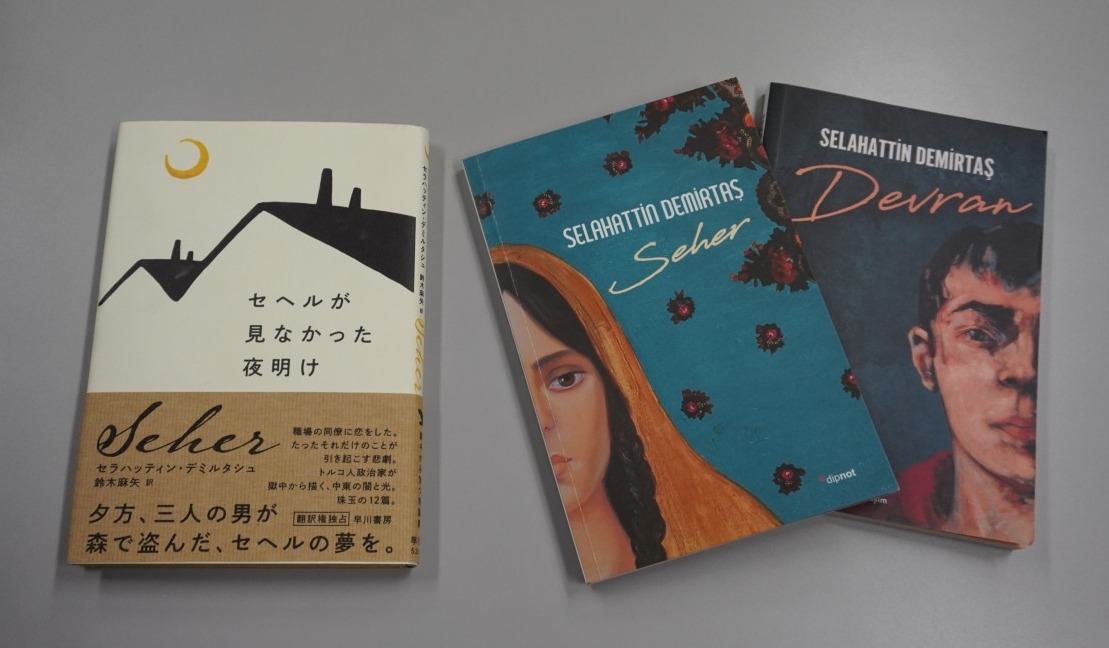
The book that inspired Hoshima to decide on Hoshima's research topic, "Dawn" by Selahattin Demirtaş (Hayakawa Publishing) (left), the original Turkish version "Seher" (center), and its sequel "Devran" (right)
There I came across a collection of short stories called "Dawn" This book was written by Kurdish politician Selahattin Demirtaş while he was in prison, and my first impression was that it was a fun, sad, humorous and well-read novel. However, although it is not directly mentioned much, the political and social issues surrounding the Kurds are actually included in the background, and as I continued my research, my perspective changed. As I read the novel, I also became interested in the author, Demirtaş. He is the co-chair of the pro-Kurdish party HDP (People's Democratic Party), which aims to resolve the Kurdish issue through parliament, and is a charismatic politician who is popular among the Kurds in Turkey. Despite this, there were very few people in Japan who were studying Turkish politics from this perspective. I felt that I had no choice but to do it myself, so I decided on this topic.
--Could you tell us specifically what kind of research you are working on?
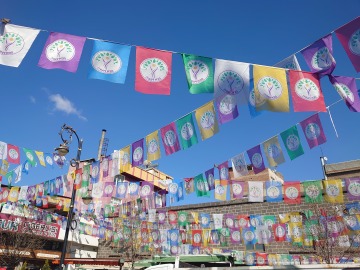
A flag of the pro-Kurdish party DEM (People's Equality and Democracy Party) in the old city of Diyarbakir, Turkey (photo by Hoshima)
Roughly speaking, I am researching the Kurds, an ethnic minority group in Turkey, the Kurdish issue, and its relationship to Turkish politics. After the Ottoman Empire was destroyed in World War I, the land where many Kurds live, called Kurdistan, was divided into countries such as Iraq and Turkey. After that, the Kurds in Turkey had their language and cultural rights restricted in the new state, and their activities in politics and society were also restricted, giving rise to the "Kurdish issue" that continues to this day.
There are two major Kurdish movements trying to solve this problem. One is the movement of the PKK and others who try to solve the Kurdish problem by using weapons and fighting the state, and the other is the movement of people who form pro-Kurdish political parties and try to carry out politics that aim to solve the Kurdish problem legally through parliament and elections. Demirtaş and the HDP he led are in the latter position. I myself am focusing on the latter and conducting research. The HDP and Demirtaş gained support by taking a political line called "Turkish citizenization (Türkiyelileşme)," which aims to solve the problem together with all Turkish citizens living in Turkey, including Kurds and other minorities. I am researching Turkish political movements surrounding these pro-Kurdish political parties every day through various materials and field surveys.
How do you study in the seminar?
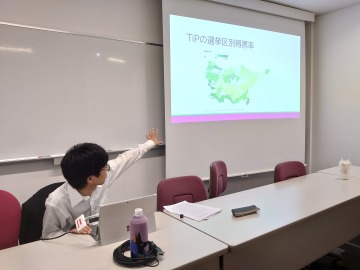
Hoshima presenting his research at the workshop. Hoshima is determined not to let the award be his peak and is pushing forward with his research.
In the Middle East and Islamic Studies course, there is a wide range of subjects to study, such as history, politics, and philosophy, as long as they are related to the Middle East and the religion of Islam, so many students choose their own research topic and delve deeper into it. I am studying in two seminars in the Middle East and Islamic Studies course at the graduate school.
In Professor Kaori Komatsu's (Faculty of Education and Integrated Arts and Sciences) seminar, each student presents their research, exchanges opinions and debates, and refines their research. I participate in the seminar with a sense of tension and stimulation because I am asked sharp questions from a different perspective than my own.
In Professor Shohei Sato's seminar (Faculty of Letters, Arts and Sciences) , we focus on training what is necessary as a researcher from the basics, and through regular seminars, I am given the opportunity to take on various challenges such as holding workshops, as well as guidance on how to write papers and research presentations. In particular, I have always been aware of Professor Sato's words, "When dealing with previous research, do not just agree with the content, but challenge the discussion" through the seminar. In addition, as an independent seminar, I read literature with graduate students who are studying Kurdish and Turkish studies at other universities, and exchange opinions with each other in a frank manner.
--Why did you decide to go to Waseda University? What are the good things about attending?
In high school, I was a member of the newspaper club, and for a feature article I wrote about Junpei Yasuda, a freelance journalist and graduate who was held captive in Syria at the time, which is what has led me to where I am today. As I conducted research in preparation for interviews and writing articles, I realized that there was still a lot I didn't know about the Middle East, even though I had learned about it in world School of Humanities and Social Sciences classes, and I wanted to know and learn more. I decided to go to Waseda University's Middle East and Islamic Studies course, thinking that I would be able to learn more in depth.
The good thing about entering Waseda University is that I get to meet a wide variety of students. When I was an undergraduate, I belonged to the Egyptian Culture Study Group (an officially recognized student club), and when I look at student club members who are serious about Egyptian archaeology and Middle Eastern studies, I feel that there are many people who are respectful and inspiring to each other, regardless of their year. Also, in student club, we sometimes exchange opinions on papers and research at study sessions, etc., and unlike seminars, I need to explain my research content in an easy-to-understand way even to people I'm meeting for the first time, and I get opinions from various perspectives, so this also leads to great learning in advancing my research.
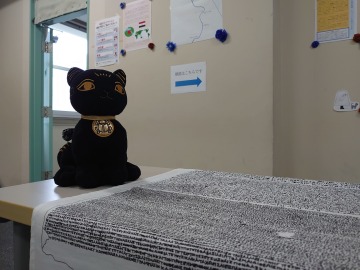
The booth of the Egyptian Culture Study Group at Waseda Festival 2022. The stuffed cat is Bastet, the cat goddess of Egyptian mythology.
--Please tell us about your future prospects.
In the future,I would like to delve deeper into Turkish politics, paying more attention to the existence of minorities, including the Kurds. As I said at the beginning, I do not want this award to be the peak of my research, but rather I would like to continue to work hard and take on various challenges. In particular, I am currently focusing on the framework of opposition parties, researching the changes in how each party deals with and approaches the Kurdish issue, and through this research I would like to continue to shed light on one aspect of the complex relationship between "Turkey" and "Kurds". To that end, I would like to put more effort into research activities, such as studying Turkish and Kurdish and continuing to read literature and papers.
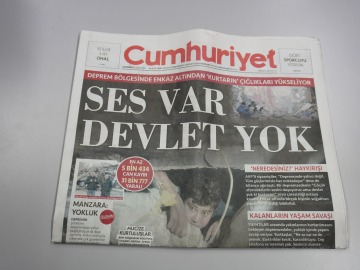
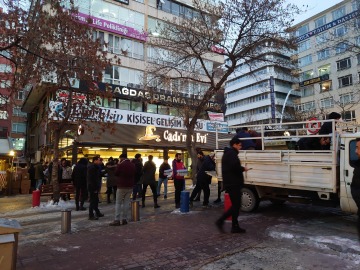
Photo on the left: A newspaper purchased in Turkey after the earthquake. The headline reads, "There are voices (under the rubble), there is no country (in the disaster area)."
Photo on the right: The Turkish Workers' Party loading relief supplies in Ankara (photo by Hoshima)
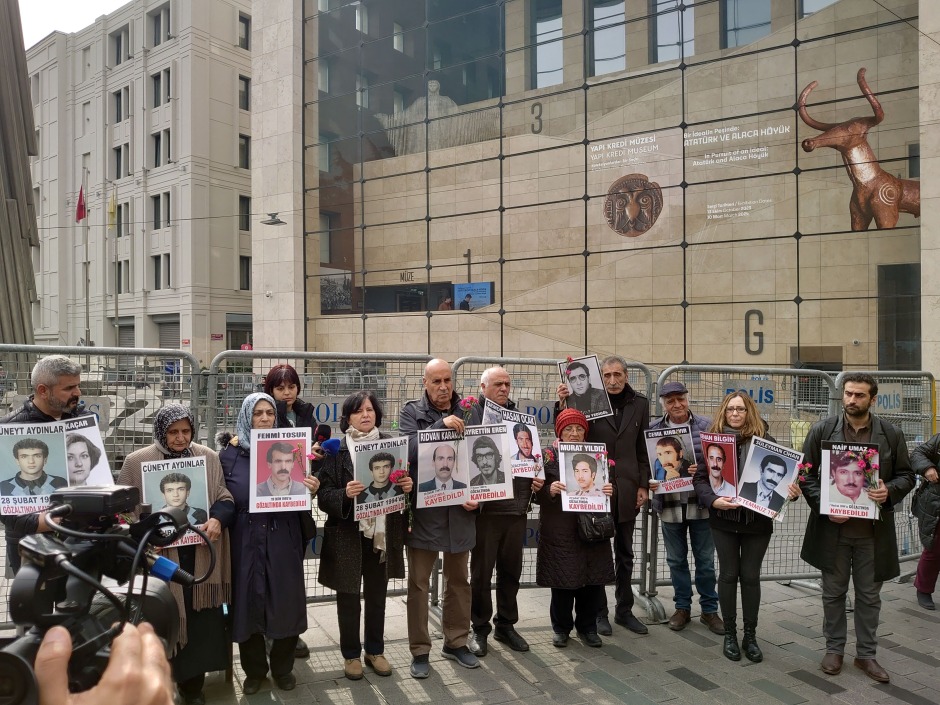
Another thing that has left a strong impression on me in my research so far is when I encountered the Turkey-Syria earthquake during a field survey in February 2023. There was no shaking where I was, but I felt that Turkish society was moving before my eyes through newspapers, television reports, and the atmosphere of the city. These various experiences and interactions with people on the ground have been a major driving force in my research. From now on, as a researcher and as a person, I would like to continue to observe and face the ever-changing state of Turkey and the Kurds.
And eventually, I would like to become a researcher who can connect Turkish studies and Kurdish studies and disseminate the results of my research to the world. I also believe that my research topic is a field that is difficult to understand in its entirety in Japanese. So, although it seems like there is still a long way to go, I would like to write a book someday that disseminates the results of my research to society.
No.878
Interview, text and photography: Waseda Weekly Reporter (SJC student staff)
Sotaro Tsutsumi 4th year student School of Social Sciences
【Profile】
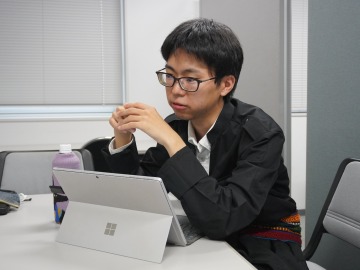
Photo taken during the interview
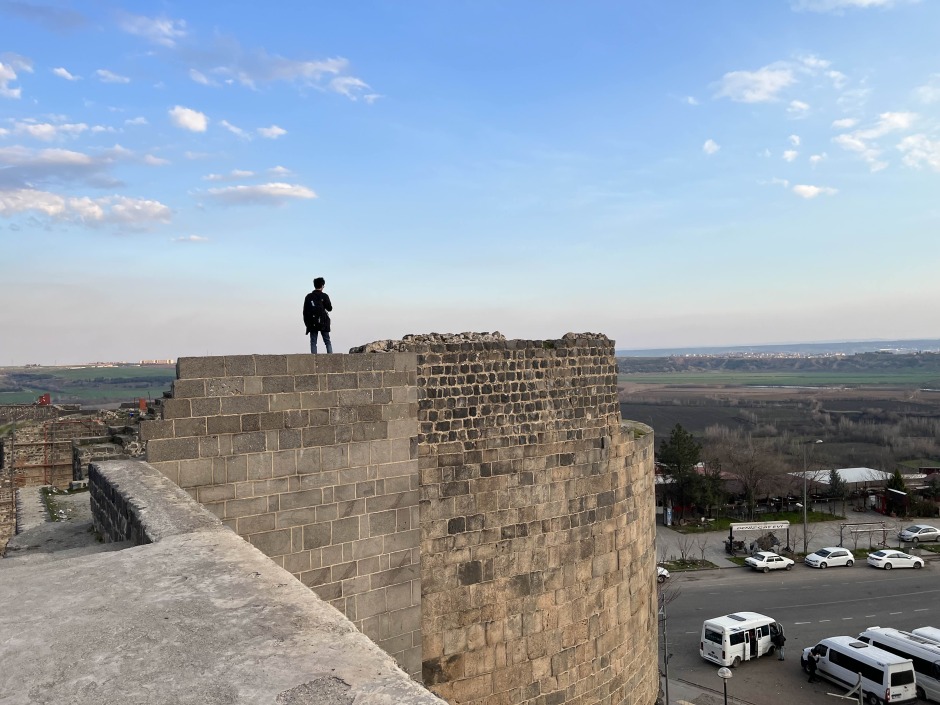
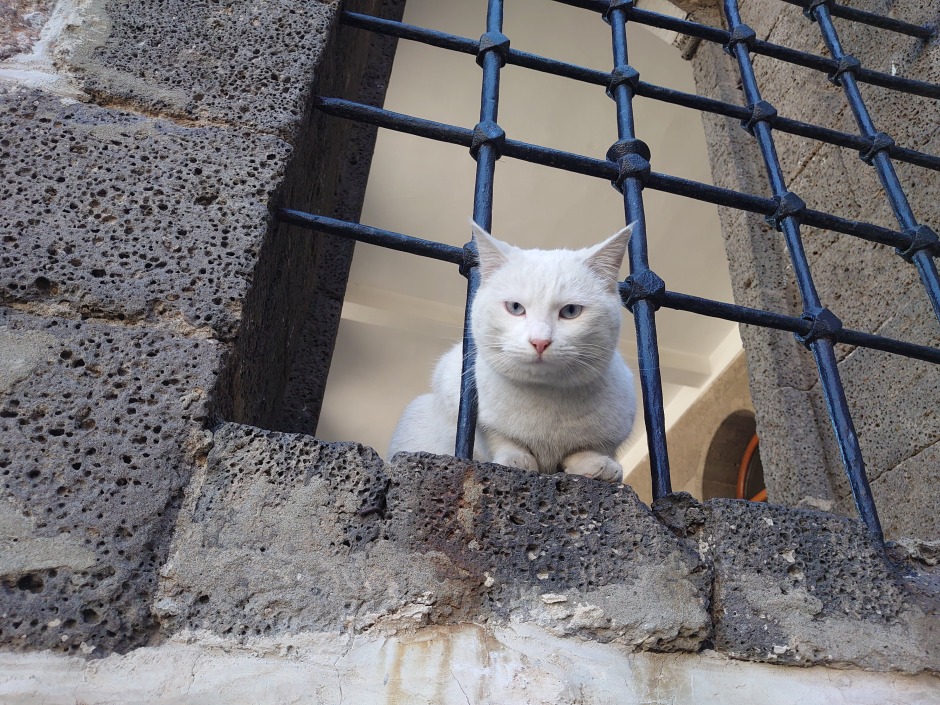
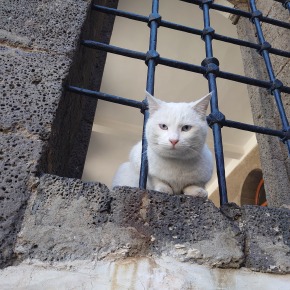
Born in Saitama Prefecture. Graduated from Kawagoe High School. Hobbies include visiting second-hand bookstores and increasing the number of books he has to read. In Turkey, Hoshima photographs political party posters and interacts with cats on the street.
![[Save version] Map of the four main campuses](https://www.waseda.jp/inst/weekly/assets/uploads/2026/06/110d605cfac40346aad1d2df464a6586-940x705-1-1-610x457.jpg)