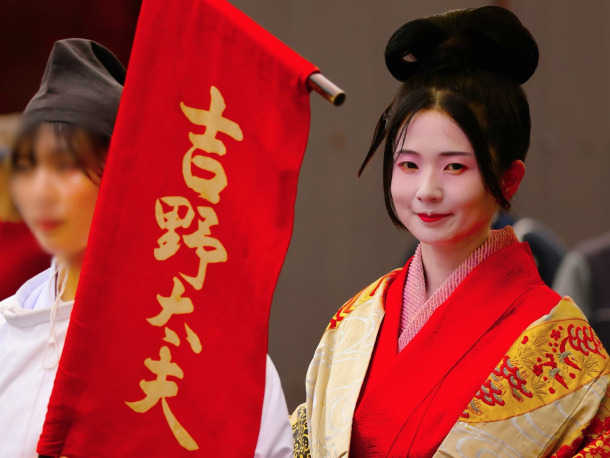
Taken during the Jidai Matsuri procession. (credit: John Norris)
Waseda University has many professors with a wide range of hobbies and special skills. In "Professor's Time Off," we introduce the unexpected side of our professors that you don't see during class.
Associate Professor Faculty of Letters, Arts and Sciences, Shoko Sasayama
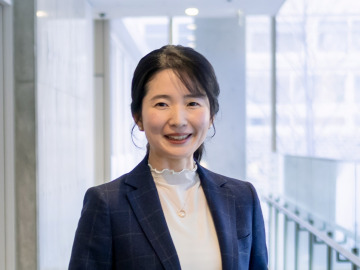
Born in Kyoto, Japan. After studying at the University of Hawaiʻi as a Fulbright scholar, Dr. Sasayama obtained a PhD in Linguistics from Georgetown University. Prior to joining Waseda in 2022, she worked at the University to Tokyo as a professor and at ETS in the US as a research scientist. Her research focuses on second language acquisition, pedagogy, and assessment.
October 22 is a special, auspicious day for Kyoto. On this day in 794, the capital of Japan was moved to Heiankyo, present-day Kyoto, and to celebrate this event, the Jidai Matsuri festivalhas been held every year since 1895. Jidai Matsuri is a historical parade where citizens of Kyoto dress up as influential figures from different periods of Japanese history, going backwards from the Meiji Restoration (1868) all the way to the Enryaku period (782-806). The procession starts at Kyoto Imperial Palace and ends at Heian Jingu Shrine, passing through some of Kyoto’s major streets.
In 2025, on the 130th anniversary of Jidai Matsuri, I had the honor to participate in the procession in the role of Yoshino Tayu, a highest-ranking courtesan from the Edo period. She was renowned not just for her beauty, but for her intelligence and cultural sophistication. She possessed exquisite skills of a variety of traditional arts, including poetry, dance, music, and tea ceremony.
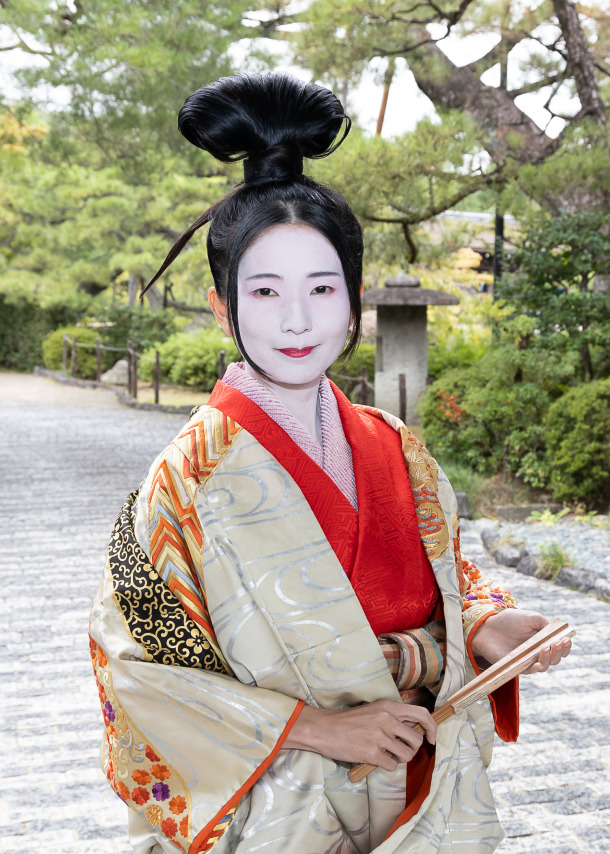
Portraying the role of Yoshino Tayu. (credit: Hayashi Photo)
It was my third time participating in Jidai Matsuri, but this time as a new character. The past two times, I had portrayed a lady-in-waiting to Princess Kazunomiya. It was exciting to play a new role this time.
One week before Jidai Matsuri, the 500 participants of the procession gathered together at Heian Jingu Shrine to seek blessings for a successful completion of the event. There, I was officially named to the role of Yoshino Tayu.
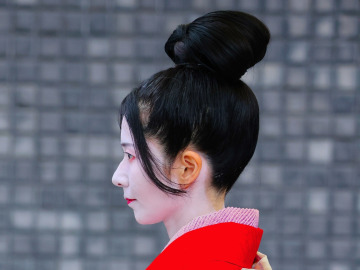
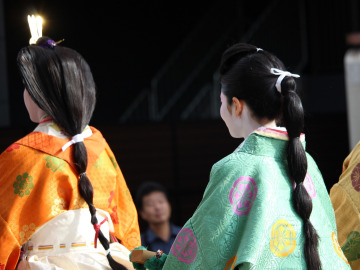
To accurately portray Edo-era fashions, participants grow their hair long for intricate styling. (credit: John Norris)
On the day of the festival, we started preparations for the noon parade before 8am. It took several hours to have our traditional hair and makeup done and to put on the costume. It was auspicious to learn that my costume had been newly restored this year, which made my participation in the procession even more special. Once we arrived at Kyoto Imperial Palace, the starting point of the procession, we were immediately surrounded by photographers, and I was approached by newspaper reporters for an interview.
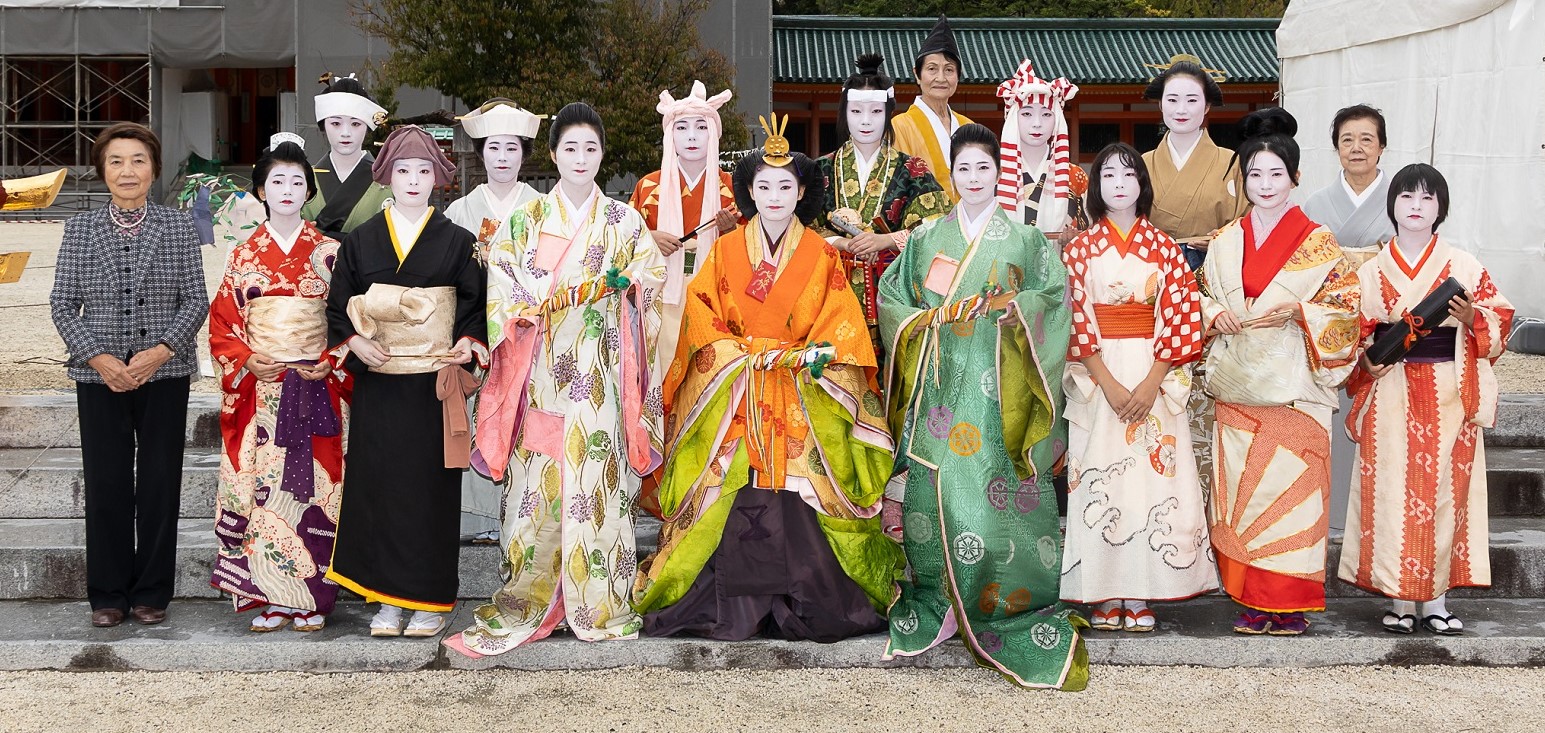
Group photograph of the Edo-era female characters. The author is second from the right in the front row. (credit: Hayashi Photo)
It was a drizzly day, but the streets were filled with spectators. Before the procession, I was worried if I’d be able to manage the 5K walk from Kyoto Imperial Palace to Heian Jingu Shrine in zori, traditional Japanese sandals that I’m not used to wearing. I felt uneasy, knowing that in the past two processions I had been carried on a float, never having to walk on my own. Once the parade began, all my worries melted away. Carried along by excitement, I completed the 2.5-hour walk effortlessly. It was a real blessing to play the role of Yoshino Tayu and be part of Kyoto’s living history.
Kyoto’s charm lies in its pride in tradition and the community’s commitment to passing down its important history to the next generation. It was only after I left Japan to study and work abroad that I understood the true appeal of my hometown, Kyoto. Sometimes, seeing things from a different perspective can help us realize how special our ordinary, everyday practices may be. I hope students will actively seek opportunities to experience a variety of cultures firsthand and to reevaluate their own from a fresh perspective during their time at Waseda.
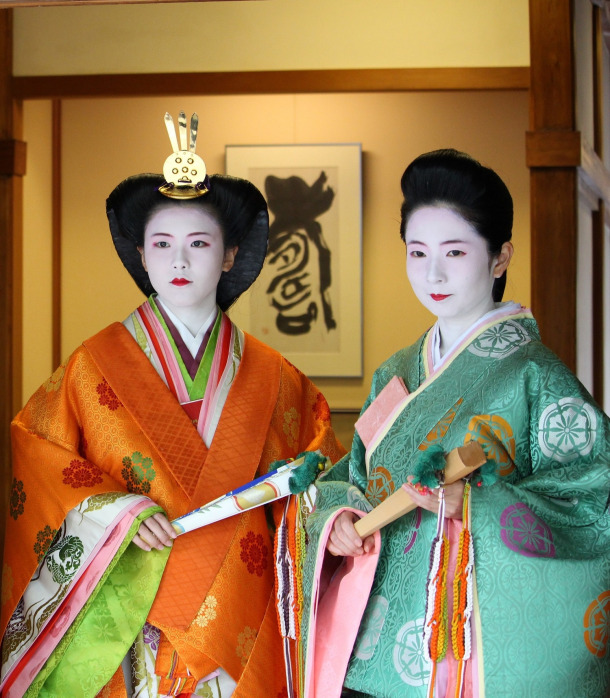
The author, on the right, in the role of a lady-in-waiting to Princess Kazunomiya in 2019. (credit: John Norris)

![[Save version] Map of the four main campuses](https://www.waseda.jp/inst/weekly/assets/uploads/2026/06/110d605cfac40346aad1d2df464a6586-940x705-1-1-610x457.jpg)