"I want to learn more about nuclear damage around the world, not just reporting it myself."
Keita Takagaki, 3rd year student, School of Social Sciences

At the relief of Chiune Sugihara near Building 14 on Waseda Campus
The Second Conference of the Parties to the Treaty on the Prohibition of Nuclear Weapons (hereinafter referred to as the Conference of the Parties) was held in New York from November 27 to December 1, 2023. Keita Takagaki, a native of Hiroshima Prefecture, participated in the conference as a youth representative of the International Committee of the Red Cross (ICRC). Mr. Takagaki participated in the First Conference of the Parties held in 2022 and the Hiroshima G7 Youth Summit (hereinafter referred to as the Youth Summit) in 2023, and is working on nuclear weapons issues as a volunteer at the ICRC's Delegation to Japan. . The reason he started these activities was because of his great-grandfather, who lived in Nagasaki and Hiroshima and was exposed to radiation. We asked Mr. Takagaki about his activities with the ICRC, his thoughts on the nuclear weapons issue, and his future prospects.
--Please tell us how you started working with the ICRC.
I first learned about the ICRC when I was participating in the newspaper club at my high school in Hiroshima. While producing an article, I had the opportunity to interview the ICRC's representative in Japan at the time, and since I had always been interested in nuclear issues, I was very impressed by their activities. At that time, I felt that I wanted to be involved in their activities and contribute myself.

Activities in the newspaper club. Mr. Takagaki wrote the article as part of the peace issues team (second person from the right in the photo).
I actually started volunteering when I was in my first year at university. The ICRC is not looking for student volunteers, but when I asked the ICRC's representative office in Japan if there was anything I could do to help regarding nuclear weapons, they took my background and past activities into account and gave me a special offer. I was able to participate. Currently, I am in charge of planning events related to nuclear weapons for the ICRC, and I also have the opportunity to write articles for the ICRC's website. I am also involved in a wide range of other activities, such as interacting with various volunteer organizations and teaching classes at universities as a special lecturer.
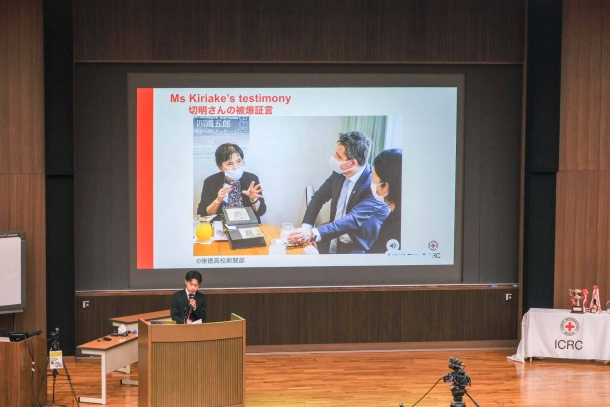
In December 2021, as a member of the ICRC, he gave a lecture at the International Humanitarian Law Moot Court at Waseda University.
--When did you become interested in the nuclear weapons issue?
My two great-grandfathers, both of whom were exposed to radiation, were the main reasons why I started working on the nuclear weapons issue, but my first opportunity was at the Hiroshima Peace Memorial Museum. The first time I visited a museum was when I was 6 years old. At the time, museum exhibits were very stimulating for me, and it became a trauma that lasted for years.
However, when I was in junior high school, I heard stories from my grandparents and mother about my great-grandfathers who were doctors and provided relief work, which was a turning point for me. It would be easy to not share with those around me what I saw at the museum or the stories I heard from my family, but if I did that, the experiences of my great-grandfather and the people of his time would be lost to me. I thought that was definitely not possible. I felt that it was my personal mission to convey to the next generation the tragedy caused by nuclear weapons. With this in mind, I decided to share the story of my great-grandfathers with as many people as possible and contribute to the abolition of nuclear weapons.

Takagaki's two great-grandfathers. As doctors, they conducted relief activities for injured people in Hiroshima and Nagasaki, and were exposed to radiation.
-- Mr. Takagaki, you have attended global events such as the Conference of the Parties and the Youth Summit as a youth representative of the ICRC. Please tell us about your most memorable activities so far.

Participating in a conference as an ICRC youth representative. The first Conference of the Parties was held in Vienna
What particularly left an impression on me was the Conference of the Parties. The first meeting was an event of great significance for the ICRC, which has been working for a long time to conclude the Treaty on the Prohibition of Nuclear Weapons. I am very proud to be able to participate in such an event as a member of the ICRC. I was constantly nervous during the event, giving lectures and hosting events held locally. My biggest task was to read out the ICRC's statement in front of delegations from each country. We conveyed the ICRC's recommendations to many people regarding relief for nuclear victims, environmental restoration of contaminated areas, and international cooperation to promote these as stipulated in the treaty.
The second conference, held the other day, included an event called ``Youth Orientation'' held by the NGO at the Irish Embassy, a lecture for people involved in the International Red Cross and Red Crescent Movement, and a statement made during the conference as in the previous one. We did readings, etc. Although the current international situation continues to be difficult, I felt a strong sense of unity throughout the conference to work as one to move the treaty forward.
During this period, I also had the opportunity to meet up with friends who have been with me since the first meeting. I was very encouraged by attending the meeting with them and seeing them express their thoughts and feelings about the damage in their own areas. It was a great accomplishment for me to be able to make connections with new colleagues and have deep conversations based on our respective awareness of issues.
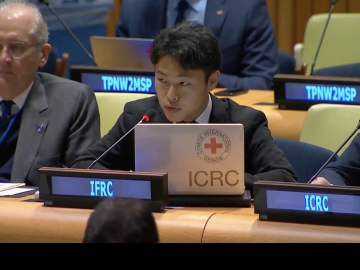

Participated in the second conference as an ICRC youth representative. On the final day of the conference, we spoke with the Pacific region community (Mr. Takagaki is on the right in the photo, and on the left in the foreground)
――In addition to your activities with the ICRC, I hear that you are currently hosting exchange events with young people from countries affected by radiation.
Starting in 2022, we have been planning and managing an online event called "Youth Session to Meet Hibakusha from Around the World (Youth Session)." The purpose of the youth sessions is to connect young Japanese people with people from other radiation-exposed countries and create opportunities for them to learn from each other. We hold online events once a month, and so far we have interviewed 10 guests, including professors who research nuclear damage and young activists working on nuclear issues overseas. .

Youth session activities (Mr. Takagaki is in the top left of the photo). I am working on a project with Mayu Seto (top center of the photo), who is also from Hiroshima.
The reason for starting this youth session was at the first Conference of the Parties, where I met young people who were complaining about the damage caused by nuclear tests in the Pacific Ocean, and people who were born without both hands as a result of the tests in Kazakhstan. That's what happened. Their stories were very shocking and made me realize that although we Japanese people put a lot of effort into spreading the word, there is still a lot we don't know about the world's nuclear damage. I would like to continue working as an ICRC youth member and create opportunities to think about nuclear damage around the world through initiatives like this.
--Did you study anything related to your activities at university? Also, isn't it difficult to balance this with volunteer work?
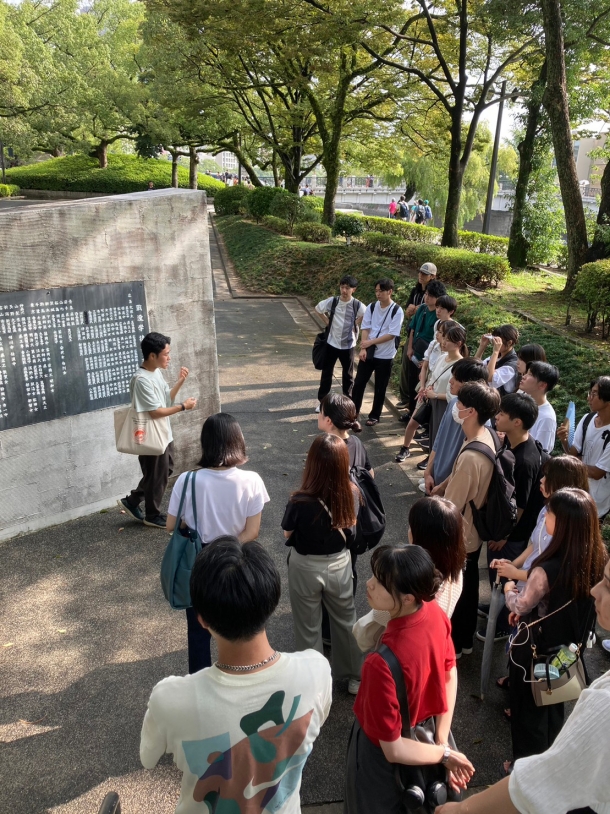
A scene from the Hiroshima training held in the seminar. Mr. Takagaki also served as a guide during the training.
I am active in Professor Hori Yoshie's (Faculty of Social Sciences Professor) peace studies seminar, and I am studying gender and international relations. In addition, since I can deal with a variety of themes in the seminar, I myself am deepening my learning centered on nuclear issues. In addition, I mainly take lectures related to international relations, peace studies, and international politics, but I would like to study more diverse fields and broaden my horizons.
Until my second year, I had a hard time balancing activities and schoolwork. However, I have firmly decided to myself that ``a student's duty is to study!'', and now I am focusing on volunteer activities while also focusing on my studies.
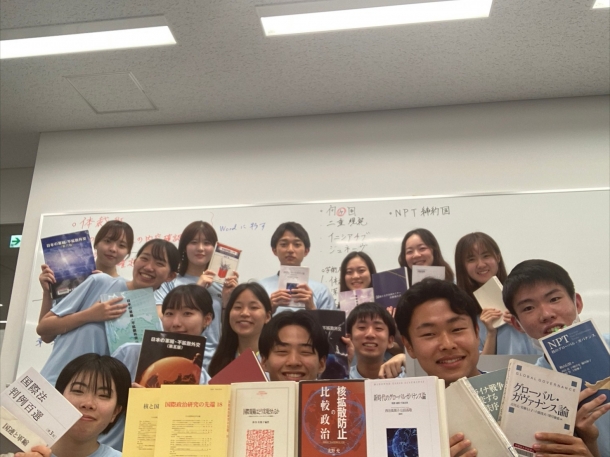
He also participates in an academic group called the ``Ten Universities Joint Seminar,'' where students from multiple universities gather to jointly write papers (Mr. Takagaki is in the front right of the photo). They are currently working on preparations for next year's operation.
--Please tell us about your future aspirations and what career path you are currently considering.
The nuclear weapons issue is a complex issue involving security and diplomatic issues. No one person can solve the problem alone. However, I believe that the most important thing is to hold up the ideal of world peace and never give up on your efforts. At the second conference, there were times when I felt the difficulty of nuclear disarmament while talking with people, but instead of rushing to achieve immediate results, I wanted to take steps to pass these activities on to the next generation. To go. I believe that a peaceful world awaits us beyond that.
In the future, I would like to go to graduate school and study disarmament and international law, including nuclear weapons issues. As a step toward that goal, I am currently writing Bachelor's Thesis on the theme of compensation for radiation survivors and related issues. I would like to continue to accumulate knowledge and experience and aim to become a person who can contribute to solving International Office, including the nuclear weapons issue.
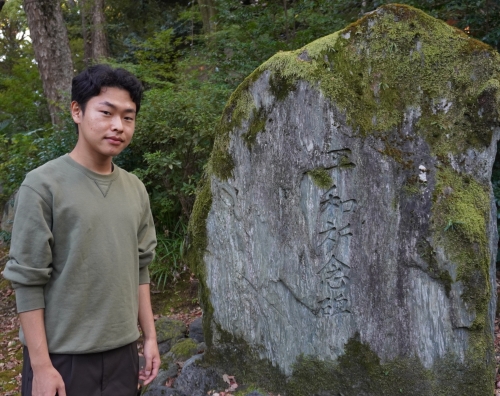
At the Peace Memorial on the way to Okuma Okuma Garden House Waseda Campus
861st
Interview/text/photography: Waseda Weekly Reporter (SJC student staff)
Ryusei Sakuma, 4th year School of Law
【Profile】
Born in Hiroshima Prefecture. Graduated from Sotoku High School. He was drawn to Waseda University's School of Social Sciences because there were many Professor who were actively involved in field work. My hobby is playing the drums. On days when I don't have classes, I sometimes go back to my hometown and work as a guide in and around the local Peace Memorial Park and coordinate training sessions.
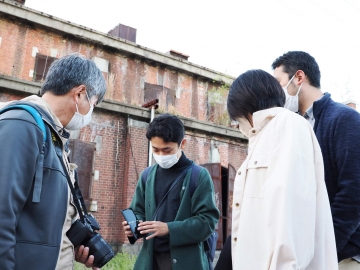
Mr. Takagaki showing around Hiroshima's atomically exposed buildings
![[Save version] Map of the four main campuses](https://www.waseda.jp/inst/weekly/assets/uploads/2026/06/110d605cfac40346aad1d2df464a6586-940x705-1-1-610x457.jpg)