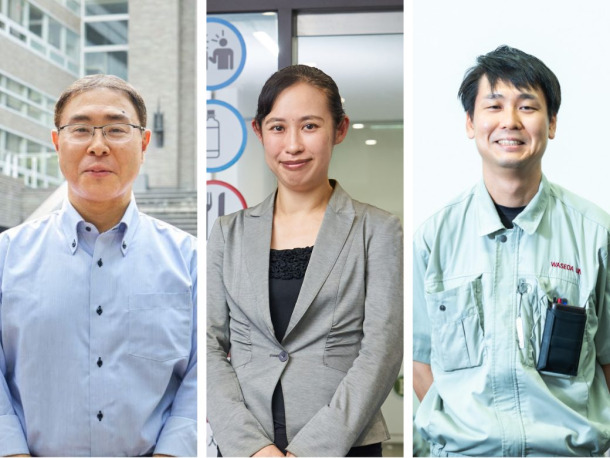
Waseda University has approximately 50,000 undergraduate and graduate students. But did you know that Waseda employs a diverse range of specialized staff to support student life? This time, we interviewed a career consultant who provides individual consultations for job hunting, a librarian who manages valuable materials on campus, and a technical staff member who supports experiments in the Faculty of Science and Engineering. Let's take a look at where they work, who they are, and what their motivations are.
▼ Offering supportive words to students struggling with job hunting - Career consultant
▼What we can do for learners now and 100 years from now - Librarian
▼ Creating an environment where students can safely fail - Technical staff at the Science and Engineering Center
Career consultants should offer supportive words to students struggling with job hunting.
Tokio Marine & Nichido Career Service Co., Ltd. - Career Consultant
Kayo Hashimoto
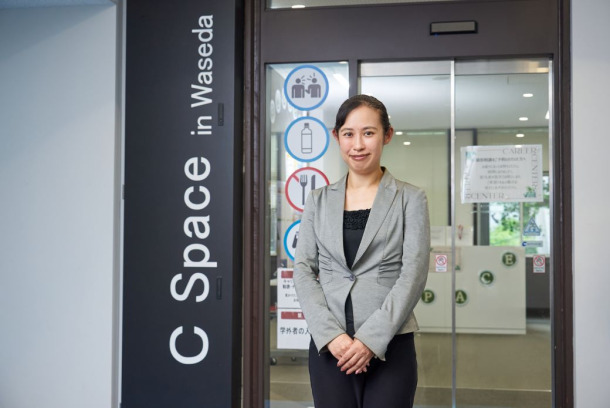
In front of C Space on the 1st floor of Building 6, Waseda Campus
--Could you tell me about your job responsibilities?
As a Career Center counselor, I provide support for students' career choices and job hunting. Specifically, to help students make proactive career decisions, I offer individual consultations on self-analysis, resume review, interview practice, and more.
—What do you keep in mind when conducting individual consultations?
I pay close attention to my opening remarks, the way I speak, and my tone of voice when I begin a consultation. I'm especially mindful of this around June, as I receive many consultations from third-year students who don't know where to start with their job search, and fourth-year students who are still actively looking for jobs. Also, since individual consultations are limited to 30 minutes, I think about how I can provide the most appropriate support for each student within that limited time.
—What are your thoughts and feelings towards the students you work with?
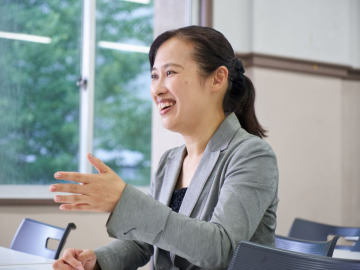
It's about offering encouraging words that help students take a positive step forward, and understanding their feelings. Many students want someone to listen to their worries that they can't tell their family or friends, so I try to listen to them carefully. I want to be someone who can gently encourage them and help them become a little more positive.
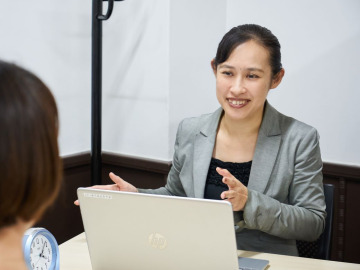
Hashimoto providing job-hunting advice at the individual consultation booth.
—When do you feel that you're glad you're doing this job?
It's when I can help students feel more positive. Many students feel they have to say something amazing in their "student achievements" section, and when they see impressive examples on job hunting websites, such as "I was involved with an NPO and built a primary school in Indonesia," they come to me feeling insecure and like they have nothing to offer. But as I listen to their stories, I'm really glad when they realize that they do have something to highlight.
—Could you share an anecdote about a student that left a lasting impression on you?
A student came to me for advice, saying that they didn't have any strengths because they were just working part-time at a Chinese restaurant. But when I listened carefully, the student told me that cleaning after closing was really hard work, and everyone else would leave because they didn't want to do it, but the student would clean until it was sparkling clean. Isn't that amazing? I advised the student that being able to take the initiative to do things that others don't want to do is definitely something you can use to your advantage.
--Finally, do you have a message for Waseda University students?
I believe the most important thing in job hunting is a positive attitude. If you get rejected by 10 companies right away, you might get discouraged and lose motivation, but it just means that you weren't meant to work for those companies, and there is definitely a place where you can shine. So, don't get too discouraged, and approach it with a positive attitude.
Some people might feel intimidated or worried about going to the Career Center for advice, thinking, "What if I get scolded if I'm not in the right place?" But we want to help students in any way we can, so please feel free to use our services. Even if it's just a small question, or even just "What should I do?", that's perfectly fine!
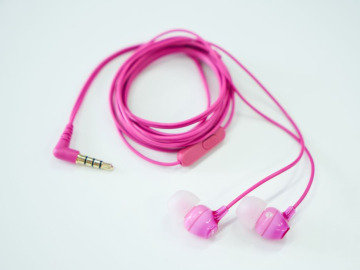
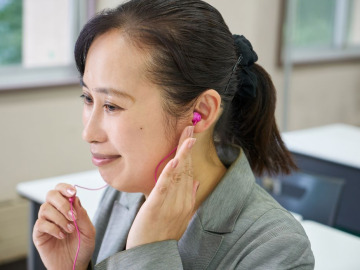
Hashimoto's work partner: earphones
Hashimoto
These days, it's possible to have online job interviews from your study abroad location, and I also have many opportunities to give online consultations to students overseas, so earphones are a necessity. Before a consultation, I think about things like, "What's the time difference?" and "Should I start by speaking in their language?"
Career and job-hunting individual consultations
Office Hours: Monday to Friday, 9:30 AM to 5:00 PM
Location: Waseda Campus, Building 6, 1st Floor, C Space
* For more details, please check the Career Center website.
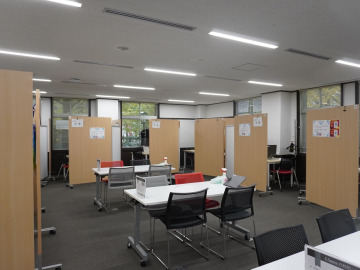
A view of C Space
What we can do for learners, now and 100 years from now: Librarian
Dept. of Collection Management / Special Materials Room Librarian
Osamu Shimada
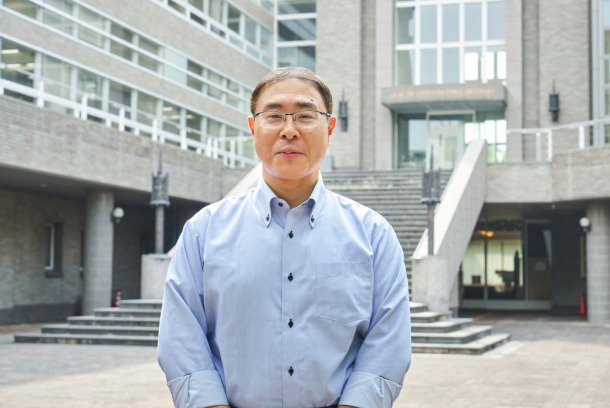
In front of the Waseda Campus Central Library
--Could you tell me about your job responsibilities?
The Special Materials Room on the 4th floor of the Central Library is the place within the Waseda University Library where ancient materials known as classical texts are preserved and managed. It houses a large number of valuable materials, including national treasures and important cultural properties, books and copies published before the modern era, as well as manuscripts by writers and letters by politicians from the modern era onward.
Since we are a small team, all of us, including myself, are responsible for all aspects of the work, from back-office tasks such as acquiring and organizing materials and managing the collection, to assisting users with browsing and other services. We also digitize classical texts by photographing them, create protective covers called "chitsu" to ensure they can be read for a long time to come, and repair materials that are in poor condition.
More recently, I've been involved in projects that consider how to best utilize and disseminate digitized materials in the future. It's about balancing preservation and accessibility; I work every day thinking about what we can do now, not only for those studying these materials today, but also for those who will learn about them 50 or 100 years from now.
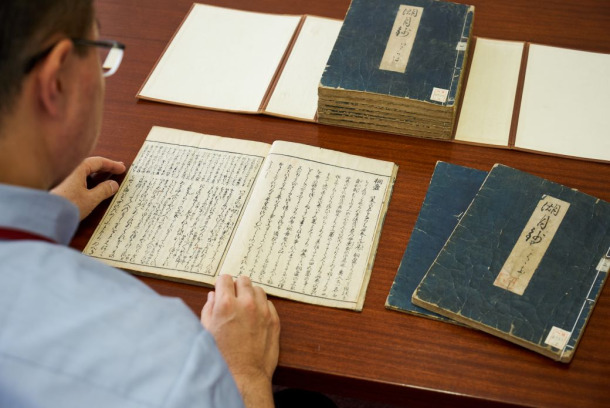
Shimada checks the condition of the documents. The documents date back to the early Edo period.
—How do you interact with students when dealing with users?
Some students who come to browse are first-timers, so in those cases, I try to understand what they are looking for and what kind of materials they need. Also, since most first-time students have never handled physical materials before, I sometimes give them a lecture on how to use them.
—What are your thoughts and feelings towards the students you work with?
For students who come to view the materials, I hope they will experience both the joy and the challenges of seeing the actual documents. Reading old documents, including how to handle them, can be difficult, but I hope that this experience will help them understand the importance of seeing the actual documents, the sense of distance they convey from the present, and how to approach historical materials.
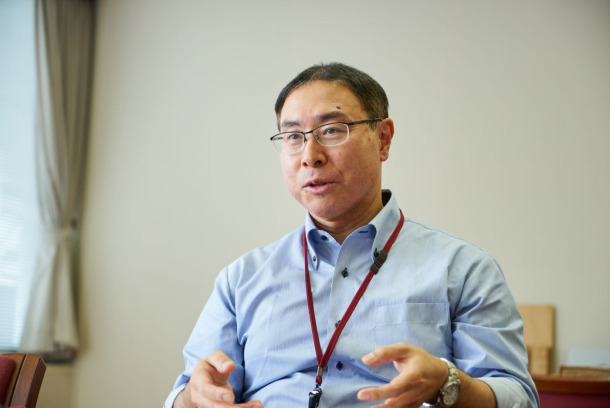
—When do you feel that you're glad you're doing this job?
This might not be limited to the special materials room, but sometimes students leave with an "Ah, I understand" look on their face after browsing the materials. I think the experience of "understanding something, learning something" by reading materials is very important, so I'm very happy when I see that.
Then there's the task of selecting and acquiring materials to add to the library, but not all of the materials we acquire will immediately be used for research. However, when we see that the materials we've collected are being used for research, it gives us a great sense of accomplishment. There aren't many materials that will appeal to everyone, but we aim to collect and make available materials that will be useful for various types of research.
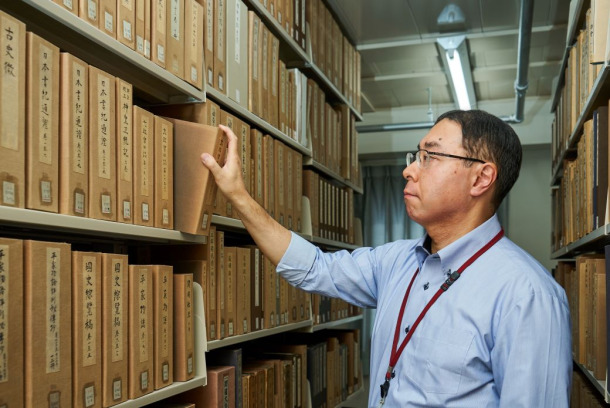
The special materials room's archives store the valuable documents that have been acquired.
--Finally, do you have a message for Waseda University students?
I hope you will have many encounters and experiences while you are at school. I believe that encountering books and materials in the library will be a treasure for all of you, so I hope you will make full use of the library.
I believe that physical materials have power. As a special materials room, we can't just show valuable materials to someone who just shows up and asks to see them, but I think it's very important to see physical materials for a bachelor's thesis or research. If you have such a clear purpose, I want to provide as much support as I can as a librarian.
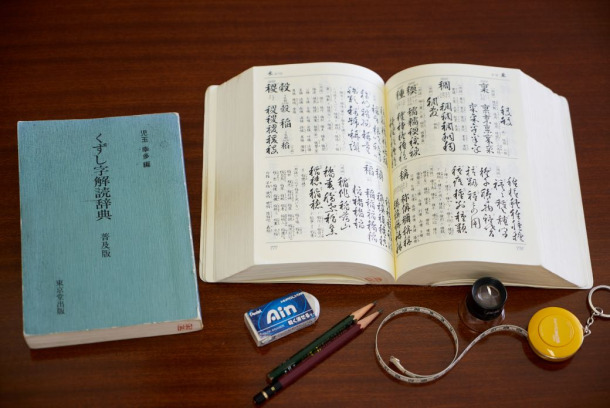
Shimada's work companions: research tools (pencil, eraser, measuring tape, magnifying glass, dictionary for deciphering cursive script)
Shimada
When handling old documents, using any writing instrument other than a pencil is strictly forbidden. Incidentally, I also take off my wristwatch when looking at documents, as it could potentially damage them. While there are now apps for deciphering cursive script, I still prefer using paper dictionaries.
Central Library Special Materials Room
Opening hours: Monday to Friday 9:00 to 18:30 (9:00 to 17:00 during school breaks). Closed on Saturdays and Sundays.
Location: 4th floor, Central Library, Waseda Campus
* For more details, please check the Central Library Website
Interview and text: Kyoko Suemitsu (Graduated from the School of Science and Engineering in 1998)
Photography: Seiji Ishigaki
Creating an environment where students can safely fail - Technical staff at the Science and Engineering Center
Technical Staff, Education Research Support Section (Section 3), Technical Administration and Technology Management Center for Science and Engineering
Yusuke Tanaka
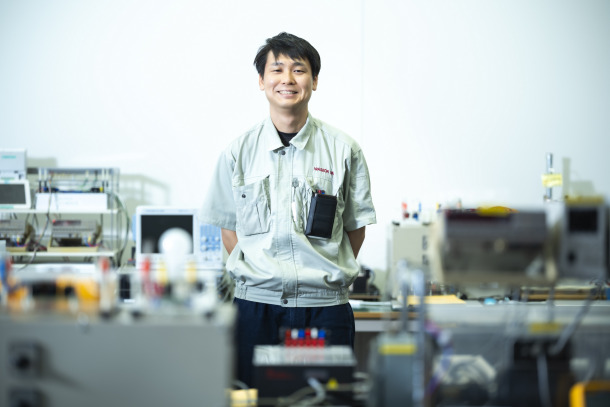
Room 11, B1F, Building 63, Nishi-Waseda Campus
--Could you tell me about your job responsibilities?
The Education Division (Research Support Section) comprises Divisions 1 through 4. Division 1 is responsible for interdisciplinary foundational experiments that are required for students in the three faculties listed at the Faculty of Science and Engineering (School of Fundamental Science and Engineering, School of Creative Science and Engineering, and School of Advanced Science and Engineering). In contrast, Division 2 handles specialized experiments for the Mechanical Engineering, Architecture, and Civil Engineering fields; Division 3 for the Electrical, Electronic, and Information and Communications fields; and Division 4 for the Physics, Chemistry, and Biology fields. The Electrical Engineering Laboratory in Division 3, to which I belong, is a facility where students from 11 departments conduct experiments tailored to their respective specializations.
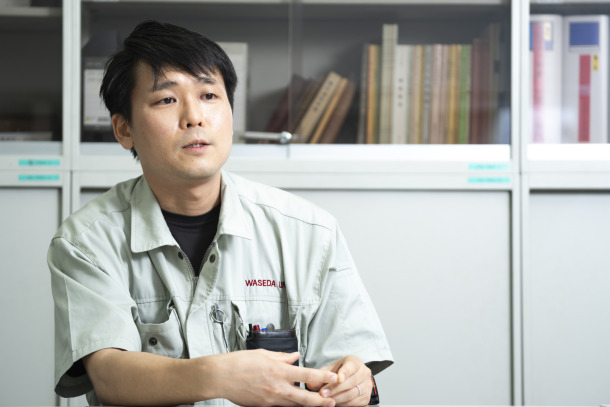
Within that role, I am responsible for the overall operation of the experiments, from developing and improving the experimental content to supervising the experiments and ensuring safety. I consult with the faculty members to plan the experiment content, prepare the materials, and guide students so that they can proceed to analyze the results. For example, I might have students perform a simulation before conducting the experiment, and if there is a difference in the results, I ask them to analyze the reasons for that difference.
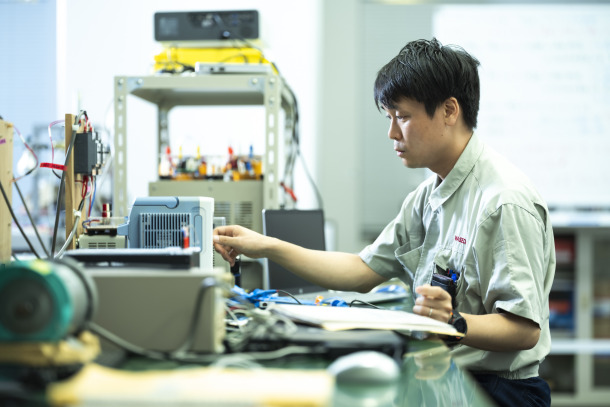
Tanaka adjusting the measuring instruments used in the experiment.
—What are your thoughts and feelings towards the students you work with?
We have created a safe environment where students can make mistakes without fear of injury or accidents, so we want them to approach experiments without fear of failure. When you conduct experiments, the results are often not what you expected, but we believe there is a lot to be learned from such failures. So, we are happy when students make all sorts of mistakes.
—When do you feel that you're glad you're doing this job?
We refine the experiment content every year through trial and error, so seeing students deepen their learning through the experiments is a very rewarding moment for us.
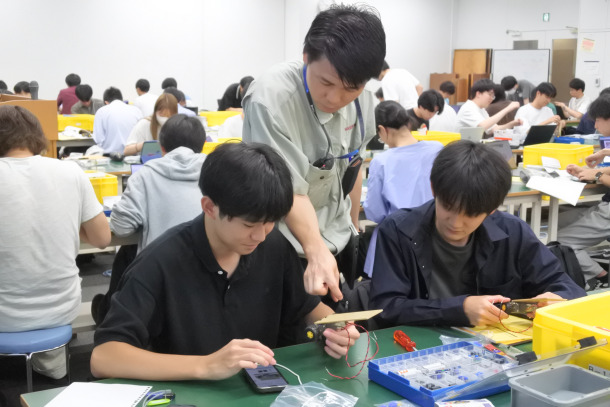
A scene from "Mechatronics Lab F," where students learn the fundamentals of mechatronics. Technical staff, including Tanaka, are providing experimental guidance along with the faculty members and teaching assistants.
In the WASEDA Monozukuri Program (hereinafter referred to as "MonoPro"), I sometimes advise student groups on technical matters as a mentor, but I also often receive motivation from the students themselves. One year, there was a student who wanted to "create a chair-like machine that automatically faces the auspicious direction of the year and supports silently eating an Ehomaki (a special sushi roll that is usually eaten facing a certain direction)." I didn't understand his reason for wanting to make it at first (laughs), but he was full of enthusiasm to move forward even if he lacked the necessary technical skills, and I felt the importance of having something you want to do.
—Could you share an anecdote about a student that left a lasting impression on you?
When I first got involved with MonoPro, I was in charge of a group of four students who were fighting over differences in direction. I watched over them, wondering what to do, but the four of them expressed their opinions to each other and in the end were able to unite and move forward. And at the end, they wrote me a letter of appreciation. I was surprised when I received it because I didn't think I had done anything significant, but I realized that providing a space where students are not overly interfered with by adults, but at the same time are being properly observed, is also an important role. Our value shouldn't be determined solely by what we can see from our side.
--Finally, do you have a message for Waseda University students?
Please don't hesitate to make mistakes. At the Faculty of Science and Engineering we want you to gain not only knowledge and skills, but also many things that can only be learned by getting your hands dirty. We believe it is our role to provide a safe environment for this and to offer support when you encounter difficulties, so we hope you will make full use of us and learn from your mistakes.
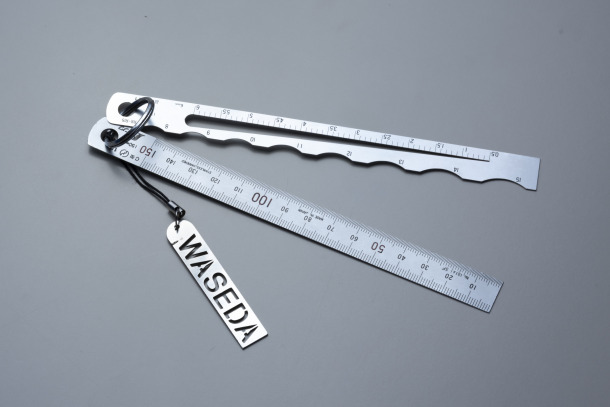
Tanaka's work partner: a metal ruler
Tanaka
It's a metal ruler, and I imagine a lot of people in mechanical engineering use it. When making things, you use it to measure the size of the object, and if you wear it, you can easily do simple measurements. I also sometimes use it as a cutter when opening packages, so it's quite handy (laughs).
Interview and text: Kyoko Suemitsu (1998 Graduate of the School of Science and Engineering)
Photo by Kota Nunokawa
[Next Special Issue Preview] "Waseda Cafe" to be released on Thursday, October 1st.
![[Save version] Map of the four main campuses](https://www.waseda.jp/inst/weekly/assets/uploads/2026/06/110d605cfac40346aad1d2df464a6586-940x705-1-1-610x457.jpg)