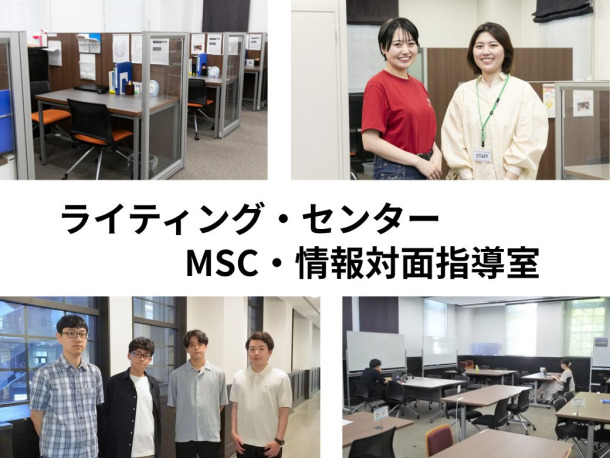
"I want to know the tricks to writing reports and papers," "I'm not good at math," "I'm studying data science, but I don't know how to study." Many students probably have these kinds of worries while taking classes. Waseda University's Global Education Center (GEC) has a support desk for Waseda students' learning. For writing, you can consult the Writing Center, and for mathematics, statistics, data science, and information, you can consult the Math and Stat Center and Information In-Person Guidance Office (MSC and Information In-Person Guidance Office). This time, we will introduce what kind of consultations you can get at these two desks and how to use them. If you are having trouble with your studies, feel free to use them!
▼Writing Center
▼MSC Information Face-to-Face Training Room
Writing Center
For advice on writing reports and papers, graduate student tutors trained in writing instruction will provide individual support. We accept writing at any stage, so it doesn't have to be the final draft. This service is free for Waseda University students and Faculty. We also offer multilingual support for Japanese and English documents.
*Documents related to job-hunting are not applicable.
Writing Center Tutor
Sana Nimura, 4th year doctoral student, Graduate School of Asia-Pacific Studies
Waseda Weekly Student Staff
Nagisa Nishimura, 4th year student, School of Culture, Media and Society
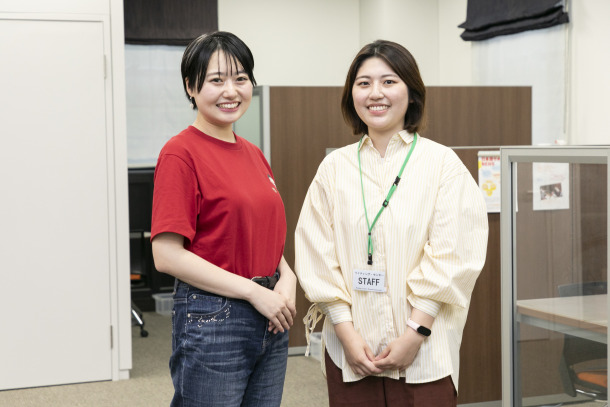
At the Writing Center on the 2nd floor of Building 3 on Waseda Campus. From left: Nishimura and Nimura. This time, student staff member Nishimura will be experiencing a session at the Writing Center.
What is a Writing Center Tutor?
—What kind of training do the tutors receive?
After taking a six-month graduate course called "Academic Writing and Instruction" (a GEC-sponsored course), and if your writing ability is deemed to exceed a certain standard, you will be interviewed and become a new tutor. Even after becoming independent, you continue to hone your skills through weekly training sessions on Mondays. While you will have mastered writing techniques by the time you become a tutor, you will continue to learn every day how to handle various types of writing and how to communicate with writers.
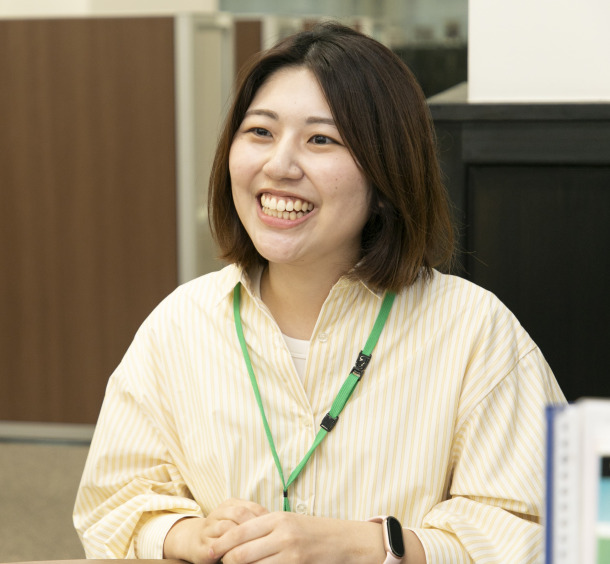
Nimura researches how teachers should interact with children from diverse cultural backgrounds. She has over three years of experience as a tutor.
—What kind of writing do you give advice on?
It varies depending on the time of year. Study-abroad documents tend to cluster around the time applications are due; end-of-semester deadlines are dominated by course reports; and the end of the academic year sees a concentration of deadlines for graduation theses and master's theses. It gets especially busy at the end of the semester. We also handle presentation scripts. Some people even come in the day before or on the day of the deadline.
—So you can still help me even if I show up that close to the deadline?
It's okay! I think it's wonderful that you've even come to the center for advice. I see it as proof of your motivation, and I want to respond to that in any way I can. I'll listen to what you're having trouble with, discuss how much you can accomplish by the deadline, and work together to help you create the best possible piece of writing.
—What do you keep in mind as a tutor?
At the center, we prioritize nurturing "independent writers," and therefore we make it a point to "respect the writer's perspective." Rather than unilaterally instructing on writing techniques, we carefully listen to the writer's intentions and work together to create writing that is easy for them, so that they can deepen their own thoughts through writing.
Experience a real session!
Nishimura, a student staff member of Waseda Weekly, experienced a writing session at the Writing Center.
Nishimura:
I used their services a few times during my first year, but back then I thought they only reviewed completed papers, which gave me the impression that it was a high hurdle. But this time, I was surprised to learn that they can even help with brainstorming before you start writing! I need to start writing my bachelor's thesis (hereinafter referred to as "thesis") seriously soon, so I decided to try a session.
First, make a reservation.
To use the service, please make a reservation in advance through MyWaseda. For more details, please check the Writing Center website.
To the Writing Center
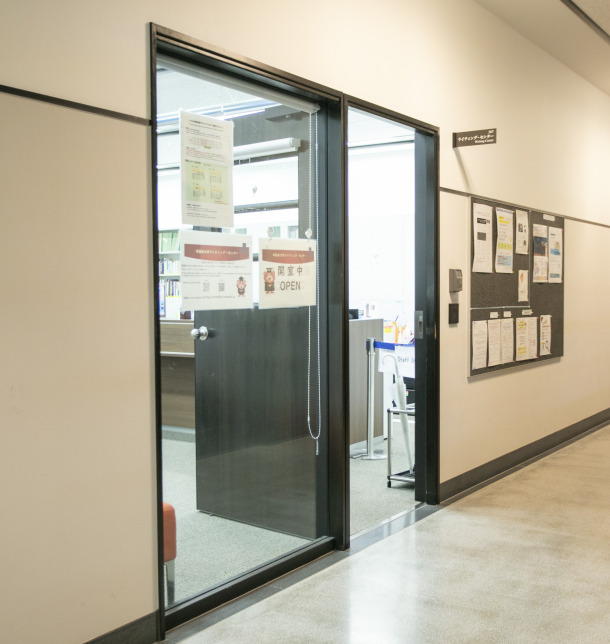
The entrance to the Writing Center, located on the second floor of Building 3 on Waseda Campus. There are also Writing Centers at the Nishi-Waseda and Tokorozawa Campuses.
Please arrive at the center at least 5 minutes before your scheduled appointment time. You will submit the document you would like the reception staff to review. Don't forget to print it out in advance and bring it with you!
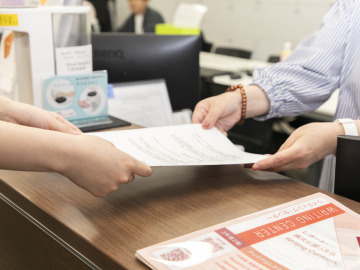
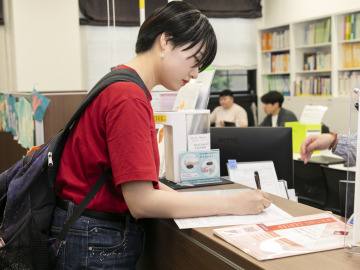
Photo on the left: Please submit the printed document to the reception desk.
Photo on the right: If there are vacancies on the day, you can use the service by filling out an application form at the reception desk without prior reservation.
Session start!
1. Confirmation of the consultation details
I went to the session booth with my tutor. Since each session is limited to 45 minutes, they efficiently elicited information about "the content of the document to be reviewed" and "the client's questions."
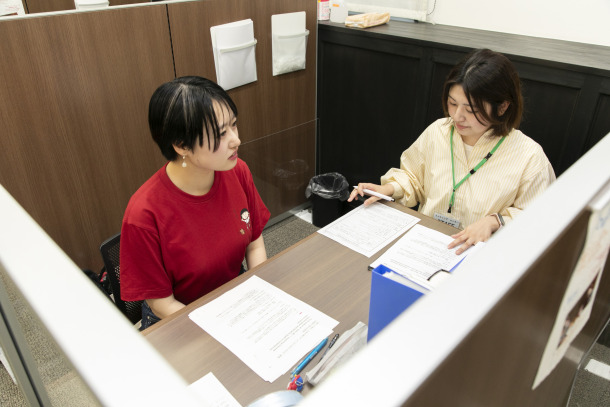
This time, Nishimura prepared a document outlining the graduation thesis she will submit in December. She wanted to ask for advice on three points: "Does this make a proper graduation thesis?", "How should I conduct a case study (*)?", and "Can I cite social media and other sources as academic documents?". Meanwhile, Nimura asked questions about the requirements and rules for graduation theses, such as the required length and instructions from the Faculty. Together, they confirmed that Nishimura's graduation thesis has the requirements of "more than 8,000 words in English" and "citing more than 15 sources."
* "Case study" refers to a research method that uses a variety of real-life cases as material for analysis and examination.
2. Have the tutor read the text aloud.
Before Nimura read the text, she requested that Nishimura explain its contents. By explaining it herself, the person seeking advice can also confirm the content again.
Nishimura's research topic is Japanese anime, and Nimura commented, "That's a really interesting topic!" Nishimura seemed a little more relaxed. While Nimura read the text, Nishimura was instructed to pick out the parts that described the purpose of the research and to check any points that caught her attention when she reread it. The time spent reading the text at the beginning of the session is also an important time for the writer to reflect on their own writing.
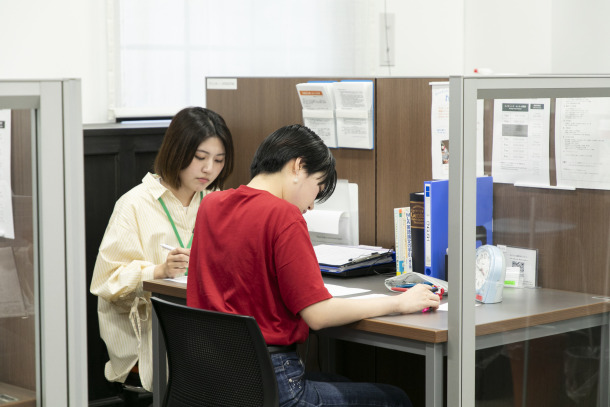
3. Examination of the points of concern
After finishing reading, Nimura commented, "I felt that it was written with a clear awareness of the academic paper format. It contained insightful content that made me think, 'I've never considered this perspective before,' and I think it will make an interesting paper!" Nishimura also clarified her questions after rereading the text, and after discussing it together, they decided to examine the following points in this order: ① "How to write a paper and the process" ② "Is it in the form of a graduation thesis?" ③ "Methods of citation" ④ "Case studies."
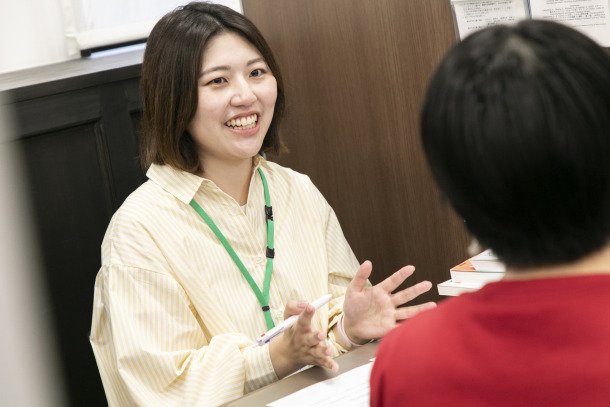
During the session, Nimura asked a series of questions to draw out Nishimura's thoughts. Nishimura had been told by her Faculty to include "content that will capture the reader's interest" at the beginning of her thesis, and she was struggling with how to do that. However, when Nimura asked her, "What kind of writing would capture your interest?", Nishimura's thoughts gradually became clearer, and she replied, "Perhaps something unexpected?" Furthermore, when asked, "This part is unexpected, but is it written in a way that someone reading it for the first time can understand?", Nishimura herself suggested, "I should explain the scope of my research more clearly."
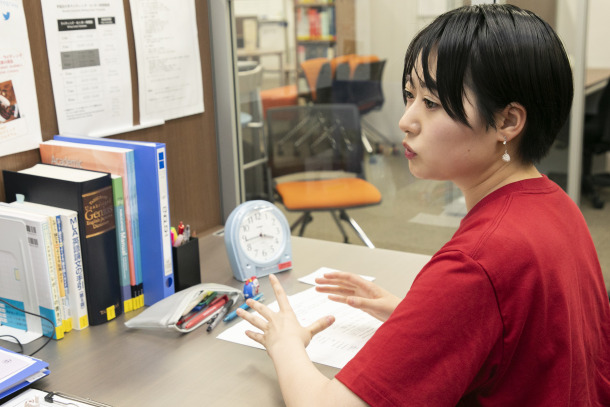 Furthermore, when Nishimura was unsure what tool to use to organize her citations, Nimura suggested a specific method: "It depends on your preference, but some people paste information into Excel, Notion, or Word." This kind of advice, which isn't necessarily something you'd consult your academic Faculty about, but is actually helpful when you're writing, is one of the attractions of the Writing Center.
Nimura
I find it rewarding when, during a session, the writer themselves realizes, "This part should be changed like this." It's easy to unilaterally point out, "I don't think this is right," but in order to cultivate the writer's writing ability, it's very important for them to realize it themselves.
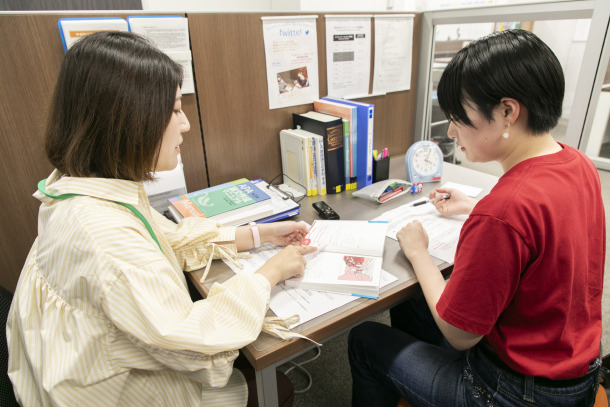
4. Identifying future challenges
As the session drew to a close, we reviewed the challenges for the future. In Nishimura's case, the conclusion was that she needed to deepen the content by summarizing the introduction and background of his research in the introduction, and to properly structure her paper. To that end, her challenge became to read through a large amount of previous research literature while simultaneously considering the structure. This concluded the session.
You can get copies of any materials the tutor presents during the session, which will be helpful when working on assignments in the future.
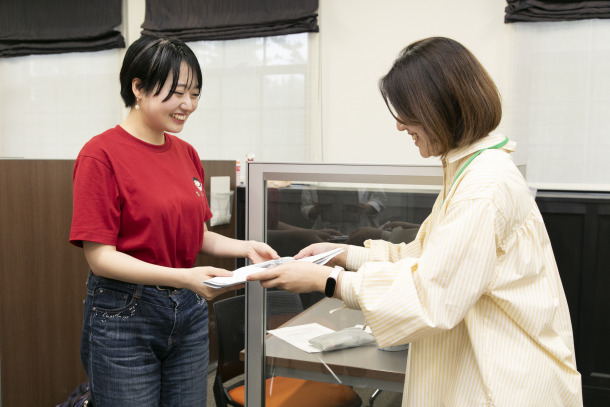
Nishimura:
Thanks to all the questions I received, such as "What does this mean?", I was able to figure out the direction I should be heading in with my writing. I got the impression that they really valued what I wanted to write about, rather than just giving me instructions. Today we discussed the outline, so I ended up asking questions from many angles, but next time it might be better to narrow the topic, perhaps just focusing on the introduction. I've now confirmed that I'll be visiting the Writing Center until I submit my graduation thesis!
Nimura
Some people may feel hesitant about having their writing reviewed, but our tutors are professionally trained, and I myself am a writer, so I know firsthand how difficult writing can be. Therefore, I hope you'll come along with a casual attitude, like, "Maybe I'll just give it a try!"
Interview and text: Kyoko Suemitsu (Graduated from School of Science and Engineering in 1998)
Photo: Chihiro Hashimoto
Writing Center
<Opening Hours>
Monday to Friday 9:45 AM to 4:40 PM (excluding Monday 12:30 PM to 1:45 PM)
<Location>
● Waseda Campus: Room 209, 2nd Floor, Building 3
● Nishi-Waseda Campus Office: Room 201, 2nd Floor, Building 60
● Tokorozawa Campus Office: Tokorozawa Library Learning Commons (Support Area), 4th Floor, Building 100
* Online sessions are also available. For details, please see below. Writing Center Website Check
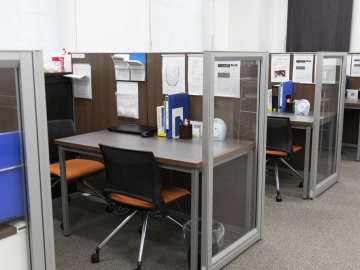
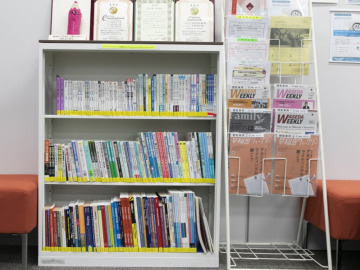
Photo on the left: The individual instruction session booths are equipped with glass partitions to prevent a feeling of confinement.
Photo on the right: The bookshelf near the reception desk is filled with books useful for writing academic documents. You can drop in and read them whenever you like.
MSC/Information Face-to-Face Instruction Room
At the Math and Stat Center (MSC), Learning Assistants (LAs) are always on standby to provide individual support for questions regarding mathematics, statistics, and data science, while at the Information Instructor's Office, they are available to answer questions about information science and other subjects.
* The Information Technology In-Person Guidance Room is only available to students enrolled in designated courses, and advance reservations are required.
MSC Mathematics LA
Ko Takahashi, 2nd year master's student, Graduate School of Education
MSC Data Science LA
Toshitaka Yakou, 4th year student, School of Political Science and Economics
Information Instructor Office LA
Sogo Kase, 2nd year master's student, Graduate School of Fundamental Science and Engineering
Iori Endo, 2nd year master's student, Graduate School of Fundamental Science and Engineering
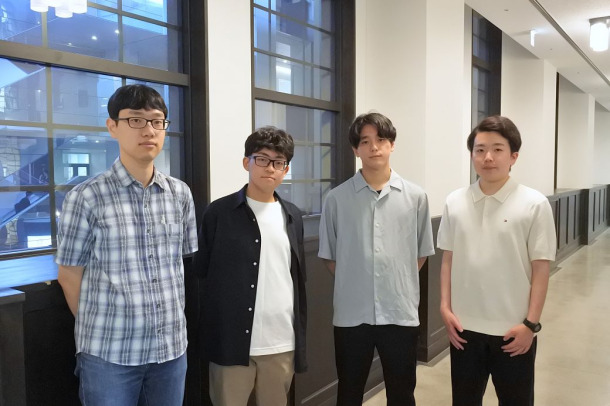
In front of the MSC/Information Instructor Room on the 2nd floor of Building 3 on Waseda Campus. From left: Takahashi, Yakou, Endo, and Kase.
What is MSC?
—What kind of consultations can I get?
Takahashi: I'm in charge of mathematics, and I mainly answer questions about "Basic Mathematics Plus" (a subject offered by GEC). I also receive many requests for information on the mathematics courses offered by each faculty, and I handle those as well.
Yakou: I'm in charge of data science, and in addition to answering a wide range of questions about GEC's data science courses, I also provide advice on statistics courses offered by each faculty.
— Is there anything I should prepare before consulting?
Takahashi: There's nothing in particular, but please note that I can't answer questions on quizzes or drills. In that case, if you can find similar problems in textbooks or elsewhere, I'll explain how to approach those problems.
—Could you tell us about some actual consultations you've received and the process you went through to resolve them?
Yakou: Data science is a fusion of statistics and programming, so we get questions from both fields. For example, when it comes to questions about statistics, I often explain it using familiar examples like the random item distribution in smartphone games, or what's known as gacha, and people seem to understand. We also provide thorough support for programming-related consultations, starting from the basics.
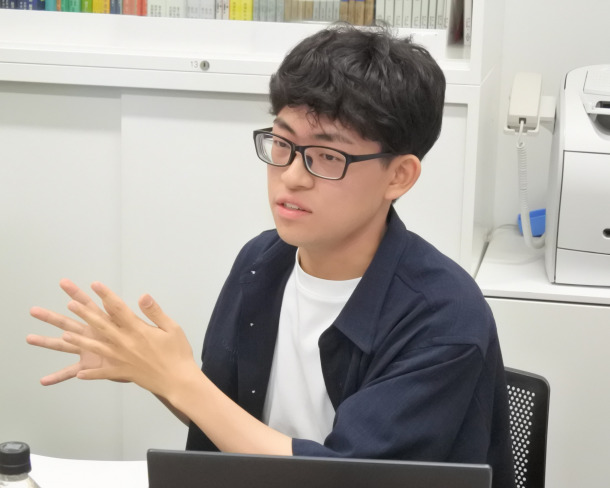
Yakou is a member of a statistics seminar. He is researching how to predict cherry blossom blooming dates based on state-space models.
Takahashi: I received a question from someone who found matrix calculations complicated and couldn't figure out where they went wrong. In those cases, I use a whiteboard and first have the questioner write down their solution. During that process, I ask them "Why did you do it this way?", which makes it easier for them to understand where they went wrong.
—What are some things you keep in mind as an LA representative?
Yakou: I make sure to avoid using technical jargon so that the questioner can easily understand. It's also good practice because it deepens my own understanding.
Takahashi: I want them to arrive at the answer themselves, so I try to ask a lot of questions and encourage them to think a lot.
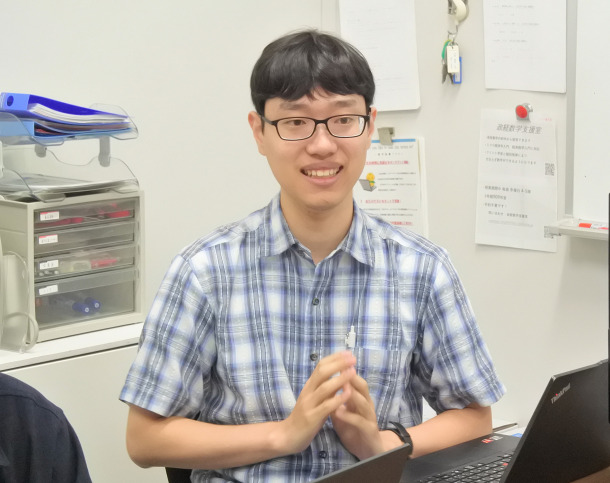
Takahashi, a student majoring in mathematics education, researches pure mathematics, particularly commutative ring theory within the field known as algebra.
-- Do you have a message for students who have never used it before?
Yakou: No appointment is necessary for MSC, so please feel free to come and ask questions if you have any. Let's work hard to earn those credits!
What is the Information In-Person Guidance Room?
—What kind of consultations can I get?
Kase: This service is for students enrolled in the following designated courses, and we will answer any questions you have regarding these courses. At the start of classes, we receive many questions about setting up your learning environment before tackling assignments and tests, PC setup, and WasedaMoodle, but from summer onwards, we see an increase in questions about assignments. You need to make a reservation through WasedaMoodle to consult with us.
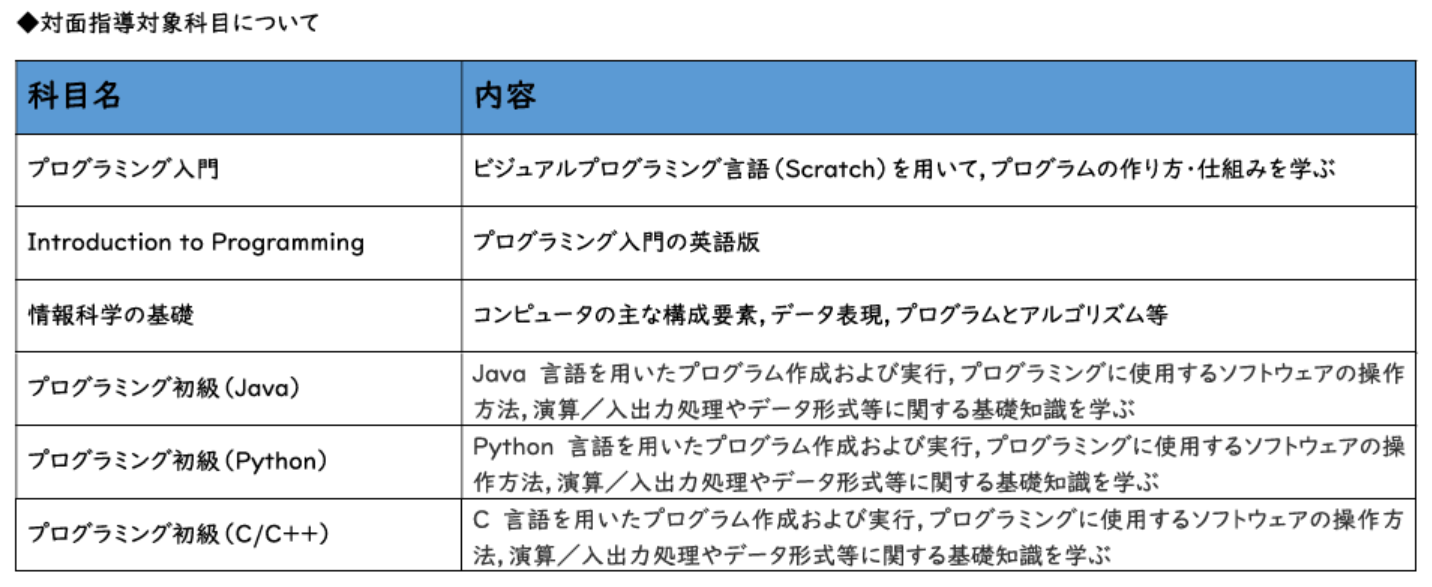
Subjects covered by the Information Technology In-Person Guidance Office. (Click to enlarge)
— Is there anything I should prepare before consulting?
Kase: We use PCs a lot in class, so it's fine if you bring your own PC.
—Could you tell us about some actual consultations you've received and the process you went through to resolve them?
Endo: There's a tool called Command Prompt that uses commands to perform various operations, but it can be difficult to understand for those unfamiliar with it, and I had a student come to me for advice because they were having trouble executing a file. However, simply telling them what needed to be corrected would be the end of it, so I taught them how to interpret the information written in the file and how to think about it so that they could execute the file on their own.
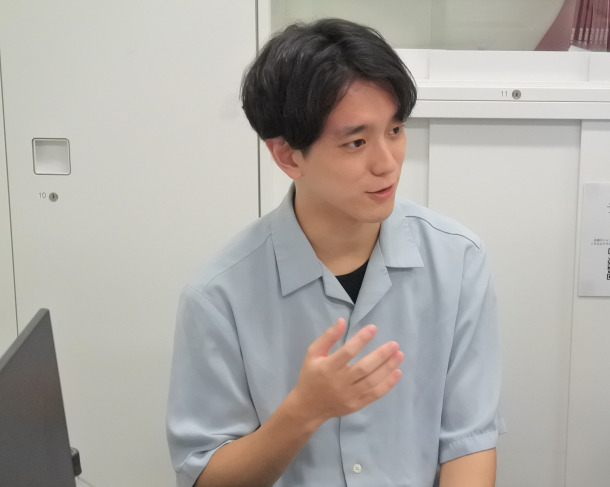
Endo, a student in the Department of Information Science and Engineering and Information and Communication Engineering, is researching ways to improve the quality of discussions by visualizing and sharing the content of those discussions in real time.
—What are some things you keep in mind as an LA representative?
Endo: Simply giving the correct answer means that the person will just take the answer home and that's the end of it. So, I make it a point to work with them to think through the process and support them so that they can arrive at the correct answer on their own.
-- Do you have a message for students who have never used it before?
Kase: Reservations are required, but it's not usually crowded, so you can use it whenever you like. Feel free to use it for anything related to the subject!
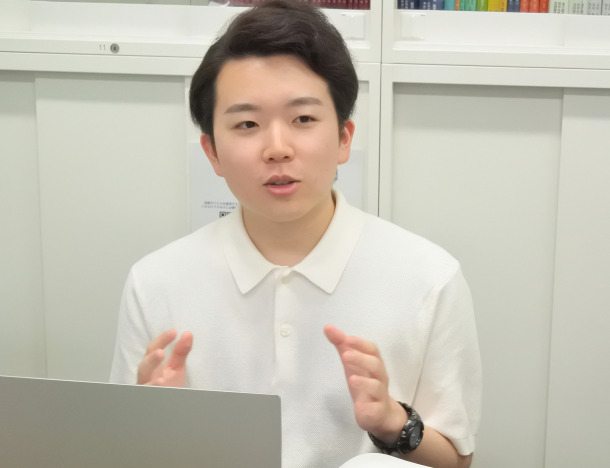
Kase, a student in the Department of Information Science and Engineering/Information and Communication, is researching the development and evaluation of a VR system to support the learning of archery form.
MSC/Information Face-to-Face Instruction Room
<Opening Hours>
Monday to Saturday during the academic term, 9:30 AM to 6:00 PM
* Closed on Sundays and public holidays when there are no classes.
* For detailed opening hours see here
<Location>
Room 208, 2nd Floor, Building 3, Waseda Campus
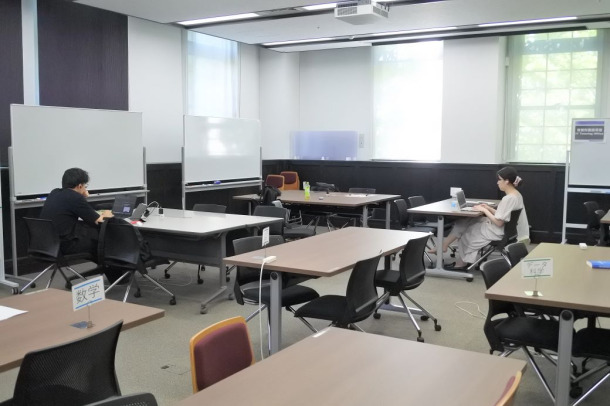
A view of the MSC Information Instructor Room. Instruction can be received in a spacious lounge area.
Interview and text: Kyoko Suemitsu (Graduated from School of Science and Engineering in 1998)
[Next Special Issue Preview] "Various Careers" to be released on Monday, June 29th
![[Save version] Map of the four main campuses](https://www.waseda.jp/inst/weekly/assets/uploads/2026/06/110d605cfac40346aad1d2df464a6586-940x705-1-1-610x457.jpg)