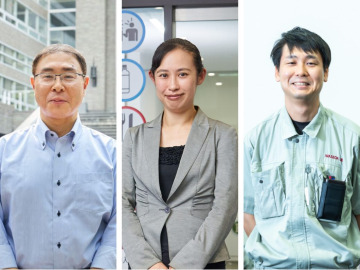
From left to right: Sato, Tanabe, Goto, and Sugimura.
"I wish I could make a living doing what I love." "No, work is a different matter. Salary and benefits are important." "I don't want to compromise on either the job content or the salary!" When faced with the major career decision of "job hunting," what will you base your job search on? This time, we interviewed two alumni who chose to make their passions their jobs, and two alumni who enjoy their hobbies in their free time, separate from their work. These four people, from completely different industries and occupations, shared how they went about their job search, what kind of lives they lead as working adults, and how they enjoy their holidays. Whether you're about to start job hunting or have already decided on a job, please use this as a reference.
INDEX
▼Turning your passion into a job? How to enjoy your time off?
▼Job hunting event hosted by the Career Center
Turning your passion into a career? How to enjoy your time off?
What kind of student lives did these four alumni have, and how did they approach job hunting? We asked them about their lives as working adults, balancing their careers with their hobbies.
Keiin Goto, employed at Kao Corporation, graduated from the School of Commerce in 2022.
Sou Sugimura, employed at MIXI, Inc., graduated from the School of International Liberal Studies in 2025.
Risaki Sato, employed at a publishing company, graduated from the School of Human Sciences in 2024.
Saya Tanabe, employed at an entertainment company, graduated from the School of Culture, Media and Society in 2025.


*Click to enlarge
The "core values" I cherished during my job search
—What were the key points you focused on when going through the job hunting process?

Tanabe
Sato: Ever since I was a child, I vaguely thought, "I want to work for a media company!" As I wrote articles as a student staff member for Waseda Weekly and worked part-time at a publishing company, my desire to do this kind of work more seriously grew stronger. That became the core of my thinking when considering my career path.
Tanabe: I love music and wanted to work in the music industry. However, I knew that the music industry had a small number of positions available for new graduates, so I applied to a wide range of industries. I received job offers from companies outside the music industry as well, but I felt that I could get ideas for my work from my hobby, and I decided that if I was going to dedicate five days a week, or more than eight hours a day, to something I loved, I could work harder at it.
--Goto and Sugimura, who chose their jobs by separating their on-time and off-time, what criteria did you use when going through the job hunting process?
Goto: I decided on three core criteria through self-analysis and applied to companies that fit those criteria. First, I wanted to be confident in the company's products and services. Second, I wanted to work with dedicated colleagues. Third, I wanted to be able to improve the quality of life for people all over the world through my work. After traveling to various countries, I realized that the sanitation standards that are taken for granted in Japan are not a global standard. If I was going to work anyway, I wanted to work for a company that could address these kinds of social issues.

Sugimura
Sugimura: In my case, I was able to speak English thanks to my parents' emphasis on English education, but I had never stayed abroad for an extended period until I entered university. So, when I went to university, I decided to go to a place unfamiliar to Japanese people and studied at the University of Warsaw in Poland. At that time, I had so many opportunities to be treated kindly just because I was Japanese. When I realized that this was a blessing from those who came before me, I thought that next I wanted to do work that would enhance Japan's value internationally, so I aspired to work for a trading company or in the entertainment industry.
I chose my current company because I realized that the structure of "planning concerts and making people happy," which I did in the Waseda Symphony Orchestra during my student days, and "planning entertainment events and making people enjoy themselves" are not that different. It felt like a perfect fit for me.
Once you become a working adult, you realize the optimal balance between your passions and your work.
— Sugimura and Goto, did you have the option of turning your student passions into your careers?

Goto
Goto: Of course, I did consider it, but I wanted to pursue a long-term dream of doing work that I could be proud of when I have children or become a grandfather. I decided on this path with the hope that my work could make the world a little richer.
Sugimura: I considered becoming a musician, but I felt that the possibilities of what we can do expand when so many people come together, like in the Waseda Orchestra, which has over 300 members. So I thought that I could utilize my abilities by working in a company, which is an organization with many people.


Photo on the left: Sugimura during his student days. He played the trombone and served as the representative of the Waseda Symphony Orchestra.
Photo on the right: During a rehearsal for a concert at the Nagoya Arts and Culture Center. He joined as a last-minute replacement after becoming a working adult in 2025.
—Since starting your professional life, have you found it beneficial to separate work and personal life?
Goto: I feel very fulfilled right now! By completely refreshing myself during my time off, I can give my all when I'm on duty, and I'm enjoying both sides of it. On the other hand, I was worried that if I turned my "passion" into my job, I might not be able to love what I love when something unpleasant happens at work, so I feel that my current situation suits me.


Photo on the left: Goto, in his first year at the company, climbing Mt. Fuji with his colleagues (center in the photo).
Photo on the right: In front of the pyramids during a trip to Egypt, when he was in his fourth year at the company. He has traveled to more than 30 countries so far.
Sugimura: What about Tanabe and Sato?

Sato's bachelor's thesis presentation. She majored in psychology.
Sato: Among my "likes," the one thing I feel I'm good at is writing. I feel incredibly fortunate to be in an environment where I can further develop that skill by using it every day as part of my job.
Tanabe: In my case, I'm grateful to be in an environment where all my colleagues and seniors love music. I can have lively conversations about music with seniors in their 50s and 60s, and seeing how seriously they approach music in their work has given me a goal to strive for, to be like them.
The difficulty of turning your passion into a job, and the difficulty of continuing a hobby.
—When your passion becomes your job, doesn't it sometimes blur the lines between work and personal life?

This photo shows Tanabe playing in a band as part of her student club activity during her student days (Tanabe is the one playing guitar on the far right).
Tanabe: That's true (laughs). When I listen to music as a hobby, I'm often intuitively drawn to things like what kind of music is cool or the unique aesthetic of a band, but at the company, we think from the perspective of "selling music," so instead of just respecting the artist's intentions, there are times when I have to give my opinion on measures that should be taken to make the music known to a wider audience.
Lately, when I discover new artists on social media, I can't help but think about it from a business perspective, like, "They're really good at promotion," and I might be losing the ability to purely enjoy it...
Sugimura: I totally understand! If I had become a musician, I think I would have struggled because my desire for self-realization and the direction the business was heading would have been different. So, I think working in product development under a company's shared philosophy of wanting to entertain users suited me.
—But when work gets busy, doesn't it become difficult to find time for your hobbies?
Sugimura: You have to make time! I confidently declare to the company, "I'm taking this day off because I have a concert." I approach my work with a strong sense of purpose, knowing that I'm working for that purpose.
Goto: You're absolutely right (laughs).
Sato: My company is also fully flexible, but when it's busy, I sometimes end up working late into the night. Because my work involves a wide range of tasks, from book planning to promotion, I'm given a lot of autonomy, so I sometimes end up spending too much time on things I enjoy.
Tanabe: It's true that when work becomes enjoyable, it's easy to lose track of what's on and off, but after working for a year, I've really come to realize that I need to take at least a minimum amount of rest (laughs).

--So, could you tell us about your goals for the future, both in your work and personal lives?
Goto: Kao is known to almost everyone in Japan, but it's not so well known overseas in some countries and regions. That's why I have a dream to deliver Kao's wonderful products and services to the world and improve the quality of life for people around the globe, even if only a little. In my free time, I want to continue cross-cultural exchange through travel and other means, meeting cultures and people I don't know in various countries and broadening my horizons.
Sugimura: I believe that "how you communicate things" is important both on and off the job, so in my work, I want to become a marketer who can communicate effectively. Off the job, I've recently been organizing an amateur orchestra for working adults, mainly with graduates from my graduating class of the Waseda University Orchestra. We think there are things that only an amateur can do, such as concerts where it's okay if children make noise or cry, or concerts that are easy for classical music beginners to attend. We plan to hold a concert in January 2027, after booking a hall.


Photo on the left: Goto posing in front of the company logo.
Photo on the right: Sugimura, who often uses the company cafeteria with its great view during his lunch break.
Sato: The publishing industry is in a pretty tough situation, but even so, there are surprisingly many books that are selling well. I want to become an editor who can create projects that are so valuable that people will want to buy them specifically because they are books, so that the books I plan will become hits.
Tanabe: There are many people creating wonderful music who haven't yet been discovered by the public, so my goal is to help them make a living from music. I want to continue working hard on my band activities in my free time, while also giving my all to my company work, and explore ways to do both. I hope to become someone who can give back to the music I love throughout my life.

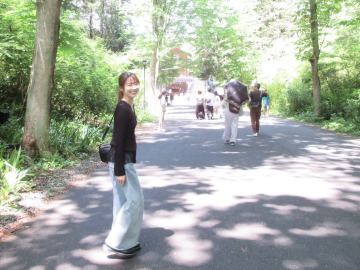
Photo on the left: Checking the proofs. Sato's work tools, along with her essential red and blue pens.
Photo on the right: Tanabe on a day off, when she went to the park with a friend.
--Finally, please give a message to Waseda students.
Goto: At first, you might not know how to choose a company, but try to imagine whether you can enjoy working there in the medium to long term. I think it's also necessary to listen to the voices of people who are already working there, not just the information from the company, to bridge any gaps.
Sato: In any case, try to attend as many information sessions and interviews as possible. You may feel a gap between your expectations and reality even after you start working, but at times like that, I think it's important to keep thinking about "how you want to work" and "what would make you happy."
Sugimura: Even if you get into your desired company, the content of your work and your work style will change depending on the department you are assigned to, so I think it is necessary to constantly proactively re-examine your own values and continue to communicate what you want to challenge yourself with. Always reflect on whether you are looking for fulfillment or money in your work, and make choices that will enrich you both mentally and physically.
Tanabe: A company is a business, so you can't just do what you want to do, and there are many times when a different approach is better than what you think. If you're wondering whether to turn your "passion" into a job, I think you can make a choice you won't regret if you ask yourself if you're prepared to compromise your feelings about what your "passion" is even if it means continuing to love it!


We asked them to bring their work essentials. From left to right: a smartphone to check how information reaches consumers (Goto), a PC for managing various tasks (Sugimura), an iPad used for proofreading (Sato), and business cards and a business card holder, indispensable for introductions (Tanabe).
Job hunting event organized by the Career Center
Waseda University's Career Center is holding events related to job hunting. Please check the Career Center website for details.
*Click to enlarge
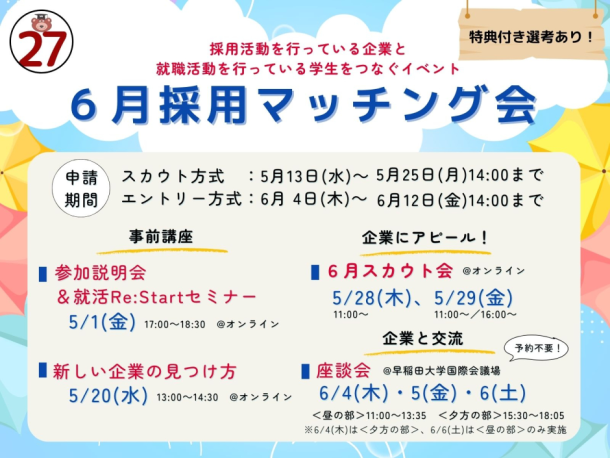
<For 2027 Graduates> June Recruitment Matching Event
Target: 2027 Graduates, and graduates/postgraduates within the last three years.
Purpose: This event is designed to match students who do not yet have a job offer or are still actively job hunting with companies. In 2026, 83 companies are expected to participate, and roundtable discussions will be held. Participants can take part in both the "Entry Method" and the "Scout Method," and will be eligible for selection with special benefits.
Dates: June 4th (Thu) - 6th (Sat) (Company Greetings & Roundtable Discussion)
Location: Waseda Campus International Conference Center (In-person event)
<For 2028 Graduates> Recruitment Selection Experience Series
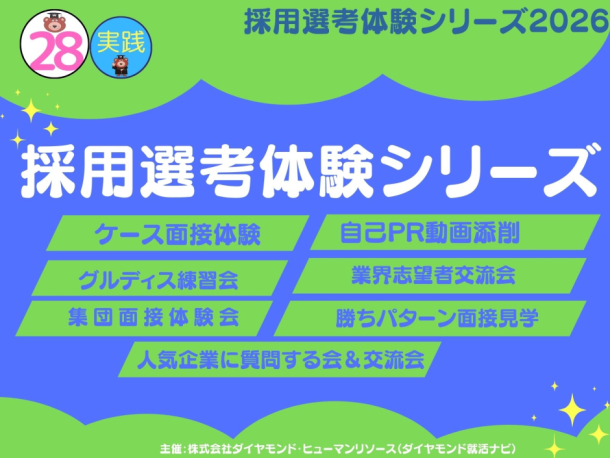 Target: 2028 Graduates
Objective: We will hold workshops on multiple themes, such as group discussions and case interviews that frequently appear in the final selection process, as well as popular industries (general trading companies, advertising), allowing you to experience them together with students from other universities.
Dates: Multiple sessions held throughout June
Location: Online (with some in-person sessions only)
* The operation is outsourced to an external company.
<For applicants taking the 2026 exam> Public Service Interview and Government Office Visit Preparation Course (Practical Session)
 Target: Those planning to take the civil service examination in fiscal year 2026.
Objective: External instructors will act as interviewers, conducting mock interviews that closely resemble the real thing. The goal is to provide students with ample preparation through interview practice and feedback from instructors, enabling them to approach the actual interview with confidence.
Date: Saturday, June 6th
Location: Toyama Campus Waseda University Student Center 3rd Floor Career Center Seminar Room (In-person event)
Career Center Website: https://www.waseda.jp/inst/career/
Interview and text: Kyoko Suemitsu (1998 Graduate of the School of Science and Engineering)
Photo by Kota Nunokawa
[Next Focus Preview] "Karuizawa Seminar House" opens June 8th (Monday)
▼Check out what a typical day was like for the four people we interviewed!



![[Save version] Map of the four main campuses](https://www.waseda.jp/inst/weekly/assets/uploads/2026/06/110d605cfac40346aad1d2df464a6586-940x705-1-1-610x457.jpg)