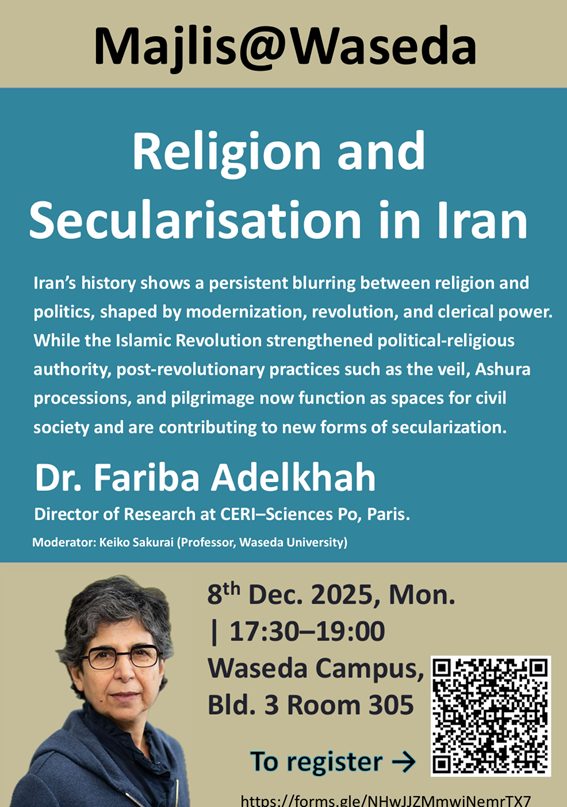
We are excited to announce that the Chair of the State of Qatar for Islamic Area Studies at Waseda University will be organizing the Majlis@Waseda on Dec.8, 2025.
We would like to share with you some important details about the event:
Dr. Fariba Adelkhah
Director of Research at CERI–Sciences Po, Paris.
December 8, 17:30-19:00 (Monday)
Waseda University Building 3, Room 305
Like European societies, Iran has experienced a continuous blurring of the distinction between religion and politics over the past few centuries and up to the present day. This isn’t to imply that Islamic society neglects the distinction between religious and political matters, subordinating the latter to the former. The two categories are well understood, and the autonomy of political power from the religious sphere is accepted, even by most spiritual authorities.
Nevertheless, within the context of the colonial expansion of Europe and the quasi-ecclesiastic institutionalization of Iranian Shiism, the defence of Dar al-Islam often went hand in hand with that of the Qajar empire. The tobacco revolt in 1891 and the constitutional revolution in 1906-1909 highlighted the confusion between the two spheres, not to mention the tensions and conflicts it arises from it. Similarly, many of the intellectuals who helped create the authoritarian modernization of Iran in between the two wars were clerics. Despite his secularism, Reza Shah has consistently supported the Iranian clergy and assisted them in transforming Qom and Mashhad into prosperous religious fields that can compete with Atabat in Iraq. More over Shiism became a national religion under his leadership. On many levels, his son will continue this policy of alliance with the Clergy in the aftermath of the Second World War.
The Islamic revolution was not unavoidable, nor was the Islamic Republic. The majority of clerks chose to stay away and maintain their distance from the new regime. The 1979 revolution was actually taken over by Khomeyni’s politico-religious faction, similar to the Bolsheviks taking over the Russian Revolution.
Their dominance enabled the government to recognize state reason above religious reason, leading to the formation of Expedience Council (Shorây-e Maslahat-e Nezêm) and a gradual secularization of the society.
However, it should not be concluded that there has been a decline in religiosity, since it borrows new forms. Despite the confusion, the religious practices in post-revolutionary Iran, such as, the veil, the processions of Ashura or pilgrimage, seem to become at the same time an opportunity of the development of civil society and a field of secularisation.
Please pre-register if you wish to attend at: https://forms.gle/NHwJJZMmwjNemrTX7