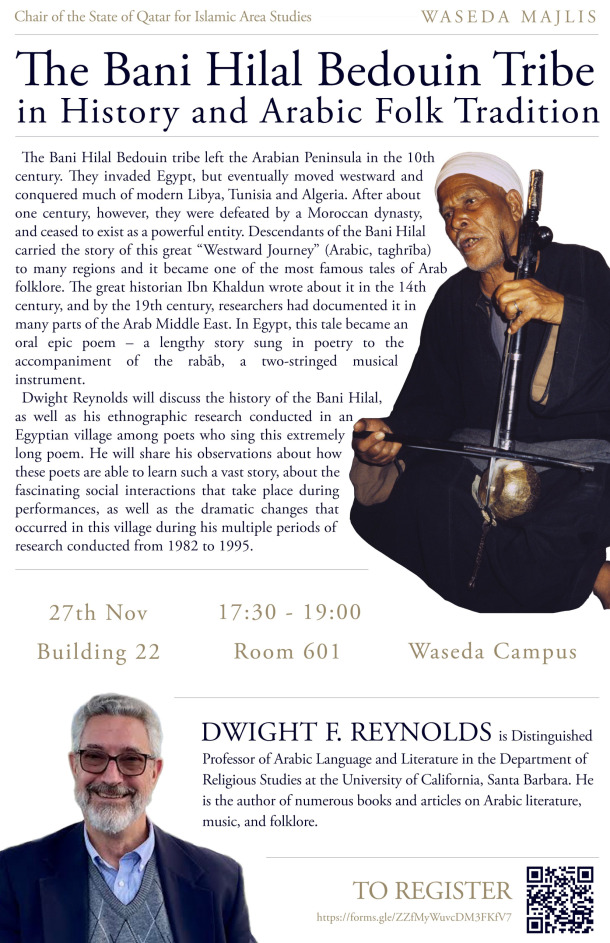
The Bani Hilal Bedouin tribe left the Arabian Peninsula in the 10th century. They invaded Egypt, but eventually moved westward and conquered much of modern Libya, Tunisia and Algeria. After about one century, however, they were defeated by a Moroccan dynasty, and ceased to exist as a powerful entity. Descendants of the Bani Hilal carried the story of this great “Westward Journey” (Arabic, taghrība) to many regions and it became one of the most famous tales of Arab folklore. The great historian Ibn Khaldun wrote about it in the 14th century, and by the 19th century, researchers had documented it in many parts of the Arab Middle East. In Egypt, this tale became an oral epic poem – a lengthy story sung in poetry to the accompaniment of the rabāb, a two-stringed musical instrument.
Dwight Reynolds will discuss the history of the Bani Hilal, as well as his ethnographic research conducted in an Egyptian village among poets who sing this extremely long poem. He will share his observations about how these poets are able to learn such a vast story, about the fascinating social interactions that take place during performances, as well as the dramatic changes that occurred in this village during his multiple periods of research conducted from 1982 to 1995.
Dwight F. Reynolds is Distinguished Professor of Arabic Language and Literature in the Department of Religious Studies at the University of California, Santa Barbara. He is the author of numerous books and articles on Arabic literature, music, and folklore.
November 27, 17:30 – 19:00
Waseda University Building 22, Room 601
Registration: https://forms.gle/D9hugphkEUhyRudP9