Kailyn Huang
Center for Japanese Language
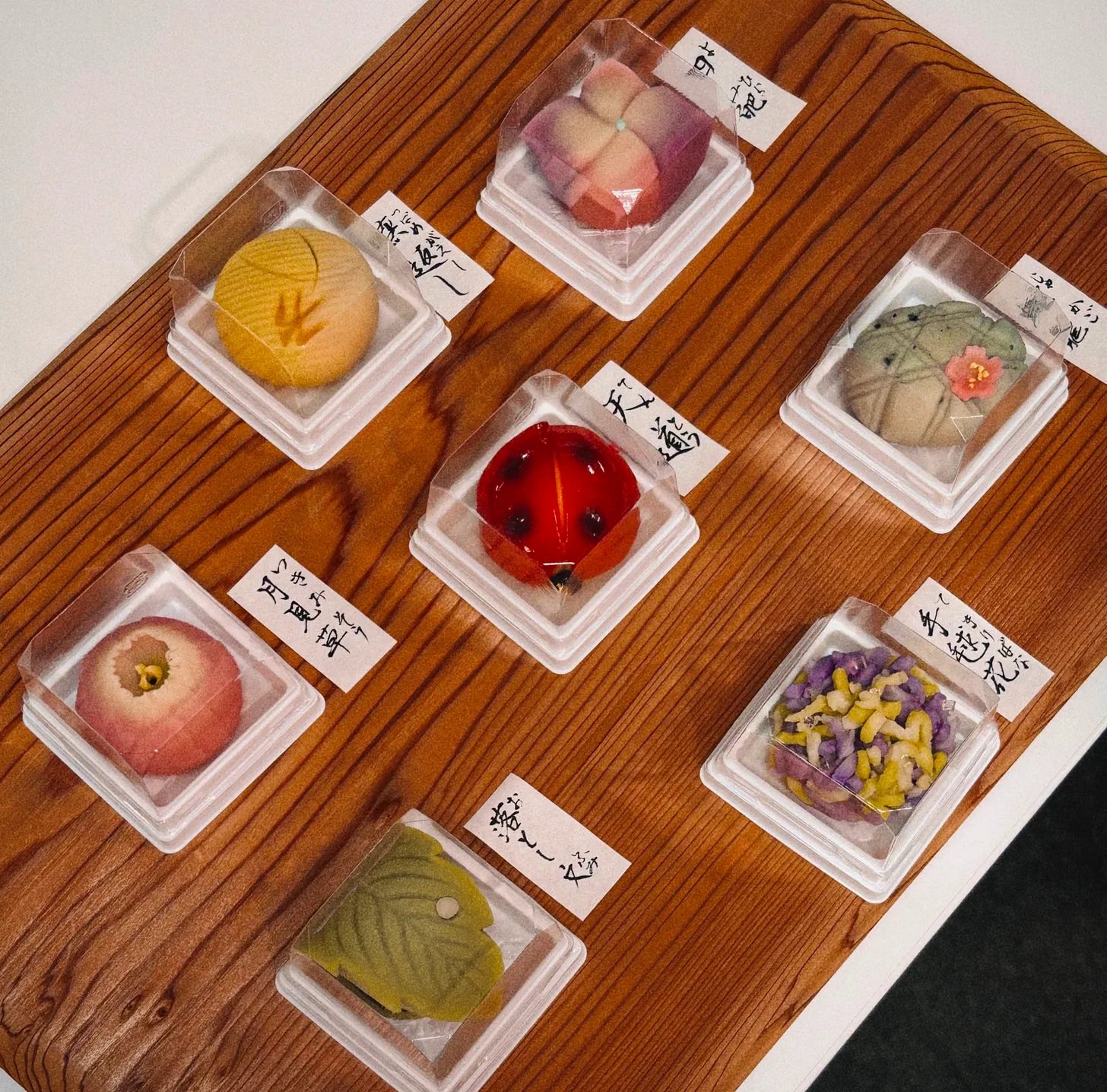
According to Takeshi Inoue, fourth-generation head of Baikatei, wagashi names often suggest rather than reveal. This ladybug-shaped sweet is called Tendō, evoking the “path of the sun” and gently leading guests toward tentōmushi, the ladybug said to climb toward the light. ーPhoto by author
For all the forms and colors it takes, Japanese confectionery, or wagashi, is surprisingly simple. Like Japan’s tea ceremony, its core ingredients rarely change, even as the microseasons determine its endlessly shifting varieties. At this time of year, the Kagurazaka-based confectionery shop Baikatei offers wagashi in all kinds of delightful forms: goldfish float in gelatinous domes, watermelon slices glisten, and flour-dusted mochi sit in pillowy mounds.
“The elements of the seasons are used as themes and motifs to craft wagashi, which developed alongside the tea ceremony,” says Takeshi Inoue, fourth-generation head of Baikatei, which began as a family business in 1935. It is late May, and he is visiting Waseda’s Intercultural Communication Center (ICC) for a third consecutive year, this time for a spring-themed wagashi-making event. Despite their variety, wagashi are fundamentally bean-based. In this, they resemble the Japanese way of tea itself: fixed in their essentials, yet ever-changing in form and presentation.
“Peonies are at their most beautiful right before they fully open,” Inoue observes. “Today, our goal is to capture the charm of a peony that is just beginning to bloom.”
Wagashi distills nature into suggestion, he remarks. It does not replicate. It quietly evokes, inviting contemplation. The flower in his palm is barely just; its petals slight indentations against blushing skin, cradling a boon of yellow pollen nestled within a shallow crater.
Despite holding distinguished titles such as Excellent Master of Wagashi and Tokyo Meister, and having helped secure wagashi’s recognition as an intangible cultural asset, Inoue remains a generous teacher. He sits with us as we try to recreate botan, an intricately petalled peony currently in season.
“Good,” he says, smiling and nodding in a way that makes me feel as though the lump of sugar bean paste in my hands might actually bear some resemblance to the delicate flower he has demonstrated assembling at the speed of mastery.
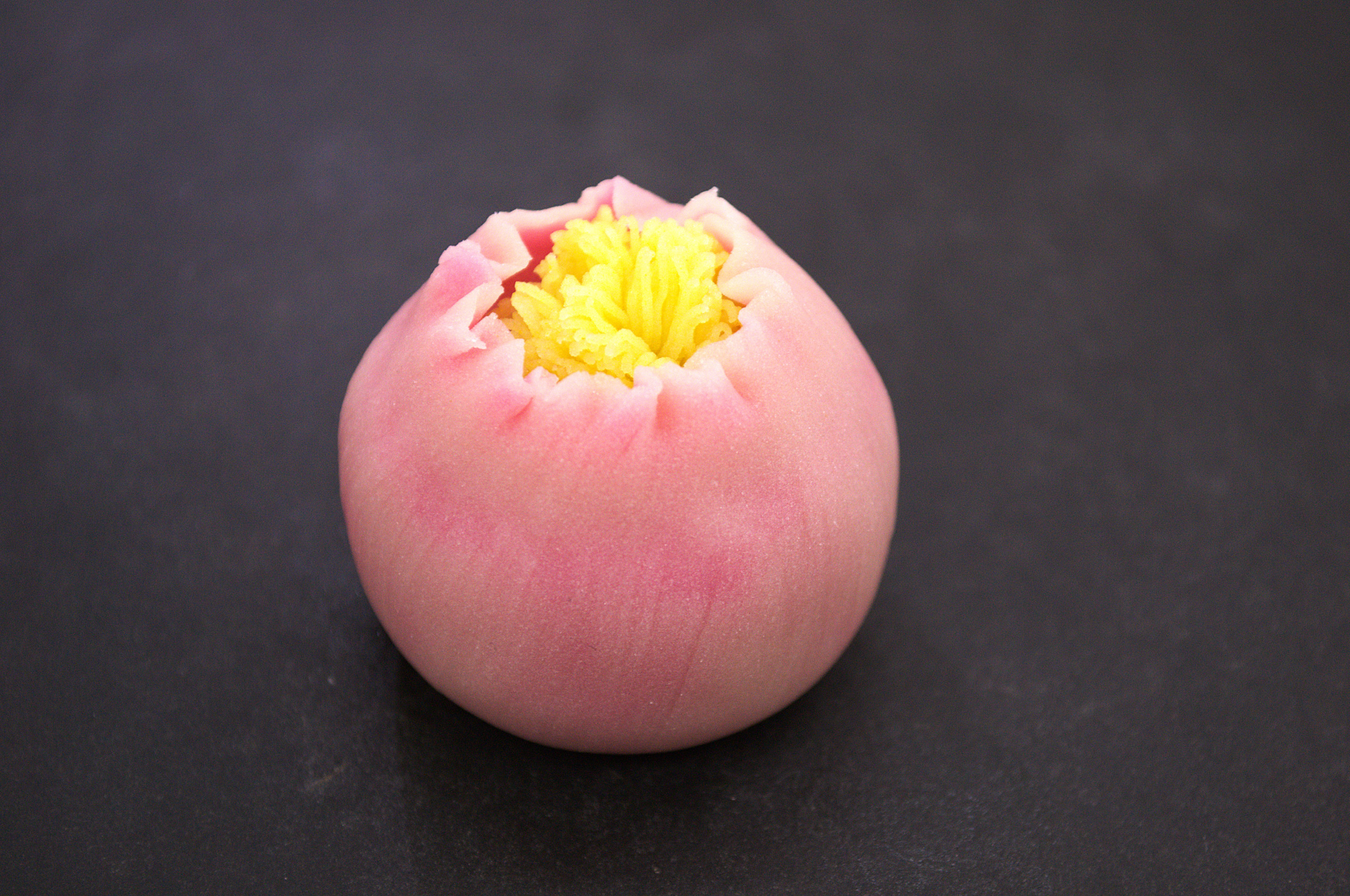
Peony’s Wagashi ーPhoto by Baikatei
But my glob of peony is blotched with maroon from the adzuki, while his is crafted so that each thinly frilled petal remains ivory white, dusted with fairy pink, the red bean hidden until first bite. Today, however, it is what’s inside that counts, and I am a grateful student. The taste is comfortingly familiar, grounded in the nutty warmth of beans. Flavor comes subtle and dense, velvet dissolving on the tongue. Following tradition, I chase its lingering sweetness with a sip of green tea.
The humble bean is a versatile actor. Shiro-an, a sweet white bean paste, plays several roles: white signifies purity and readily absorbs dyes. Folded into nerikiri with rice-based gyūhi, the paste becomes whatever the maker kneads it to be. Red beans carry their own symbolism: according to East Asian folklore, red wards off evil and misfortune, which explains why adzuki is so often tucked inside even the most fragile-looking wagashi.
During our conversation, I struggle to define American dessert— ice cream? Pie?—while Inoue reveals that he does not have a favorite sweet. Instead, he enjoys the year’s rotation of seasonal delights, a rhythm he has known since childhood. Though Baikatei first opened in Juniso, Shinjuku, the shop relocated to Ikebukuro after the war, where it operated for 60 years. It was there that Inoue was born. His wagashi education began in middle school, when he received okozukai, or pocket money, in exchange for his labor.
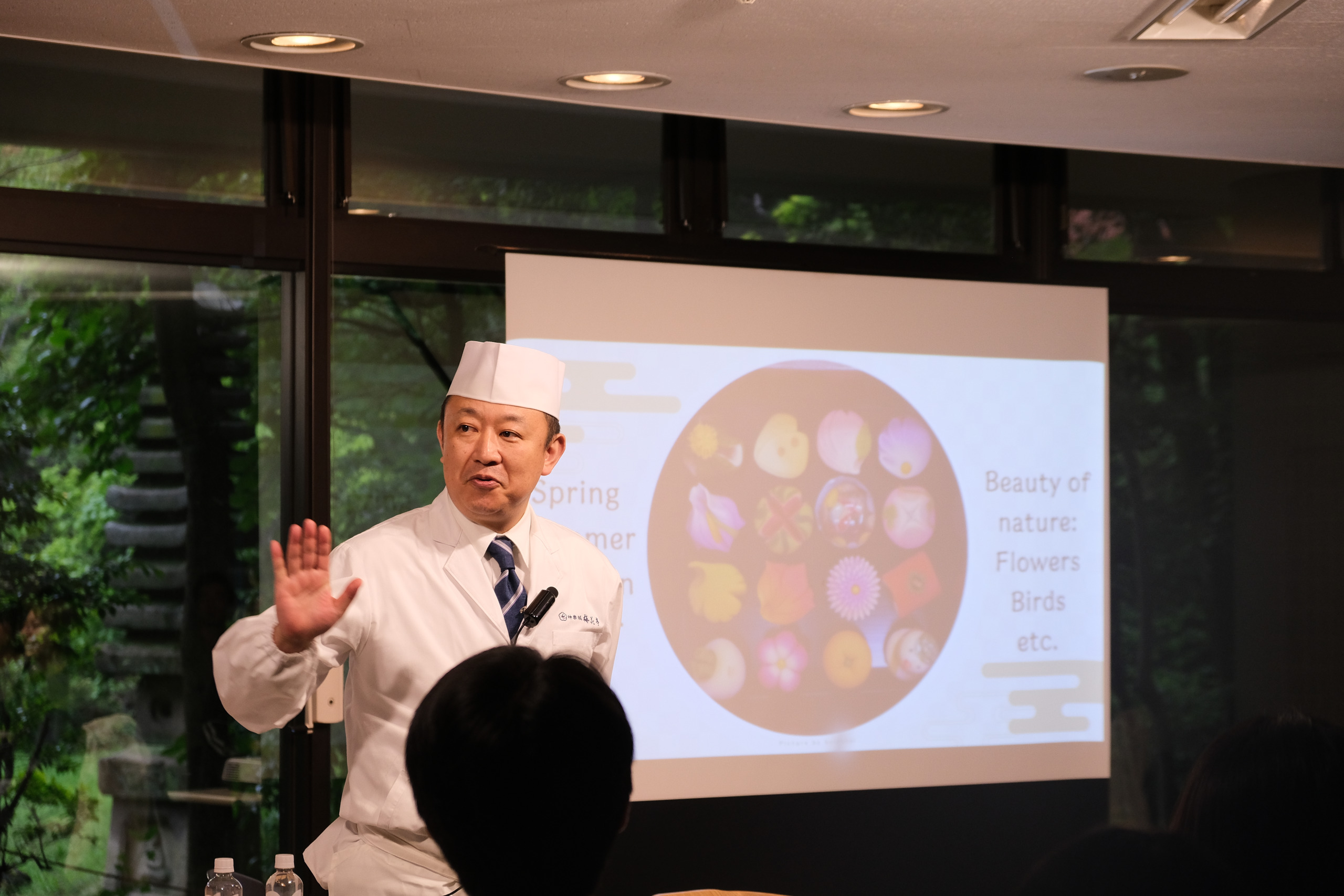
Mr. Takeshi Inoue ー Photo by ICC
I imagine that Baikatei’s Ikebukuro store would have been difficult to miss. In an archival photograph, the storied shop towers above its neighbors. Its name, as tall and wide as the windows themselves, cuts a swift, bold movement against wooden slats. The present-day Kagurazaka location is more modest, almost easy to pass by. Though the store maintains its Showa-era charm, it sits snugly among the gourmet bakeries and quaint boutiques that make up Tokyo’s so-called Little Paris—or Kyoto, depending on whom you ask.
Still, Baikatei has a following of its own. Those acquainted with the shop know that its offerings are not limited to seasonal wagashi; in fact, it is one of the few places in Kagurazaka that accommodates the particular requests of local tea ceremony practitioners. Inoue is especially well-equipped for the job. He holds the prestigious tea name Sōgō, bestowed upon him by the grand master of the Urasenke school—a distinction within one of Japan’s foremost tea ceremony traditions.
Wagashi, he notes, is a fixture of the ceremony itself. Its role is as practical as it is decorative: eaten while matcha is whisked, it gently prepares the palate and stomach for the tea’s intensity. It is also perhaps the most original element of the ceremony. While hosts match hanging scrolls and tea utensils to the theme of the gathering, wagashi are custom-made, their imaginative designs as fleeting as the seasons they represent.
As I listen to Inoue speak, a memory returns. I am standing in the kitchen of a Kagurazaka temple during tea ceremony practice. Someone shows me the day’s wagashi and reads aloud the characters printed on the box: Plum Flower House, or Baikatei.
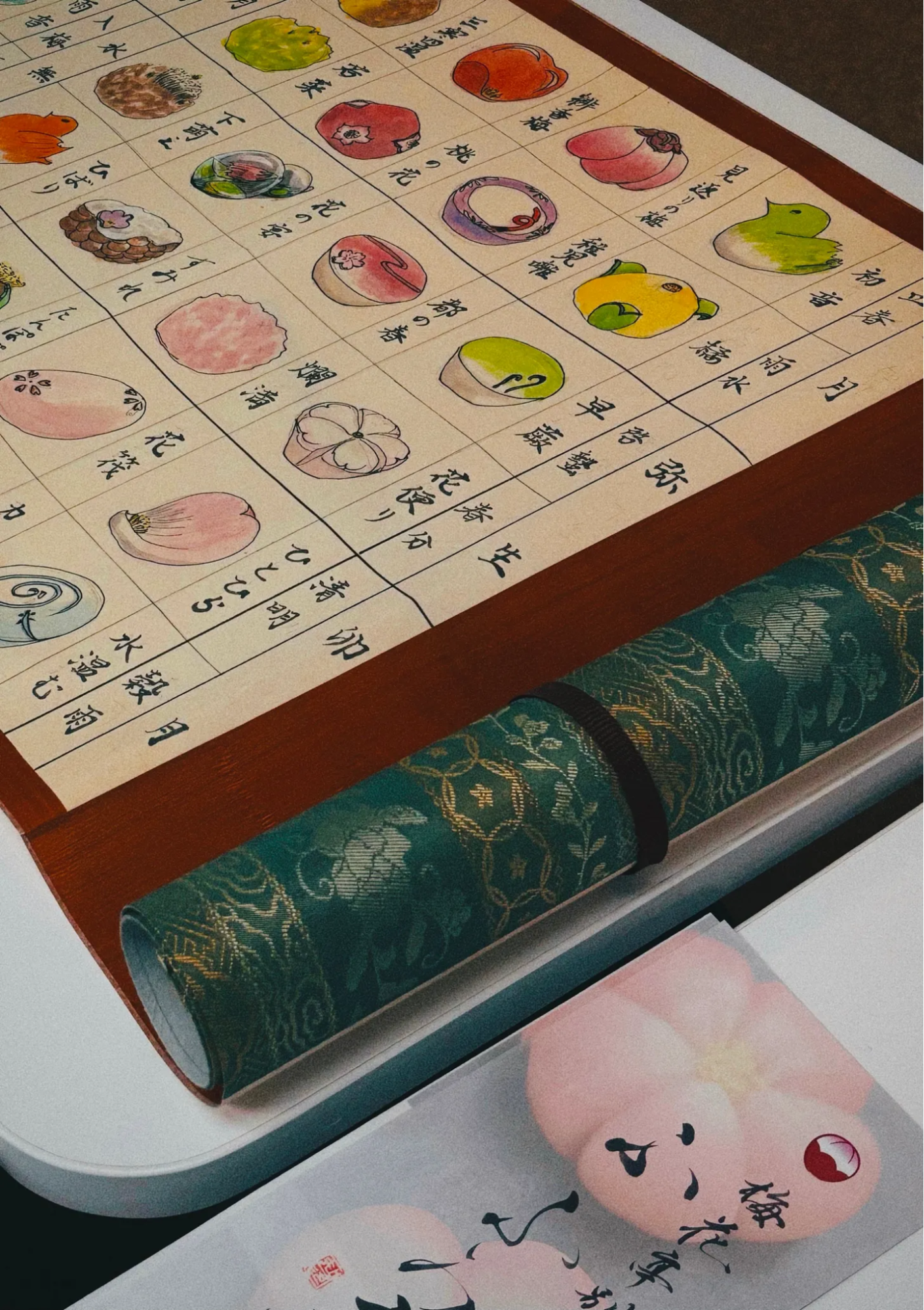
A hand-painted record from Baikatei’s archive of custom wagashi designs. As Inoue explained, the shop preserves yearly files of tea ceremony requests, from birds to seasonal flowers, each created as a gesture of hospitality. ーPhoto by author