Kailyn Huang
Center for Japanese Language and Culture (CJL)
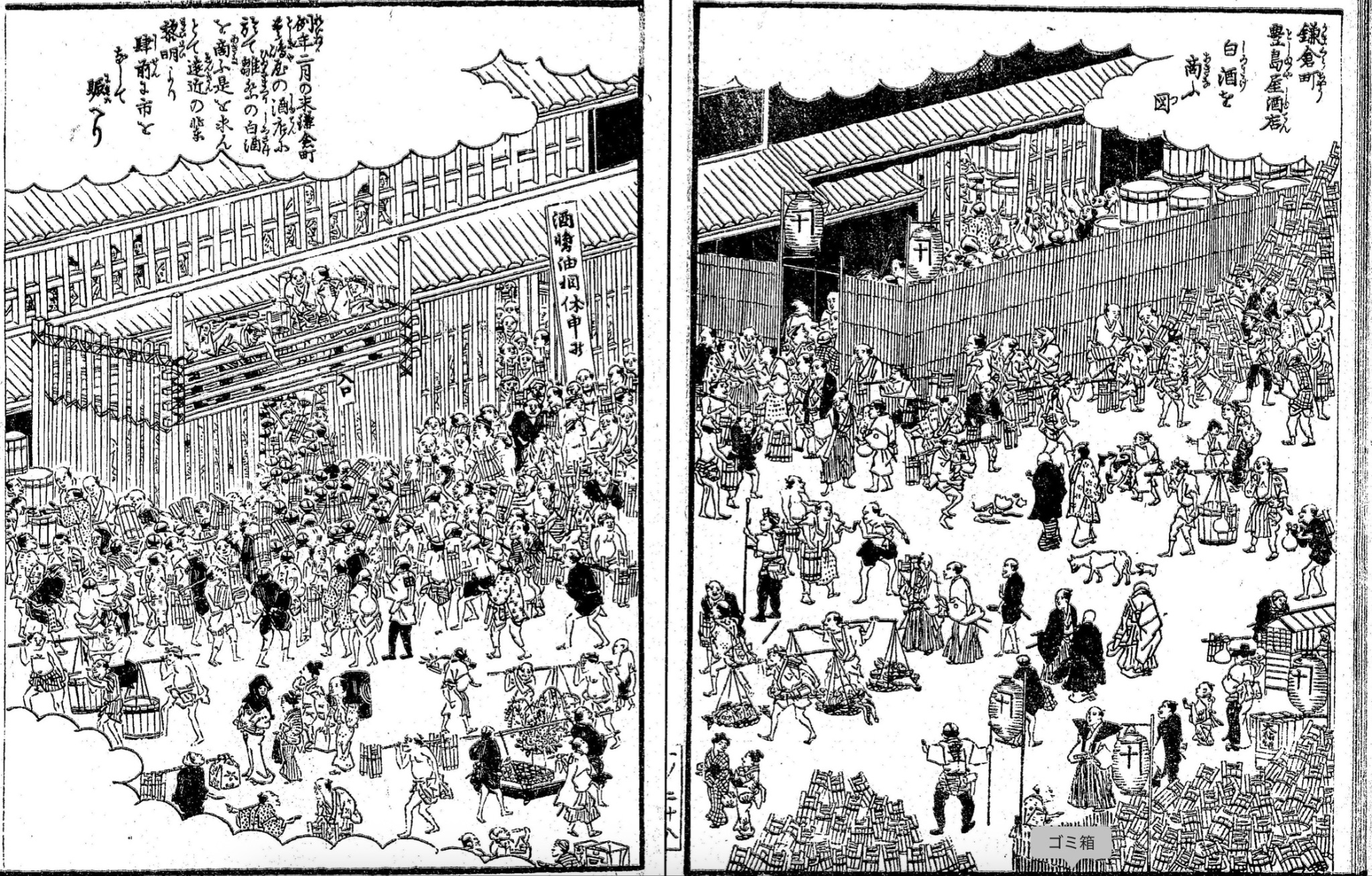
“Kamakura-chō: Toshimaya Sake Shop Selling Shirozake” (鎌倉町豊島屋酒店 白酒を商う図) in the Edo Meisho Zue (江戸名所図会), 1893 printing. Compiled by Saito Yukio (斎藤幸雄), with illustrations by Hasegawa Settan (長谷川雪旦). Source: National Diet Library.
It was a cold winter night, and an intimate crowd had gathered in Waseda University’s warmly lit Garden Hall, the chill lingering just beyond its glass doors. Once the audience had settled into their seats, the moderator opened the January talk session at the Waseda ICC (Intercultural Communication Center) with a simple question: “Who here is a fan of sake?” Only a few hands rose at first. By the evening’s end, they all did.
In a literal sense, sake (酒) means alcohol, but traditionally speaking, it refers to nihonshu (日本酒), which is produced by fermenting polished rice. Although scent and flavor profiles differ markedly, rice, koji, and yeast are essential ingredients. References to sake appear in records dating back to antiquity, long before the arrival of tea. Yet domestic consumption today is steadily declining.
For a brewery whose history spans over four centuries, however, the future remains bright. Toshiyuki Yoshimura, president of Toshimaya Corporation and the ICC’s guest speaker, explained why.
Generally regarded as a “niche” product, sake—unlike its Western counterparts—is hard to come by in global marketplaces. Despite the wide variety in taste, age, and texture, overseas selections remain scant. To Yoshimura, however, the status quo is merely an indicator of potential market growth. He points to a graph illustrating sake exports over the last few years, which shows modest gains that contrast sharply with the steep drop in domestic demand.
This decline in consumer appetite for sake reflects a broader shift in drinking habits: people simply aren’t drinking nearly as much as they used to. Even when they are, sake is rarely a first choice. From my experience working at a nihonshu specialty izakaya staffed by certified sake connoisseurs, Japanese diners both young and old most often call for beer and whiskey instead.
Historically affordable, sake is produced through methods that vary by brewery and require considerable labor. Without sufficient demand, production becomes difficult to sustain. In the worst cases, breweries close, taking with them generations of accumulated expertise.
Yoshimura proposes a deceptively simple solution: exposure. He takes a grassroots approach: though the hour is late, he remains dressed for work—not in a suit, but in a brown happi bearing the Toshimaya crest. He speaks to a roomful of international students while handing out samples from his family’s brewery.
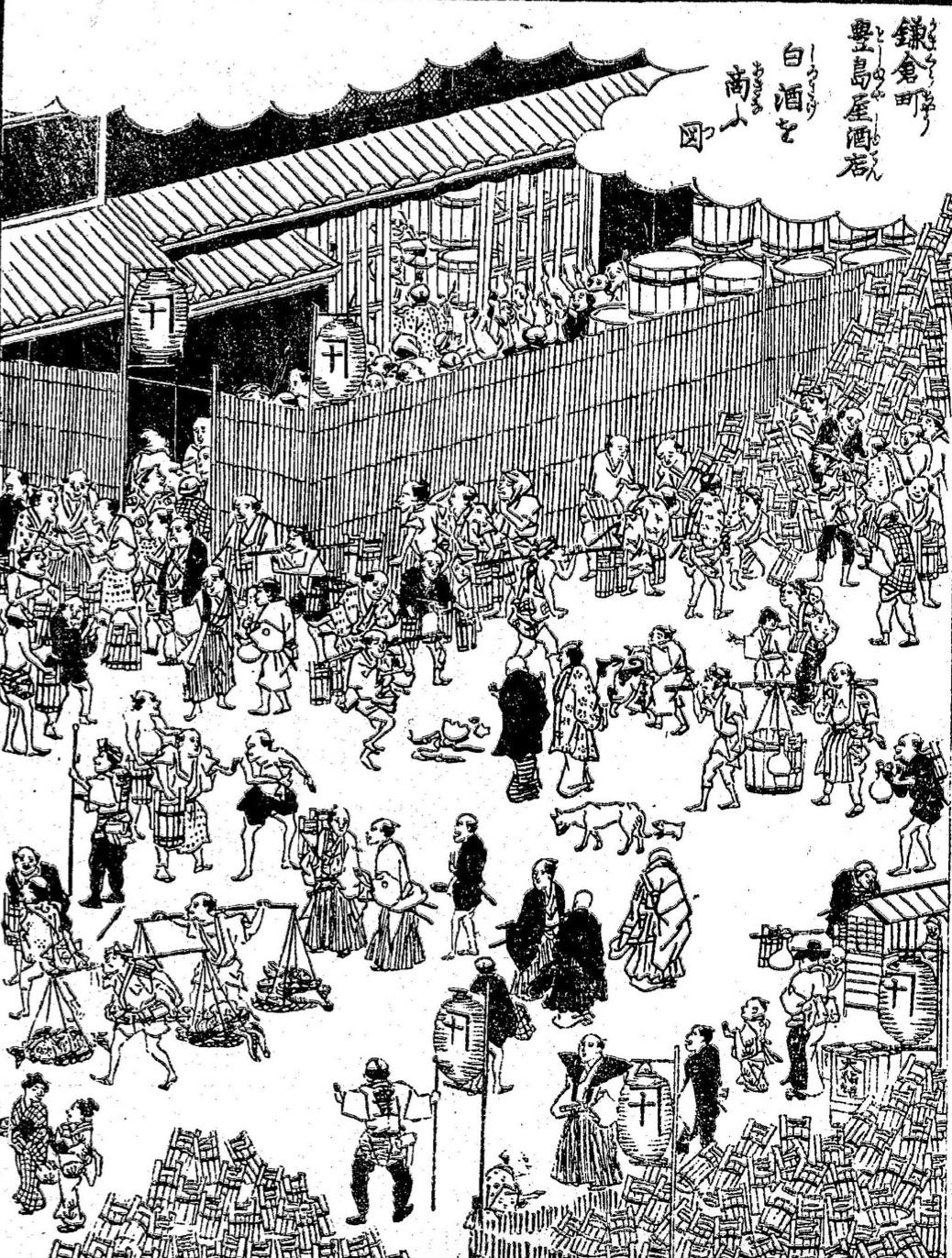
Detail from “Kamakura-chō: Toshimaya Sake Shop Selling Shirozake.” This scene features the brewery’s kane-jū trademark, a carpenter’s steel square, which symbolizes hope for stability and prosperity, enclosing the character jū (“ten”), one part of the name of the Founder. Source: National Diet Library.
Founded in Tokyo in 1596, Toshimaya prides itself on its locality. Its famed shirozake appears as a cultural reference in novels and kabuki plays and is depicted in Edo-period “famous places” ukiyo-e (meisho zue) prints, including a work by Utagawa Hiroshige.
Since Toshimaya produces shirozake only once per year, guests instead sampled three representative brews. The evening opened with Kinkon, the brewery’s signature sake and a fixture at Shintō ceremonies at the Meiji Jingū and Kanda Myōjin shrines. A dry honjozo–shu, it is light, aromatic, and nutty—restrained in a way that feels immediately familiar. It tastes, as one Tokyoite beside me put it, like a sake that “tastes like sake.” Comfortingly so.
Clear, clean, and crisp, Kinkon is the mildest of the three. Drinking it feels like a warm—if room-temperature—welcome. Its popularity at weddings makes sense because it’s a real people-pleaser in a bottle.
But its cousin, Kinkon Edo Sake Ōji, is the drink with a personality that sticks. Brewed from rice cultivated in Tokyo, it pours dark and malt-like, with a depth that divides opinion. I detect pickle brine and lactic acidity. A bartender from Chengdu tells me that it is his favorite, explaining that it reminds him of festive family gatherings. The contrast in reactions is fitting: Edo Sake Ōji resists easy categorization.
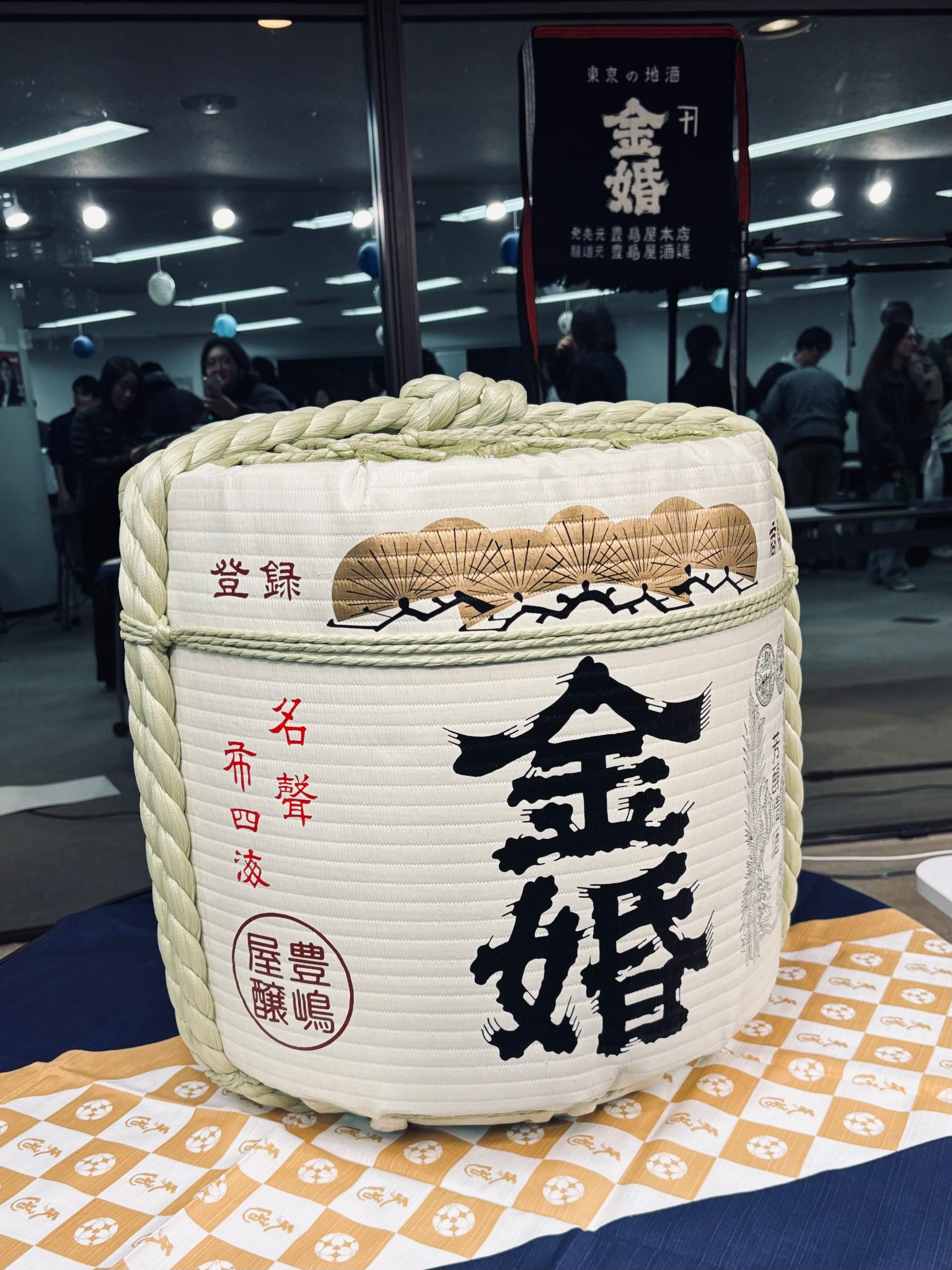
A cask of Kinkon at the ICC event. Photo by the author.
Jūemon, named for Toshimaya’s founder, occupies a middle ground. Unfiltered and heat-treated post-bottling, it carries a faintly fruity aroma: banana to some; melon to others. Sparkling acidity and gentle sweetness give way to a sharp umami finish. Jūemon takes you on a ride, and it rounds out the tasting by illustrating the range possible within a single brewery.
Although these brews are products of a modernized process, Yoshimura suggests that broader innovation is still necessary within the industry as a whole, beginning with globally oriented events like this one. He envisions a future in which sake, like wine, extends beyond izakayas into Western establishments. The evening tasting reveals at least one truth: sake is a drink that takes many forms. How to best pair it with cuisine remains a question for the wider world.
Like his ancestors, Yoshimura follows the principle of fueki ryukō (不易流行), wise words from Matsuo Bashō. It is continuity with change: for Toshimaya, “preserving what should be preserved, while changing what needs to be changed.” Perhaps we could all take a sip of that.