
[Event Report] Public Lecture: Japan-South Korea Insurance Pre-forum “Cutting-Edge Technology and Insurance Compensation: A Japan-Korea Comparison” was held on April 9 (Thu).
![[Event Report] Public Lecture: Japan-South Korea Insurance Pre-forum “Cutting-Edge Technology and Insurance Compensation: A Japan-Korea Comparison” was held on April 9 (Thu).](https://www.waseda.jp/folaw/icl/assets/uploads/2022/10/shutterstock_1889907112-2000x1082.jpg)
Dates
Add to calendar0409
THU 2026- Place
- Waseda Campus
- Time
- 15:00-16:40
- Posted
- Wed, 29 Apr 2026
Cutting-Edge Technology
and Insurance Compensation:
A Japan-South Korea Comparison
【Host】Sustainable Technology and Law Institute
【Co-Host】Institute of Comparative Law, Faculty of Law/Graduate School of Law, Waseda University
【Support】The Japanese Society of Insurance Science
【Date and Time】April 9, 2026 (Thu), 15:00-16:40
【Venue】Waseda University, Building 8, Room B-107 & Zoom Webinar
【Lecturer】
Myung-Ho Hong(Attorney at Law, Dowon Law Firm CEO, Korean Insurance Law Association Senior Vice President, and President-Elect)
Yoshihiko Hasegawa(Visiting Research Fellow, Institute of Legal Studies, Kanagawa University)
【Language】Japanese and Korean
【Interpreter】Shin Hyeonho(Advisor, Dowon Law Firm)
【Moderator】Tadao Koezuka(ICL Research Staff, Professor, Waseda University)
【Number of Participants】29 (15 in-person, 14 online)
On April 9, 2026, a public lecture titled “Japan-Korea Insurance Pre-forum: Cutting-Edge Technology and Insurance Compensation: A Japan-South Korea Comparison” was held. The rapid advancement of cutting-edge technology in modern society is presenting new challenges and requiring significant changes to the existing legal framework. This lecture was organized to highlight the various challenges facing the insurance laws of both Japan and South Korea under these circumstances, and to explore future directions for legal frameworks in light of cutting-edge science and technology. On the day of the event, in addition to those attending in person, the webinar attracted many viewers, bringing the total number of participants, both within and outside the university, to 29.
Session 1: Indemnity Health Insurance in South Korea: Present Situation, Problems, and Measures for Systemic Reform
Lecturer: Myung-Ho Hong
Mr. Myung-Ho Hong presented a report on legal problems facing private medical insurance in South Korea.
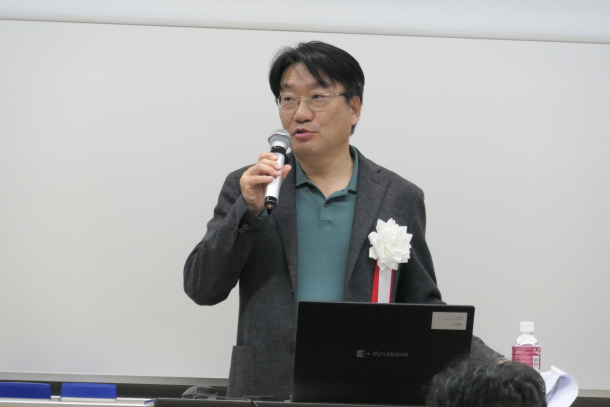
Mr. Myung-Ho Hong
Indemnity Health Insurance is a form of medical expense insurance in South Korea designed to reduce the burden of medical costs by compensating for actual medical expenses not covered by the national health insurance system, such as copayments and uninsured medical care. Nowadays, approximately 70% of Koreans are covered by such medical insurance.
On the other hand, Indemnity Health Insurance is at the crossroads. Driven by moral hazard among participants and excessive medical treatment by medical institutions, insurance premiums have risen while compensation has been reduced. Mr. Hong warned that the system’s original design has been destabilized and that structural reform is an urgent necessity.
Mr. Hong indicated that the current system has two major flaws that result in a general disadvantage through the rise in the insurance bill and unfairly shift the financial burden onto good policyholders:
- The unregulated price of medical care: the price of medical care not covered by the national health insurance is placed in the hands of market mechanisms.
- The convergence of insurance payment: Insurance payouts are disproportionately concentrated on specific non-covered treatments, such as Dosu therapy (manual therapy) and specialized injections.
As remedial measures, Mr. Hong proposed a three-pronged approach:
- Refining insurance product structure: Designing insurance plans that are hard to misuse, like excessive medical treatments and moral hazards.
- Strengthening supervision: Establishing a collaborative public-private management structure to tighten controls on medical care not covered by the national health insurance.
- Enforcing sanctions: Implementing stricter penalties, including criminal prosecution, for insurance fraud and false claims.
In closing, Mr. Hong shared his view that resolving malfunctions in the insurance system leads to consumer protection.
Session 2: Recent Trends in Insurance for Cutting-Edge Medical Technologies in Japan: Coverage for Advanced Medical Care, Private Treatment, and Beyond.
Lecturer: Yoshihiko Hasegawa
Mr. Hasegawa presented a report on the influences on the practical business of Japanese private health insurance, especially in cancer insurance.
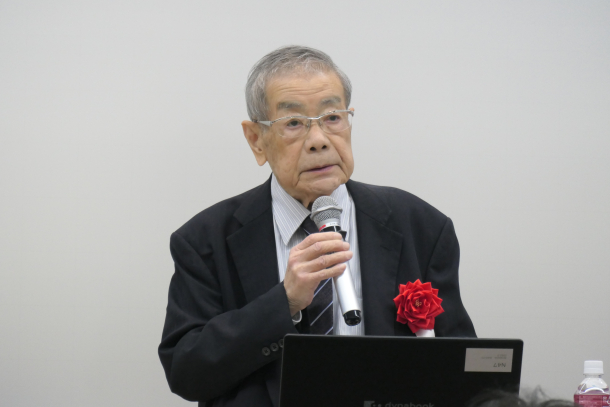
Mr. Yoshihiko Hasegawa
Public health insurance does not cover advanced medical care, so the technical fee is expensive. For that reason, advanced medical care benefits under life and medical insurance have been offered to cover the technical fee.
In a case where technical fees were claimed from multiple insurance companies, the Nagoya High Court decision of October 2, 2024 (unpublished) ruled that advanced medical care insurance is considered non-life insurance. Mr. Hasegawa proposed that it should be interpreted as fixed-benefit insurance under the current insurance policy conditions.
Improvements in medical care technologies have led to shorter hospital stays for cancer patients and increased outpatient care. As a result, the ideal scope of coverage in cancer insurance is changing, with product design shifting its focus from hospitalization expenses to outpatient treatments, advanced medical care, and treatments not covered by public health insurance. Today, mainstream insurance products for such treatments either compensate for the actual costs within a specific limit (non-life insurance type) or provide a prescribed fixed benefit for treatments, including those not covered by public health insurance, based on the categories defined in the policy conditions (life insurance type).
Mr. Hasegawa referred to cancer risk screenings via urine testing or other methods that have appeared in recent years. According to Mr. Hasegawa, cancer risk screening may give rise to several issues, such as increased underwriting risk, violations of the policyholder’s duty to disclose health conditions, evasion of the liability commencement period, and rising insurance premiums.
At the end of the lecture, Mr. Hasegawa introduced the new type of health insurance: the preventive benefit-type insurance. The trend in health insurance products has been shifting from death benefits to health improvement. Insurance companies advance the development of insurance products to increase the health span.
In the questions-and-answers session, participants asked about several topics, such as moral hazard in South Korea and the tension between technological progress and the design of insurance products in Japanese cancer insurance. The event ended in great success.
(Text: Haruka Nomura, ICL Research Assistant)
Link to Japanese page