Journal of Waseda International House of Literature is an academic journal published annually by the Waseda International House of Literature. Our aim is to offer a space for scholarly dialogue on the subject of literature written in Japanese. We welcome submissions with new global perspectives on this subject. Manuscripts will be reviewed by a panel of international scholars.
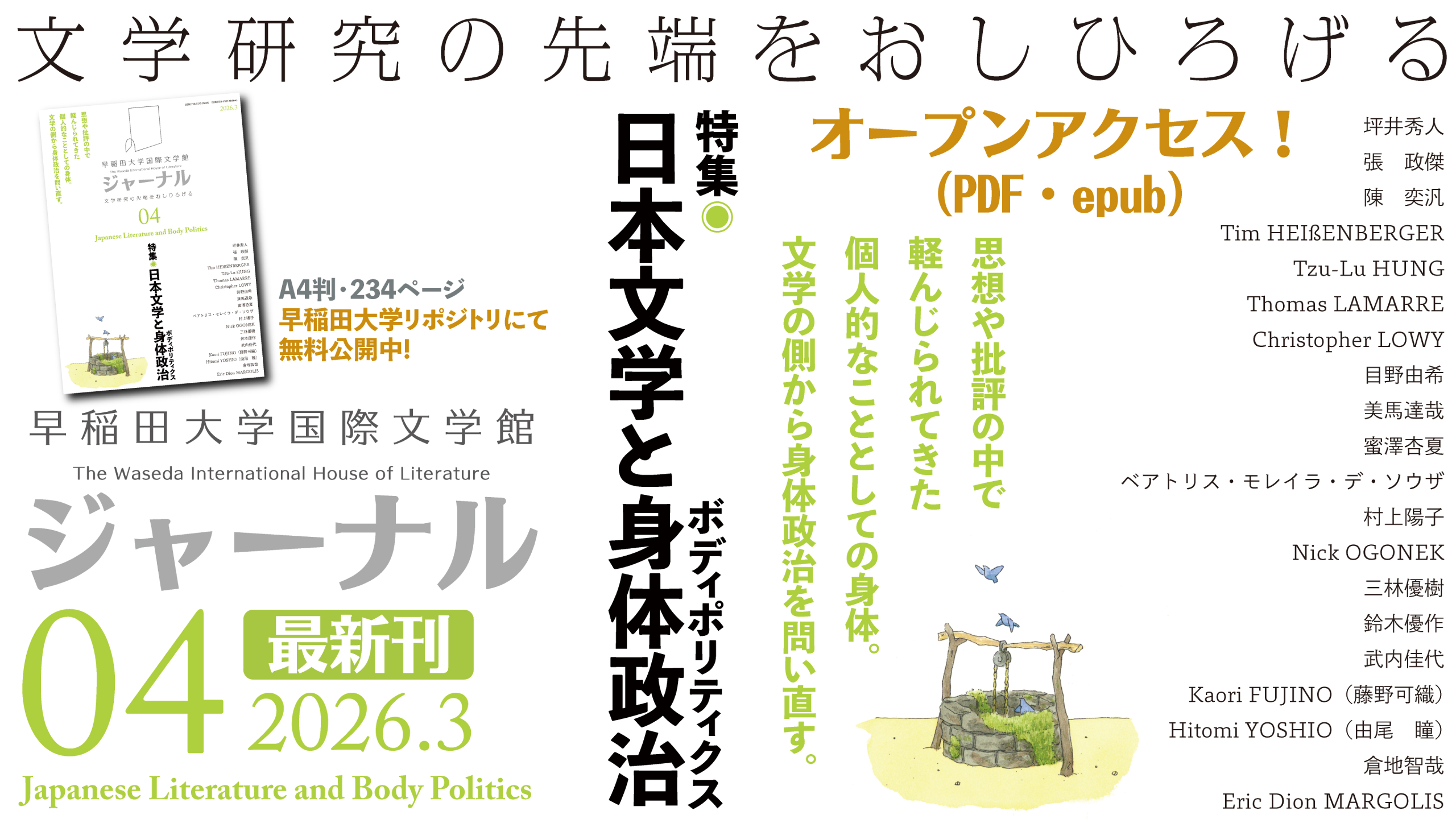
The latest issue, No.4, was published on 20 March 2026.
Click on the cover of each issue to view the contents.
The Journal of Waseda International House of Literature is currently inviting submissions for its fifth issue. In addition to general research articles, we are also calling for contributions to the special issue titled “The Potential of The Translator,” and welcome a wide range of scholarly essays on this topic.
For further details on the theme, please refer to the special issue statement below.
The journal aims to actively feature contributions that offer new perspectives and methodologies, and we especially encourage ambitious submissions from early-career researchers and graduate students.
Submission Deadline: Tuesday, September 15, 2026
Publication Date: Monday, March 15, 2027
We accept manuscripts written in either Japanese or English.
For detailed information regarding submission guidelines and formatting requirements, please refer to the link below.
The Potential of the Translator
In The Task of the Translator (1923)—now considered a classic of translation theory—Walter Benjamin argues that the translator’s task is to “set free” in their own language “the pure language spellbound in the foreign [one],” “to liberate the language imprisoned in the work by rewriting it” (trans. Steven Rendall). What continues to astonish us about Benjamin’s words, even after more than a century, is his assertion that the task lies in liberating (befreien) the language hidden within the “reworking” (Umdichtung) of a work. As the proverb “Traduttore, Traditore” (“the translator is a traitor”) suggests, translators are beings torn between “fidelity” and “freedom” (a point which Benjamin also notes), and yet it is remarkable how Benjamin had already prepared the words to transcend this rift and translation’s perceived limitations so long ago.
While criticism has been repeatedly leveled at the politics of dominant languages that constrain translation into the service of hegemonic power, the situation surrounding translation can be said to have changed significantly in the 21st century. Speaking of Japanese literature of the past, it was established in a translation culture whose foundation was oriented towards Western languages (which is, of course, not incorrect); in this sense, translation in Japan was perceived as something that absorbed and transformed the West. Would it be an exaggeration to say that, from the perspective of Western-language societies, on the other hand, the initial translation of Japanese literature meant little more than the introduction of a peripheral or minor literature to a dominant one?
Today, new Japanese works are being translated at a remarkable pace into various languages, primarily English, and gain an ever-growing readership worldwide. In translation, Japanese literature is not the peripheral, minor literature that it once was. At the same time, translation theory and research have become increasingly active fields of discourse on a global scale, arguable drawing greater awareness about these tensions within translation culture. Yet, we must ask whether the discussion surrounding the significance of the translator as Benjamin conducted it a century ago—namely, its questions about who the translator really is and why they make possible—has been sufficiently revitalized?
In this special feature, we wish to return to the fundamental question of what the potential of the translator truly is. Rather than simply celebrate Japanese literary translation’s contemporary popularity, the question of the field’s future asks for a reconsideration of the underlying principles and issues concerning what translators and translation affords literary cultures.
We invite contributors to consider themes such as the following:
・Literary translation and AI. The current state, future, and challenges of AI implementation in literary translation.
・Self-translation. The relationship between creation and translation for writers who create in multiple languages. Using examples such as Tawada Yōko and Sekiguchi Ryōko.
・Writers who translate. Examples ranging from historical figures like Mori Ōgai to contemporary writers like Murakami Haruki.
・The reception of translated Japanese literature in the English-speaking world and Asia.
・Studies on translators. Research on memoirs, essays, and other works by translators.
・The relationship between authors and translations agents.
We look forward to receiving ambitious essays based on free-thinking ideas.
In principle, submissions in English should follow The Chicago Manual of Style and our guidelines below:
Submissions should use an A4 page size.
English texts should use the Century font. Font size should be 10.5 for the body text and 9 for notes. Japanese words other than those accepted in common English usage should appear italicized, with the initial appearance followed by the original Japanese in MS Mincho font if necessary.
Character and word counts should follow item [2] from the Submission Guidelines, but please count half-width Japanese characters as 0.5.
Notes should appear at the bottom of the page. A bibliography should appear at the end of the document.
Japanese names and terms should follow Hepburn romanization. Please use macrons for long vowels. In principle, Japanese names should appear with the family name first. The use of specialized terminology, proper nouns, and other such phrases should follow a uniform pattern throughout the submission.
Years should be listed in the Western format, with corresponding Japanese years listed only when necessary.
Units can be listed as the author prefers but should remain uniform throughout.
All quotations must be cited in Notes and Bibliography style of The Chicago Manual. Please indicate in the note when quotations have been altered from their original sources, for example: old form traditional characters have been changed to simplified characters, kana orthography has been changed to the contemporary usage, italics or underlines have been added for emphasis, etc.
If submissions include images, please format the layout of the document in such a way that it indicates the approximate size and location of the image that will be added. If you intend to add images to your submission but have not formatted the document to include them, please indicate this in your submission email.
Images should be labeled individually, with each image including a sequence number and title or explanation.
In principle, space taken up by images will not count against the submission’s word count.
For images that require citations, please include that information after the bibliography at the end of the document.
Please follow our submission guidelines.