Bridging the Information Gap: AI-Driven Quality Control for 5G Multicast Broadcasting
Wed, Sep 9, 2026-
Tags
Bridging the Information Gap: AI-Driven Quality Control for 5G Multicast Broadcasting
Innovative strategy helps achieve reliable last-mile delivery of cable television through 5G wireless communications
Delivering high-definition television over local 5G networks could help modernize cable TV in buildings where installing fiber-optic cables is impractical. However, since lost data cannot be retransmitted in 5G multicast broadcasting, temporary video freezing is common. Now, researchers from Japan have developed a lightweight AI model that predicts wireless conditions in advance and proactively adjusts transmission settings, enabling stable, real-time video delivery via 5G broadcasting. Their work helps bridge the information gap in underserved areas.
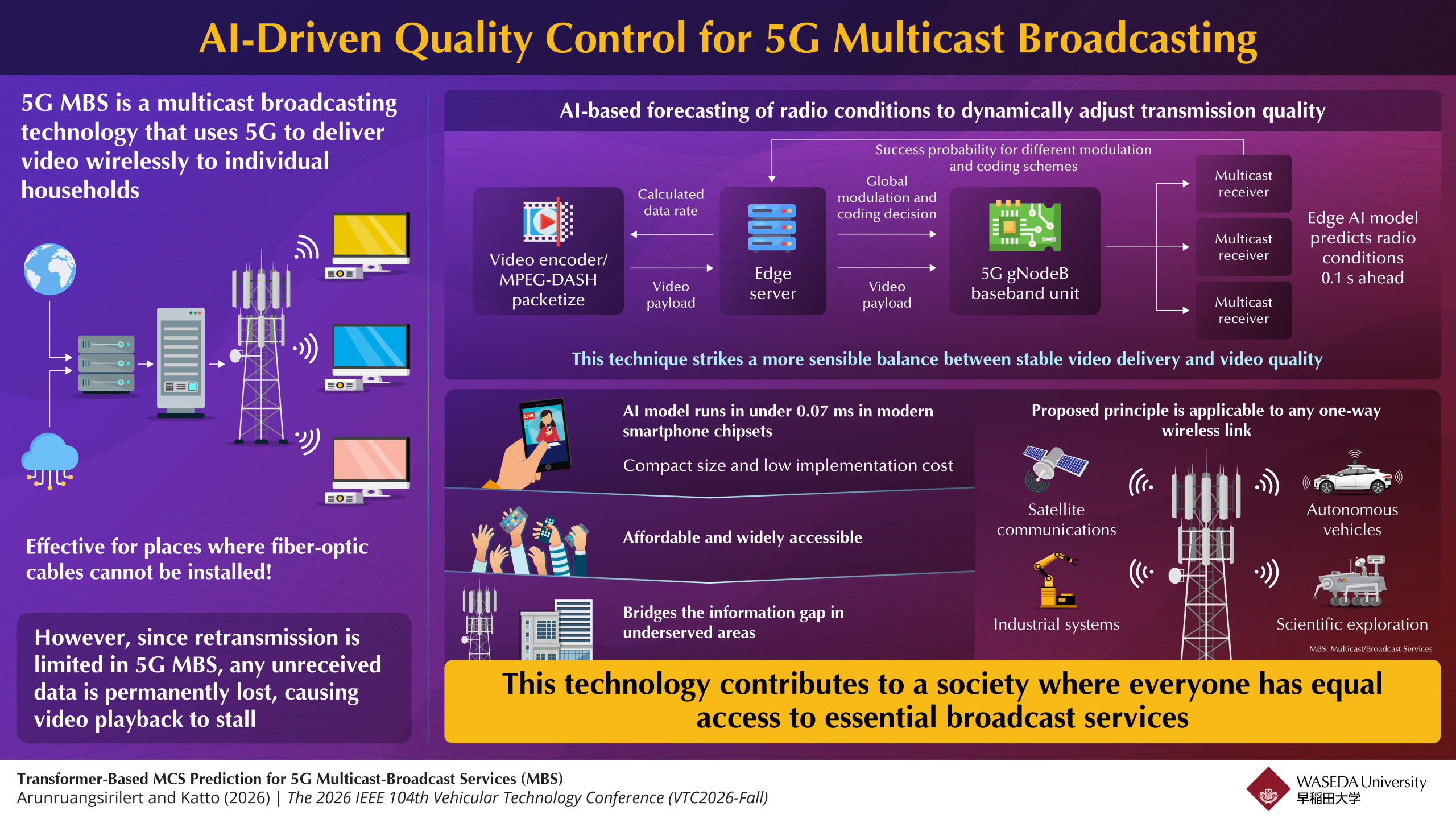
Image title: Proposed scLS algorithm
Image caption: The scLS algorithm enables the detection of pseudotime-dependent dynamics in branching trajectories while being more computationally efficient and not requiring explicit regression models or branch assignment.
Image credit: Assistant Professor Hitoshi Iuchi from Waseda University
License type: Original content
Usage restrictions: Cannot be reused without permission
Cable television (CATV) remains a cornerstone of how national broadcasts and emergency information reach thousands of households. Unfortunately, since many older apartment buildings were not built with fiber optics in mind, retrofitting them with the necessary wiring for CATV is too costly or impractical, leaving residents unable to access broadcast services. One emerging alternative is 5G MBS (Multicast/Broadcast Services), a technology that uses 5G wireless signals to deliver the same television stream to many households simultaneously. By making efficient use of the limited radio spectrum, it offers a realistic path to modernizing CATV infrastructure.
However, 5G multicast broadcasting has a fundamental limitation. Ordinary 5G connections on smartphones are two-way, so when a data packet fails to arrive, the receiving device can simply request retransmission. Multicast broadcasting may not support such return channels, which means lost data packets cannot be resent, causing the video stream to freeze momentarily. Conventional 5G communication protocols, designed around retransmission requests and maximizing speed, are not built to handle situations where retransmission is limited.
Addressing this challenge, a research team led by Professor Jiro Katto and PhD candidate Kasidis Arunruangsirilert from Waseda University, Japan, developed a lightweight AI model that predicts wireless conditions before they deteriorate and adjusts transmission settings accordingly. Their findings were presented at the 2026 IEEE 104th Vehicular Technology Conference (VTC2026-Fall) on September 8 in Boston, Massachusetts, USA.
This AI model was trained using approximately 26 million measurements collected every 0.5 milliseconds from a commercial 5G network, enabling it to capture rapid fluctuations in radio conditions that coarse datasets miss. Importantly, it relies entirely on information already collected by smartphones during standard operation and is compact enough to run in real time on consumer devices without requiring specialized hardware.
Tests on a real-world commercial 5G network showed that the AI model selected an error-free transmission setting for approximately 87% of video segments, compared with only 32% for a conventional speed-oriented approach. The model also operated in less than 0.07 milliseconds on smartphone chipsets released from 2020 onward, introducing no perceptible delay to viewers. As the researchers’ remark, “Our study stands as a practical example of AI-native wireless communication, in which AI takes on decision-making responsibilities in next-generation networks, and represents a meaningful step toward the long-sought convergence of broadcasting and broadband on a single, spectrally efficient wireless platform.” Overall, this strategy could help bridge the information gap in underserved areas, contributing to a society where everyone has equal access to broadcast services.
Beyond improving television services, the researchers believe the same approach could benefit many forms of one-way wireless communication where retransmission is impossible, including satellite communications, autonomous vehicles, industrial systems, and scientific exploration. The findings also demonstrate how local 5G infrastructure, currently used primarily by large organizations, could deliver practical public services. “We hope that this work encourages broader use of local 5G as a tool for solving social challenges and serving the public good,” concludes the researchers.
Title of original paper: Transformer-Based MCS Prediction for 5G Multicast-Broadcast Services (MBS)
Journal: The 2026 IEEE 104th Vehicular Technology Conference (VTC2026-Fall)
Presentation Title: Transformer-Based MCS Prediction for 5G Multicast-Broadcast Services (MBS)
Authors & Affiliations: Kasidis Arunruangsirilert, Jiro Katto, Waseda University
Session Details: IEEE VTC2026-Fall (The 2026 IEEE 104th Vehicular Technology Conference), 8 September 2026, 14:00–15:30
Link to the conference: https://events.vtsociety.org/vtc2026-fall/wp-content/uploads/sites/48/2026/09/VTC2026-Fall-program-web.pdf
About Professor Jiro Katto from Waseda University
Prof. Jiro Katto received a PhD in Electrical Engineering from University of Tokyo in 1992. He joined Waseda University in 1999, where he currently serves as full Professor in the Department of Computer Science and Communications Engineering. His research interests lie in the field of multimedia communications and multimedia signal processing. He is a member of several academic societies and standardization organizations, including IEICE, IPSJ, ITE, IEEE, and ACM. He has over 380 publications to his name.
About Kasidis Arunruangsirilert from Waseda University
Kasidis Arunruangsirilert obtained a Master’s degree in Engineering in 2023 from Waseda University. He is currently pursuing a PhD there at the Department of Computer Science and Communications Engineering. He specializes in multimedia communications, with a strong focus on 5G technologies. He has over 10 publications to his name.
Funding information
This study was supported by the Ministry of Internal Affairs and Communications (MIC) under the Research and Development for Expansion of Radio Wave Resources Program and Japan Science and Technology Agency (JST) under the Cutting-edge Research and Development on Information & Communication Sciences (CRONOS) program (Grant Number: JPMJCS25N2).