Transferring Cytoplasmic Contents and Organelles Between Living Cells
Fri, Apr 3, 2026-
Tags
Researchers develop a platform that uses nanotechnology to safely and reliably exchange intracellular material
Cells naturally exchange cytoplasmic components like proteins, RNA, and mitochondria, but scientists lack tools to control such transfers in living cells. Now, researchers in Japan have developed a nanotube membrane-based injector—a system that enables high-efficiency, minimally invasive cytoplasmic transfer between cells. This platform preserves cell viability and can even transfer functional mitochondria, opening new possibilities for cell engineering and regenerative medicine.
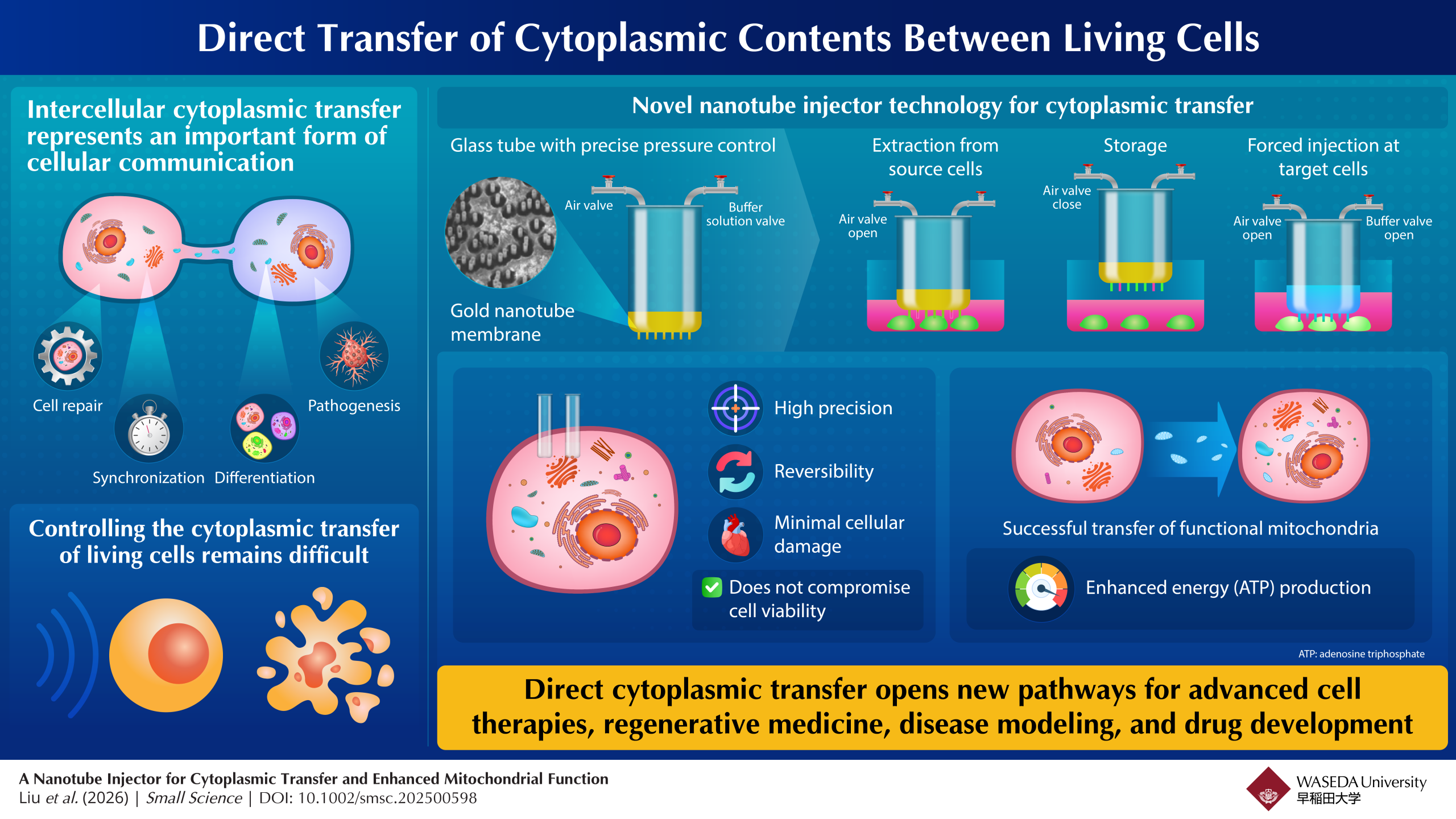
Image title: A scalable platform for cellular engineering
Image caption: This novel system enables scientists to modify cells in ways that go beyond gene editing, with applications in medicine, basic research, and drug development.
Image credit: Professor Takeo Miyake from Waseda University
License type: Original content
Usage restrictions: Cannot be reused without permission
Cells are not isolated units; they continuously exchange proteins, genetic material, and even entire organelles with their neighbors. Intercellular transfer influences how tissues develop, respond to stress, and repair damage. In certain cancers, for example, tumor cells can acquire mitochondria from nearby cells to sustain growth; similar exchanges are also linked to aging processes. However, despite massive advances in gene-editing and molecular-targeting technologies, we still lack the tools to directly and reliably manipulate the cytoplasmic composition of living cells.
Many attempts have been made towards this end over the past decades, but challenges arise at multiple stages. Extracting cytoplasmic material often relies on cell lysis using detergents or enzymes, which destroy the cells. Ultrasound and other sophisticated physical disruption methods need to be carefully tuned to avoid damaging biomolecules, rendering them too time-consuming. Delivering material into cells presents further challenges. Lipid-based carriers are limited to small molecules, viral vectors are costly, and microinjection techniques are difficult to scale. To date, no approach allows for controlled and efficient cytoplasmic transfer without compromising cell viability.
Against this backdrop, a research team led by Professor Takeo Miyake of Waseda University set out to develop a system that overcomes existing limitations. Their latest study, published in Small Science on March 17, 2026, reports a nanotube membrane-based injector—a platform that combines nanomaterials and fluid physics to directly transfer cytoplasmic contents between cell populations.
The system consists of a thin gold membrane with vertically aligned nanotubes mounted on a glass tube. When this membrane is carefully pressed against cultured cells, the nanotubes penetrate the phospholipid bilayer of the living cells without causing significant damage. By adjusting the internal air pressure of the glass tube, the researchers can ‘suck up’ cytoplasmic material from the source cells, hold it as the tube is repositioned over the target cell culture, and gently flush it into this new population using microliters of a buffer solution.
Through several experiments using fluorescent dyes and protein assays, the researchers confirmed that cytoplasmic contents could be extracted in a pressure-dependent manner. They also found that careful selection of nanotube diameter, nanotube density, and applied pressure was key to minimizing cellular damage. Notably, under optimized conditions, cell viability hovered around 95%, with a cytoplasmic transfer efficiency of well over 90%.
To further test the capabilities of their platform, the team investigated whether it could transfer intact mitochondria. To this end, they labeled mitochondria in donor cells with a fluorescent tag and observed them in the recipient cells via confocal microscopy. They found that dozens of mitochondria could be reliably delivered per cell. Most importantly, these mitochondria remained functional, as evidenced by markedly higher levels of adenosine triphosphate (ATP) produced in recipient cells compared to controls. “This technology establishes a new paradigm for cell manipulation—transforming cells not by genetic modification but by reconstructing intracellular composition itself,” says Prof. Miyake.
Such controlled cytoplasmic engineering, enabled by the proposed nanotube injector, could support the development of next-generation cell therapies, improved disease models, and more precise drug screening platforms. “Directly transferring healthy mitochondria or cytoplasmic components into target cells is particularly relevant for regenerative medicine, where therapeutic cells often suffer from reduced metabolic activity or functional heterogeneity after isolation and expansion,” highlights Prof. Miyake, “By restoring or augmenting mitochondrial function without genetic modification, the technology offers a new strategy to improve cell quality prior to transplantation.”
Overall, this innovative system paves the way for a new level of control in cell biology research, as well as bioengineering and biomedical applications.
Authors: Bingfu Liu, Zhuhang Dai, Bowen Zhang, Kazuhiro Oyama, Chenxi Li, Yukun Chen, Mingyin Cui, and Takeo Miyake
Title of original paper: A Nanotube Injector for Cytoplasmic Transfer and Enhanced Mitochondrial Function
Journal: Small Science
DOI: 10.1002/smsc.202500598
Affiliations:Graduate School of Information, Production and Systems, Waseda University, Japan
About Professor Takeo Miyake
Dr. Takeo Miyake obtained MS and PhD degrees in Nanoscience and Nanoengineering from Waseda University in 2006 and 2008, respectively. He is currently a Professor at the Graduate School of Information, Production and Systems. His research focuses on bioelectronics, biomedical engineering, bionanotechnology, and materials science. He has published over 40 peer-reviewed papers on these topics.