Next-Generation Cancer Immunotherapy Using Quantum Computing Selected for NEDO Demonstration Program
Fri, Oct 2, 2026-
Tags
Next-Generation Cancer Immunotherapy Using Quantum Computing Selected for NEDO Demonstration Program
-A Joint R&D Project by NEC, Taiho Pharmaceutical, the Japanese Foundation for Cancer Research, AIST, and Waseda University
Tokyo, October 2, 2026 – A joint research and development project titled “Development and Demonstration of a Computational and Evaluation Platform for Next-Generation Cancer Immunotherapy Using Quantum Computing Technology,” undertaken by NEC Corporation (NEC), Taiho Pharmaceutical Co., Ltd. (Taiho Pharmaceutical), the Japanese Foundation for Cancer Research (JFCR), the National Institute of Advanced Industrial Science and Technology (AIST), and Waseda University, has been selected for the Large-Scale Demonstration for Use Case Creation under the Research and Development Project of the Enhanced Infrastructures for Post-5G Information and Communication Systems administered by Japan’s New Energy and Industrial Technology Development Organization (NEDO).
Under this project, the five organizations will integrate their respective technologies and expertise in quantum computing, artificial intelligence (AI), drug discovery, and immunology to establish a new computational and evaluation platform that enables the optimal design and immunological validation of neoantigen(*1) candidates , which are regarded as promising targets for cancer immunotherapy.
Note: The Principal Investigator for Waseda University in this project is Professor Nozomu Togawa of the Faculty of Science and Engineering.
Background
Cancer immunotherapy, which harnesses the body’s own immune system to eliminate cancer cells, has made significant advances in recent years. Among the most widely used approaches are immune checkpoint inhibitors, which enhance the immune response against tumors. However, not all patients derive sufficient benefit from these therapies, highlighting the need for new forms of cancer immunotherapy. Cancer immunotherapy targeting neoantigens that are present exclusively in cancer cells has emerged as a promising next-generation therapeutic approach for addressing this challenge.
Neoantigens, which arise specifically in cancer cells, are presented on the cell surface by major histocompatibility complex (MHC) molecules and can trigger antigen-specific immune responses. In particular, CD4-positive T-cell responses induced through MHC class II molecules (*2) are expected to play a pivotal role in activating other immune cells and sustaining immune responses, making them a key driver of potent and durable antitumor immunity.
However, the biological factors that govern MHC class II-mediated immune responses, including amino acid sequence characteristics, MHC class II binding, and cell surface presentation, remain highly complex and less understood. To date, no systematic methods have been established for designing and optimizing neoantigen sequences that induce CD4-positive T-cell responses via MHC class II while taking these multiple factors into account.
One of the key challenges lies in evaluating the vast number of possible amino acid sequence combinations, as well as the complex biological processes involved in antigen formation, presentation, and immune recognition. By applying quantum computing technology to this multifactorial sequence design and optimization challenge, the project aims to establish a new approach for exploring a broader design space and generating diverse neoantigen candidates with enhanced immunogenicity.
Project Overview
This project is scheduled to run from September 2026 to March 2029. It will serve as a drug discovery use case for applying quantum computing technology and AI to design and optimize neoantigen candidate sequences that induce CD4-positive T cell responses through MHC class II.
The project will utilize AI to predict and score immune responses to neoantigen candidates, and apply quantum computing technology to the design of amino acid sequences flanking the neoantigen core region. Researchers will evaluate the potential of methods for designing diverse and promising sequence candidates from a vast number of sequence combinations while taking multiple factors into account, and the immune response generated by these optimized neoantigen sequences will then be evaluated through immunological experiments. By incorporating insights gained from these immunological experiments into computational models and AI-based prediction and evaluation methods, the project aims to establish a new drug discovery pipeline that integrates feedback between computational candidate design and experimental validation.
This project will utilize the ABCI-Q computing infrastructure-which integrates quantum computing, high-performance computing (HPC), and artificial intelligence (AI) being developed by the Global Research and Development Center for Business by Quantum-AI Technology (G-QuAT), AIST. Looking ahead, the companies aim to accelerate research and development of drug discovery innovations using quantum technologies originating in Japan.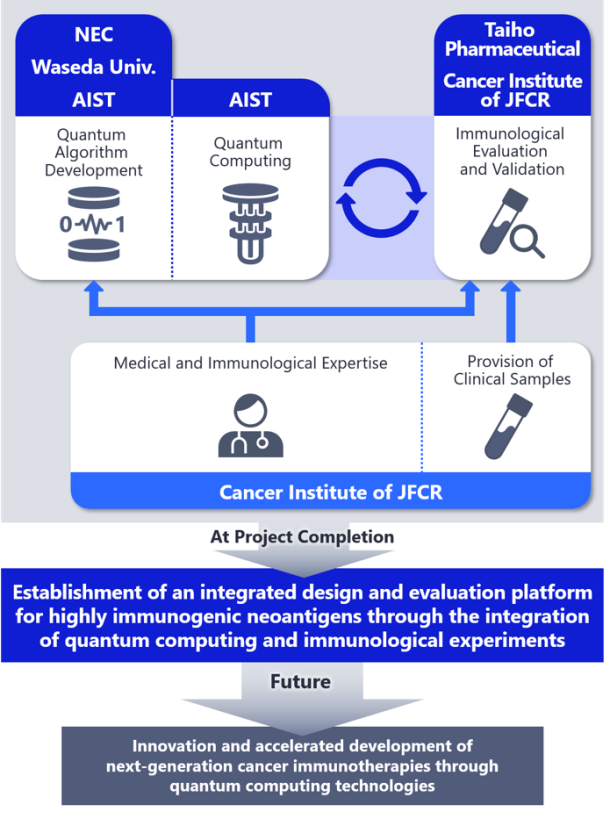
Notes:
(*1) Neoantigens are antigens generated by cancer-specific mutations. Since they are absent from normal tissues, neoantigens represent one of the most promising targets for cancer immunotherapy.
(*2) In the immune system, MHC class II molecules bind antigenic peptides and transport them to the cell surface for presentation to CD4-positive T-cells.