Waseda University Concludes an Agreement on Collaboration and Cooperation with Kanagawa Prefecture for the Promotion of Space-Related Industries
Tue, Sep 8, 2026-
Tags
Waseda University and Kanagawa Prefecture have concluded an “Agreement on Partnership and Cooperation” (hereinafter “the Agreement”) to contribute to the promotion of space-related industries. This marks the first time the University has entered into a space-related partnership agreement with a government entity. Additionally, Waseda University plans to establish its first hub within Kanagawa Prefecture.
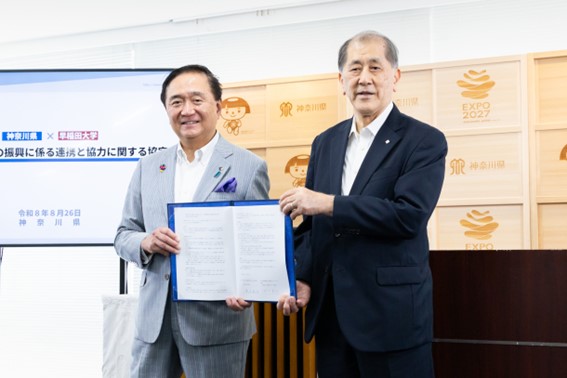
From left: Kanagawa Prefecture Governor Yuji Kuroiwa, Waseda University President Aiji Tanaka
The Purpose of this Agreement
The objective is to contribute to the promotion of space-related industries through close coordination and cooperation between the two parties, based on the spirit of mutual benefit, in various fields where mutual cooperation is possible.
Key Areas of Collaboration
(1) Matters related to promoting and raising awareness of “dual applications in space and on Earth”—specifically, the application of technologies developed for the space environment, where resource use is limited, to sustainable living on Earth;
(2) Matters related to the development, recruitment, and exchange of personnel who contribute to the promotion of space-related industries;
(3) Matters related to the societal application and implementation of research results from the Space QOL and ECLCSS Co-creation Hub established by Waseda University in Kanagawa Prefecture;
About the Space QOL/ECLSS* Co-Creation Hub Promoted by Waseda University
Waseda University will advance research and development aimed at improving space-based Quality of Life (QOL) and delivering value back to society on Earth through the JAXA Space Strategy Fund project “SX-CRANE” (SX-Center of Research And Engineering”). Professor Tomomi Nonaka of the Global Consolidated Research Institute for Science Wisdom (affiliated with the Faculty of Science and Engineering) serves as the principal investigator for this project.
This project aims to transform space systems, which have traditionally been designed for highly trained astronauts, to accommodate the use of space by ordinary civilians in the near future, thereby realizing a comfortable and healthy life in space, or “Space QOL.” The research findings will also yield benefits for terrestrial society, applicable to areas such as disaster evacuation environments, medical and nursing care, and the hospitality industry. The University aims to establish a new research hub that generates value for both space and Earth.
Furthermore, Professor Nonaka, the principal investigator of this project, will collaborate with another education and human resource development program she leads (the “Program for Developing Human Resources in Product and Service Design Supporting Human Comfort in ECLSS Environments,” selected in FY2025 under MEXT’s “Space Human Resource Development Project”). Through this collaboration, the initiative will promote personnel development from non-space sectors, broaden the base of participants, and enhance public acceptance.
To advance these initiatives and translate research outcomes into practical societal applications, Waseda University plans to establish a “Space QOL & ECLSS Co-Creation Hub” in Kanagawa Prefecture. In addition to research and development, this hub will facilitate collaboration on information dissemination and personnel development. Looking ahead, the University aims to evolve it into a “Space QOL Lab” where individually developed technologies can be integrated, tested, and demonstrated within a space-based living environment.
* ECLSS (Environmental Control and Life Support System)
This is a foundational system that maintains the living environment within closed spaces, such as spacecraft and space stations, by performing essential functions for safe human habitation, including oxygen supply, water reclamation, carbon dioxide removal, and the regulation of temperature, humidity, and air pressure.