![[Podcast Column] Trust, Training, and the Making of Employees in Japan](https://www.waseda.jp/top/en/assets/uploads/2026/08/2026.6.29-meeting-room-screenshot-for-podcast-column-8.jpg)
[Podcast Column] Trust, Training, and the Making of Employees in Japan
Tue, Aug 25, 2026-
Tags
In this podcast column, we introduce the final episode of Season 2 of Waseda University’s English-language podcast “Rigorous Research, Real Impact.” Professor Yuhee Jung (Faculty of Social Sciences) joins the program to discuss organizational socialization, human resource management, and how newcomers transition from outsiders to insiders within organizations.
Focusing on the Japanese employment context, Professor Jung explores how long-term employment, seniority-based promotion, and company-based labor unions shape a distinctive HR system built around large-scale annual recruitment and intensive newcomer training. In the excerpt below, she explains the “simultaneous hiring system,” its assumptions about employee loyalty, and how shifting attitudes among younger generations are challenging traditional organizational expectations in Japan today.
All eight episodes of Season 2 of Waseda University’s English podcast “Rigorous Research, Real Impact” are currently streaming for free on Spotify, Amazon Music, Apple Podcasts, and YouTube.
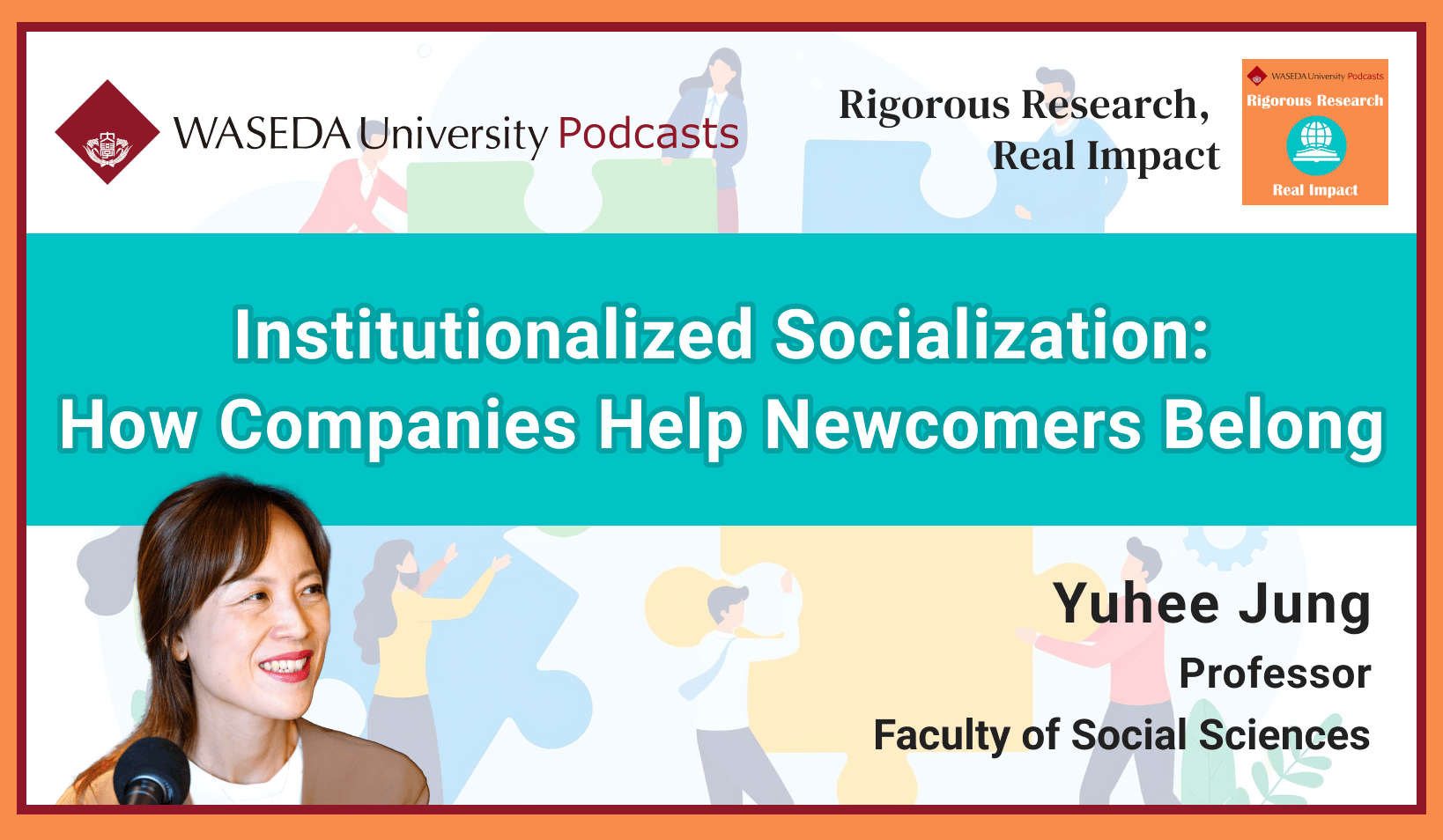
You can read the full transcript by clicking the above episode banner.
Question: What makes Japan such an important context for studying organizational socialization and human research management (HRM), especially given its distinctive employment systems?
Professor Jung (8:34):
Japan is always a unique country in terms of culture, people’s behaviors, customers, and even the good food. So many people from all over the world are interested in Japan. In the same way, Japanese companies have a very unique management style. A long time ago, scholars already mentioned this unique Japanese management style.
Professor Jung (9:11):
…long-term employment, which we call “lifetime employment,” seniority-based promotion, and company-based labor unions—interestingly, these three pillars characterize Japanese management. This is related to the very unique HR practice that I call the “simultaneous hiring system.” Simultaneous hiring system means that Japanese companies hire a large number of newcomers at once, just once a year.
For example, I remember two years ago, Toyota, a large company, they hired 1,300 newcomers at one time. This is, interestingly, a totally different practice from other countries where companies hire their newcomers if they have a need for specific positions, they hire some people.
Professor Jung (10:08):
But Japanese companies, they hire a large number of newcomers every year at the same time. Mostly, these newly graduated newcomers don’t have any industrial experience; they have no idea. This means that Japanese companies have to take the responsibility to educate and train the newcomers until they can independently conduct their tasks. So it means that it costs, it’s expensive and takes time, at least over one year.
So why do Japanese companies still keep doing this traditional thing? Because most Japanese managers strongly believe that those newcomers will stay with them until they retire, showing high loyalty to their company.
Professor Jung (11:13):
Actually, that was true, maybe for their parents’ generation. But nowadays, Gen Z in Japan is the same as Gen Z in other countries. Most of the young generation don’t believe they should stay with only one employer through their whole career. If they have a better chance, why not? They can move and change companies easily.
So now we have a big gap between the individuals—the newcomers—and the company managers’ perspective. Many HR managers are now worrying about this situation, wondering whether they should keep this same simultaneous hiring system or not.
So, Japan is now dynamically changing and transforming, and that’s why most researchers are focusing on these socialization issues in the Japanese context.
About the Guest:

Professor Yuhee Jung holds a PhD in Business Administration and specializes in organizational behavior and human resource management. She has previously served as an associate professor at Ritsumeikan University and a professor at Gakushuin University, and began teaching at the Faculty of Social Sciences at Waseda University in April 2020. Professor Jung also spent one year as a Visiting Scholar at the UCLA Anderson School of Management.