![[Podcast Column] The Strange Appeal of Abnormal Psychology in Modern Japan](https://www.waseda.jp/top/en/assets/uploads/2026/07/2026.6.29-old-typerwiter-screenshot-for-podcast-column-6.jpg)
[Podcast Column] The Strange Appeal of Abnormal Psychology in Modern Japan
Tue, Jul 28, 2026-
Tags
This podcast column features an episode of Season 2 of Waseda University’s English-language podcast “Rigorous Research, Real Impact.” In this installment, Associate Professor Pau Pitarch (Faculty of Letters, Arts and Sciences) joins the program as a guest in an episode exploring the relationship between modern Japanese literature, psychology, and cultural identity.
Focusing on his research into early 20th-century literary culture, Assoc. Prof. Pitarch examines why writers in 1920s Japan openly engaged with the idea of “abnormal psychology” as part of their artistic identity. In the excerpt below, he discusses a 1923 survey of authors that asked them to describe their own mental “abnormality,” and situates this within the broader social experience of rapid modernization and the emergence of new ideas about the overworked modern mind.
All eight episodes of Season 2 of Waseda University’s English podcast “Rigorous Research, Real Impact” are currently streaming for free on Spotify, Amazon Music, Apple Podcasts, and YouTube.
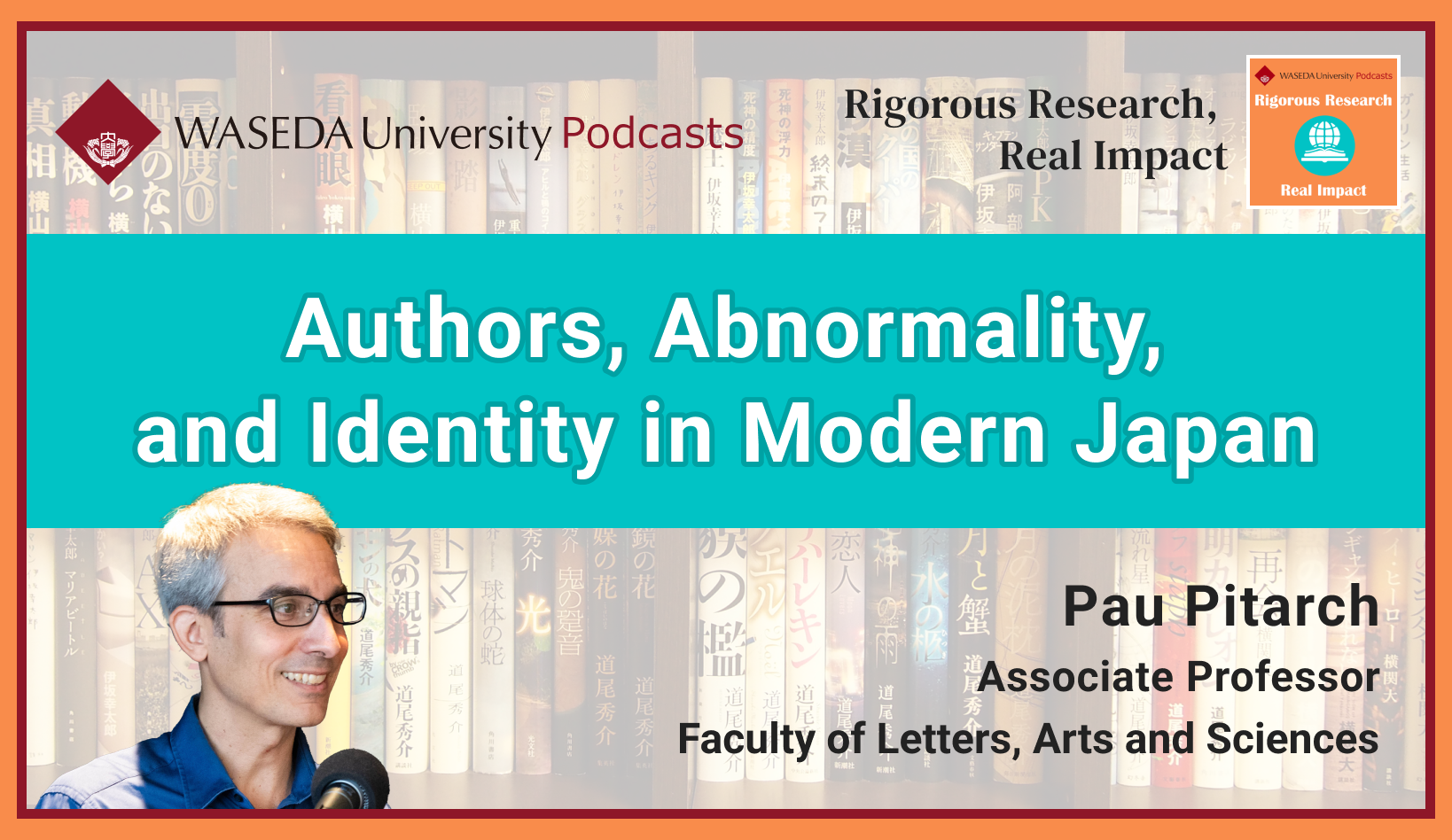
You can read the full transcript by clicking the above episode banner.
Question: In your article “Abnormal Genealogies”, you explore why many writers and artists in 1920s Japan embraced the idea of “abnormal psychology.” Could you explain the social and cultural context behind this, and why abnormality became such an important part of artistic identity at the time?
Professor Pitarch (1:55):
Yeah, it sounds odd, right? So, in this article, I’m looking at a survey of writers that was carried out in 1923. And the survey asked a very simple question: what is your mental abnormality? And I think most of us, if we got that question from a journal, would feel maybe even offended or at least weirded out. Why are you asking me about this? But it’s very interesting that in that survey, all the writers respond with great… very naturally. They know why they’re being asked what’s your mental abnormality, right? And they consider that part of their persona as artists.
Professor Pitarch (2:31):
To understand why that was so in 1920s Japan, we have to think about the way Japanese modernity was received in the 19th century, right? If you think of modernity as a process that takes several centuries in the West, that might seem odd, but in Japan, those centuries are received all together in the late 19th century after the modernization of the country. Basically, in Japan, you received discourses of progress, science, rationality, and development, together with all the worries about the effects of progress and development on the human psyche.
Professor Pitarch (3:11):
Let’s take the example of information. Japan goes from a pre-modern society with a telegraph, a postal system, news from all over the world, right? There is this worry that in modern times, we have too many stimuli. There’s too much that’s affecting our brains, and that is obviously going to overtax them. And that creates this image of the intellectual modern worker as somebody whose nerves, whose sensibility, whose brain is overworked. And that overwork is shown in this psychopathology of the time, right? And it’s, if you think about it, it’s very easy to self-diagnose oneself as, “Oh, I’m too nervous. I can’t sleep well. I’m tired. It must be that I’ve been reading too much. I’ve been thinking too much,” right?
It’s a pathology, but it’s also a way of showing that you are kind of embedded in this modern times where stimuli are flowing, everything happens very fast, right? You’re living in that modernity, and that–your psychopathology–is proof that you are smack in the middle of that exciting new world.
About the Guest:

Associate Professor Pau Pitarch
Associate Professor Pau Pitarch’s specialization is modern Japanese literature and media. He is interested in exploring how issues of aesthetics, psychology, ideology, and economics interacted in the formation of the modern literary field. He has published on authors like Akutagawa Ryūnosuke, Chŏng Yŏn-gyu, Okamoto Kanoko, Ōtsuka Kusuoko, Satō Haruo, and Tanizaki Jun’ichirō, among others. His wider interests include narratology, translation, and the development of global genres such as mystery, fantasy, horror, and science fiction. Pitarch received his B.A. in Comparative Literature from Universitat Autònoma de Barcelona, M.A. in Japanese Literature from the University of Tokyo, and Ph.D. in Japanese Literature from Columbia University. He previously taught at CUNY Queens College (2015-2017).