
Is it better to be fat in a cold environment?
There is a story (a myth) that “if lost in a snowy mountain or sea (in water), fat people have a better chance of survival.” We cannot make a general statement, but there may be a common understanding that being fat gives you a higher adaptability to cold environments.
Animals that hibernate in winter, such as bears, eat until they are full just before hibernation, accumulating nutrients. This might have led to the idea that “being fat = more nutrients = better survival.” Though unscientific, there is also another perception that “being fat = uncomfortable in heat = storing heat.”
These are simply perceptions that individuals hold, but in fact, a German anatomist, Carl Bergmann, discovered that for the same species, the body size tended to be greater in colder areas. This is called “Bergmann’s rule.” The reason for this phenomenon is that the larger the body, the greater the decrease in the surface area of the body per unit of body weight, making it more advantageous to maintain the body temperature in cold environments.
How did the size of the Japanese macaque change?
Bergmann’s rule represents the relationship between changes in the body sizes of animals and temperatures in each area. I was curious if this change in body size is also affected by temperature change over time and thus began my research. To examine this topic, one must begin with whether sizes of teeth and bones preserved as fossils follow Bergmann’s rule. From my Master’s program, I moved onto the Primate Research Institute of Kyoto University and first examined if Bergmann’s rule can be applied to the size of the teeth of the present-day Japanese macaque.
Generally, body size is correlated with the size of teeth (molars). When body size increases, the head increases in size, followed by the jaw and teeth. The size of the permanent teeth does not change notably for many mammals; thus, these are suitable criteria for determining the body size.
Thus, I examined the geographical environmental gradient and teeth size of the present-day Japanese macaque. When I measured the teeth size of populations in Honshu, Shikoku, and Kyushu and analyzed the results, I found a trend in which the mean dimensions of the crown for molars in each population clearly decreased from areas with low mean temperature in the coldest month (January) to areas with high mean temperature. In other words, the tooth size of the Japanese macaque increased in colder areas, following Bergmann’s rule.
Next, I examined fossils of the Japanese macaque to see if Bergmann’s rule applies to not only regional variation in the living species but also to changes in size over time. With the increase in temperature from the last ice age (about 10,000 years ago) to today, I examined if the body size of the Japanese macaque decreased using fossils of molars.
Fossils of Japanese macaque have been found in several hundred locations in Honshu, Shikoku, and Kyushu, which is consistent with the distribution of the living species. Some argue that there were fossils larger than the living species, while others say the fossils were smaller. There is no consensus, and changes in the body size of the Japanese macaque in the past and present remain unclear. Therefore, I decided to conduct a thorough re-examination. Genetically, living Japanese macaque is divided into the eastern Japan population and western Japan population. According to this division, we compared the molar size of Japanese macaque fossils and found that there was little difference between the eastern and western populations in the late Pleistocene (about 130,000 to 10,000 years ago), but by the early Holocene (about 10,000 years ago), there appeared a population with relatively smaller molars in western Japan (Chugoku and Kyushu regions) (Figure 1). In other words, it is possible that in some areas, the Japanese macaque decreased in size around the late Pleistocene/Holocene boundary.
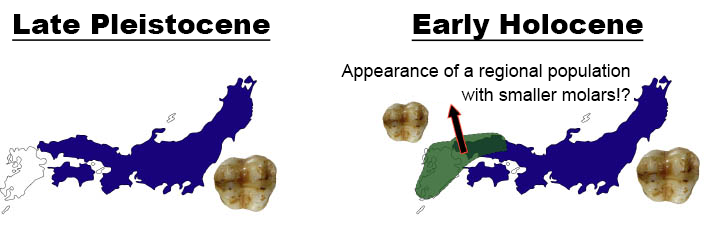
Figure 1. Discussion on geographical differentiation of Japanese macaque based on fossils of molars (from measurement data by Nishioka et al., 2011). Left, late Pleistocene; right, early Holocene.
In such a quantitative analysis, it is important how skeletal specimens of the living species and fossils are collected. Attempts were made to exterminate the Japanese macaque at times, and I was able to collect skeletal specimens of living species across Japan. However, the number of fossil Japanese macaque samples is low, and continuous surveys in the future are necessary. I will use the experience I gained in the study of the Japanese macaque and examine small mammals such as mice and bats, for which a relatively large number of fossils have been found.
Waseda University Nobuo Nara fossil collection
Waseda University stores a fossil collection gathered by the late Dr. Nobuo Nara (a professor at the Faculty of Science and Engineering). The majority of this collection burned down during World War II, but a recent survey by Waseda University discovered that a part of the collection was preserved at Honjo Archaeological Museum in the Honjo Campus. The Nara Collection contains several hundred mammalian fossils, among which Quaternary sediments (from about 2.6 million years ago) sampled in Kuzuu Quarry in Sano City, Tochigi Prefecture, were discovered (Figure 2).
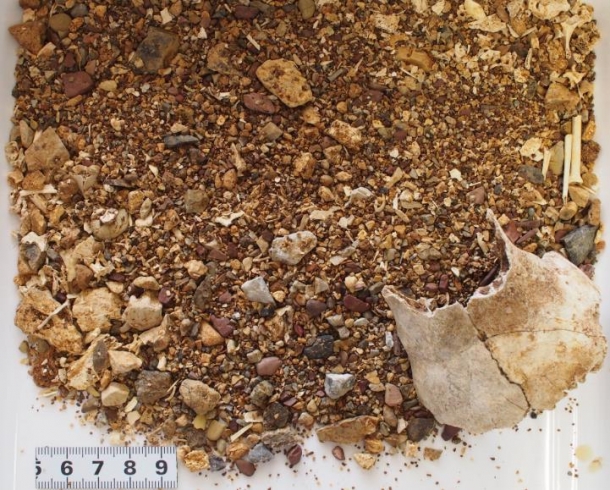
Figure 2. A large number of small fossils included in the Kuzuu sediments in the Nara Collection
When this sediment was washed with water and sieved, hundreds of small mammalian fossils—large Japanese field mouse (Apodemus speciosus), Japanese grass vole (Microtus montebelli), Japanese white-toothed shrew (Crocidura dsinezumi), and bats—were discovered. We are currently working on species identification and morphological analysis (Figure 3). Because we found a large number of fossil samples from one location, which was not possible with Japanese macaque, we hope that we will be able to elucidate the changes in the sizes of the animals over time.
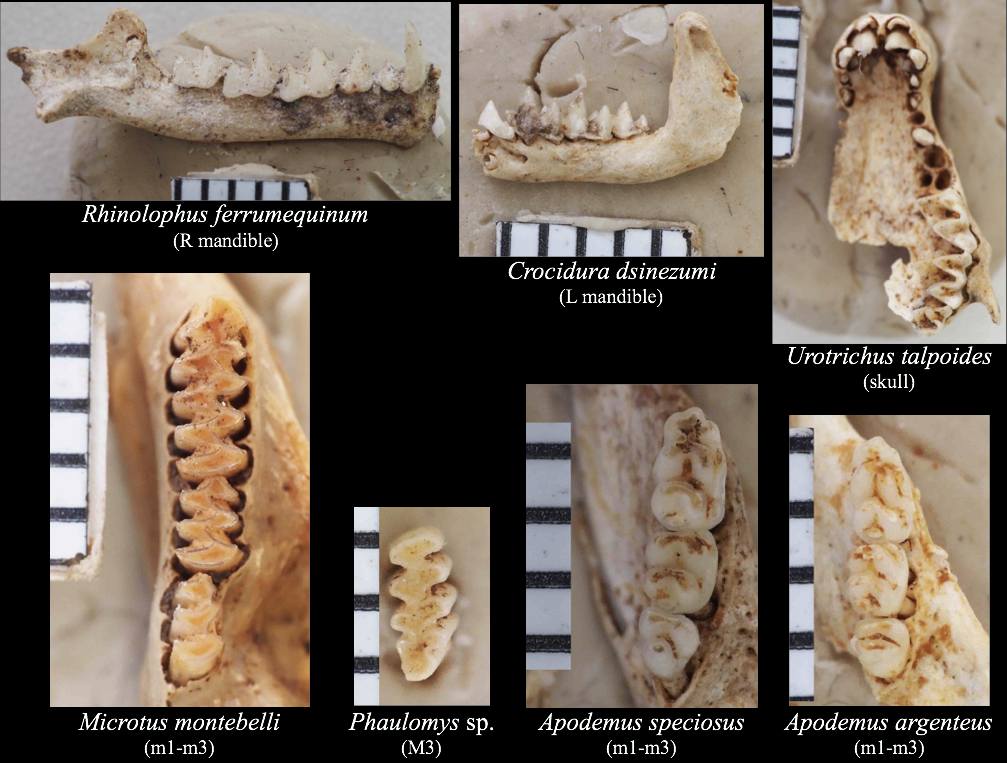
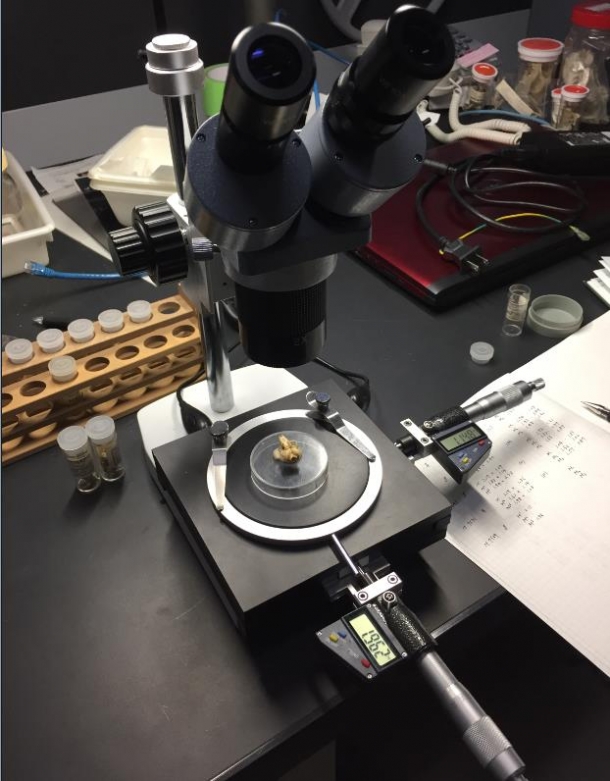
Figure 3. Left: Fossils of jaws and teeth of small mammals collected from the Nara collection. Clockwise from top left: greater horseshoe bat (Rhinolophus ferrumequinum), Japanese white-toothed shrew (Crocidura dsinezumi), Japanese shrew mole (Urotrichus talpoides), small Japanese field mouse (Apodemus argenteus), large Japanese field mouse (Apodemus speciosus), a species of Smith’s vole (Phaulomys sp.), and Japanese grass vole (Microtus montebelli); right: observation and measurement of small mammalian fossils are performed under a stereomicroscope.
Deriving a theory on fossil research for the future
The father of the theory of evolution, Charles Darwin, observed many living organisms and extinct animals and pondered how living organisms have evolved. In recent years, studies of molecular evolution that uses DNA, etc., have become popular, but I focus on the traditional and classic morphological observations like those of Darwin. If someone asks, “What is the point of classifying fossils (living organisms)?” I would honestly answer that my contribution is likely limited to updating the information panels and exhibits in museums. However, it is obvious that gathering such fundamental data leads to building a theory. In the field of ecology, there are studies that graph observational results (numerical data) of living organisms and create a numerical model for temporal behavior and the evolutional process. If we are able to show that the body sizes of mammals change with temporal changes in temperature, we may be able to model these changes to predict how the morphology of mammals will change with environmental changes in the future. Today, there are many animals that are threatened by extinction. To consider measures to prevent the extinction of such animals, a theory of evolution and extinction of living organisms will be necessary.
Many mammals became extinct from the last ice age to today. Generally, the extinction of past animals, including dinosaurs, has received attention in paleontology. However, I want to focus on why and how extant animals were able to withstand the harsh environmental changes and survive, and my research results are expected to be useful for future studies.
Interview and Composition:Chisato Hata
In cooperation with: Waseda University Graduate School of Political Science J-School