Imagine walking on the surface of the Moon. Your primary task is to navigate from the lunar lander to a geology site and collect scientifically valuable rock samples. You look to the horizon for direction, but there are no trees, snowy mountaintops, or structures of any kind to guide you. The sun is blindingly bright. The shadows are pitch black and may conceal hazardous craters that could trap you. Every movement reminds you that you are inside what is essentially a portable spacecraft. While walking in this spacesuit, you must continuously monitor life-support consumables, work efficiently to stay on the timeline, and communicate with mission control center (MCC) against a small but noticeable communication delay.
When you reach your destination, and throughout the traverse, you must see the terrain around you through the eyes of a geologist, recognizing subtle differences in rock formations, variations in color and texture, and mineral signatures you learned during training. You carefully kneel—no easy task in a pressurized spacesuit—and brush aside some lunar regolith. Is that outcrop rich in olivine, or pyroxene? As you examine the geology site, MCC reminds you that you have less than an hour left to spend on this part of the EVA. You start to respond, but the fragmented sleep from the night before, and the many hours of EVA you’ve already conducted this week, seems to slow your reaction time. You take a deep breath, examine the outcrop once more, and make your call. It’s olivine.
Future astronauts conducting extravehicular activity (EVA) on the Moon will routinely face situations like these. These environments will not only be physically demanding but extraordinarily cognitively demanding as well. Although they will undergo extensive training to prepare for these conditions, future astronauts will be asked to accomplish more than ever before.
Psychology in Extreme Environments
I am a psychologist and cognitive neuroscientist by training. From my graduate and postdoctoral research examining how social, cultural, and psychological factors shape the experience of pain, to my current work investigating cognition in high-stakes operational environments such as human spaceflight, I have been driven by a common question: how do humans adapt their thinking and behavior in challenging conditions? Although my research has explored very different contexts, from the doctor-patient relationship to walking on the Moon, they share a common theme in understanding how the human mind adapts when confronted with adversity, uncertainty, and constraint.
In graduate school, I gained experience using simulation and virtual reality to understand the factors influencing pain perception in the doctor-patient relationship. These simulations allowed me to leverage multimodal methods, such as self-report, psychophysiology, and brain imaging to better understand these complex processes. Replacing the medical context in my graduate training with simulated spaceflight at NASA was a surprisingly natural transition. The key was that both contexts allowed me to pursue my core interest in the constraints that shape human cognition in adverse conditions, and how humans can perform and adapt despite these constraints.
Lessons from Human Spaceflight
The experience of an astronaut on the Moon is a useful model for understanding how humans adapt their thinking and behavior in the face of adversity. Although no human has walked on the surface of the Moon since 1972, there are numerous ways to simulate this challenging environment on Earth. While at NASA, my research focused on one of the most physically and cognitively demanding sets of tasks that astronauts can execute: surface EVA. With the goal of returning humans to the Moon and eventually Mars, I supported NASA’s Behavioral Health and Performance Laboratory in conducting a series of studies whose goal was to characterize the cognitive demands of surface EVA. Toward this aim, we first conducted a cognitive task analysis in which we interviewed astronauts and experts in EVA operations and research. We wanted to understand what specific tasks are cognitively demanding during surface EVA; what cognitive domains and brain regions potentially underlie these cognitively demanding tasks; and what strategies can be used to maintain optimal performance despite these substantial cognitive demands. The face-to-face interviews I conducted for this project, particularly with highly experienced astronauts, were among the most intellectually engaging experiences of my professional career. I was able to talk to astronauts and experts about a topic that I was passionate about—cognition and adaptation in extreme environments—that was not often discussed in day-to-day operations at NASA.
The resulting study (Anderson, Jorge, & Bell, 2025) shed light on the distributed cognitive demands during the various tasks that comprise surface EVA. In both open-ended remarks and self-reported ratings, there was substantial variability in the perception of cognitive demand of these tasks within and across the different groups of experts interviewed.
Surprisingly, one of the tasks that experts agreed would be highly cognitively demanding was traverse, or navigation between different work locations on the lunar surface. At first glance, traverse would seem to be merely walking from point A to point B. How could this be cognitively demanding? In talking to experts, however, it became clear that traversing on the surface of the Moon is mentally challenging for many reasons, including the adaptation and altered gait needed to walk effectively in new spacesuits in partial gravity, navigation in the harsh lighting conditions of the Moon, and the need to continuously multitask, task switch, and suppress distracting information under time pressure, where any mistake could have life-threatening consequences.
Simulating Spacewalks with Virtual Reality
Based on the results of the cognitive task analysis, we then sought to understand the relationship between the cognitive demands of a surface EVA task and actual performance on that task. In the resulting study (Anderson et al., 2026), we experimentally manipulated the cognitive demands of a specific task highlighted in our cognitive task analysis—geological sample identification—using a combined virtual reality and treadmill setup. Participants completed hours of physically and cognitively demanding surface EVA tasks in a morning and afternoon session, with the difficulty of the geological sample identification task experimentally manipulated between sessions to result in either high or low cognitive workload.
As expected, participants reported that the geological sample identification task in the high cognitive workload condition was more mentally demanding than in the low cognitive workload condition. The quality and efficiency of their performance on this task were also lower in the high compared to low cognitive workload condition (Figure 1a-b). We furthermore saw physiological changes consistent with increased cognitive workload during the high compared to low cognitive workload condition, specifically increased heart rate and decreased heart rate variability.
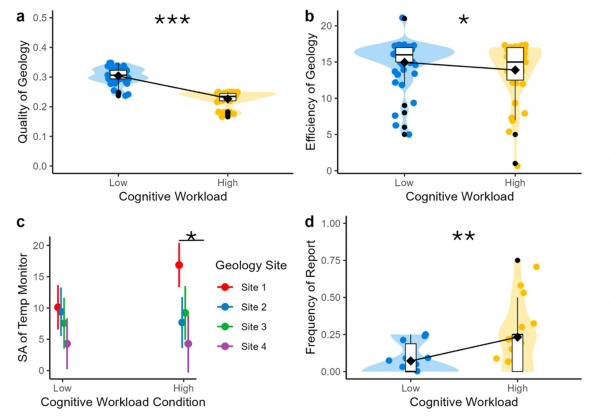
Figure 1. Differential effects of surface EVA task cognitive workload on performance.
Interestingly, however, increasing the cognitive workload of geological sample identification did not uniformly impact performance on the other EVA tasks. For example, we found that participants’ situational awareness (SA) of their secondary task of suit temperature monitoring increased during the first geology site of the high workload condition, before steeply decreasing by the second geology site (Figure 1c). Participants were also more likely to report noticing an unexpected, but geologically significant, discovery (water ice crystals) in the high compared to low cognitive workload condition (Figure 1d). This suggests that the increased cognitive workload of the geological sample identification task in the high workload condition may have redistributed cognitive resources rather than merely degraded them. Understanding this adaptive reallocation of cognitive resources in challenging environments, and the role that technology can play in optimizing this process, has become a central theme of my research.
From Cognitive Workload to Cognitive Offloading
The research I’ve conducted to date raises an interesting question: do all the cognitive demands of thinking under pressure need to be handled internally? In many high-stakes operational environments, they’re not: artificial intelligence (AI) systems, physical checklists, team coordination, and MCC all change how cognitive work is distributed. This motivates research focused not just on how individuals manage cognitive workload in challenging circumstances, but how cognitive work can be redistributed. I’m particularly interested in how technology can be used toward this aim. Under what conditions can technology be used to improve cognitive performance in high-stakes operational environments without introducing new risks?
The phenomenon of cognitive offloading, defined as the use of a physical act or tool to alter the information processing requirements of a task (Risko & Gilbert, 2015), is a useful lens to examine this research question. Cognitive offloading via technology can help reduce cognitive workload in safety-critical human performance domains, but only when it is done effectively. As humans increasingly rely on technology for cognitive offloading, it is crucial to understand how it can be most effectively integrated in these environments. For example, there is emerging concern that suboptimal use of generative AI can have detrimental effects on human cognition, a phenomenon that has been termed “cognitive surrender” (Shaw & Nave, 2026). If AI has the potential to augment human cognitive capabilities in high-stakes operational environments, the challenge becomes leveraging it appropriately to improve performance without introducing new risks. As emerging technologies become increasingly integrated into everyday decision-making, understanding not only how humans think under pressure, but also how cognitive work can be most effectively shared between people and technology, will become an increasingly important scientific challenge.