
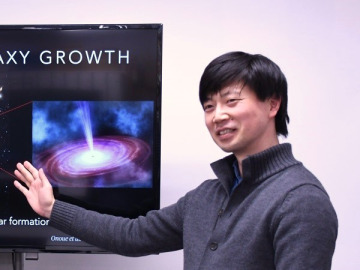
ONOUE Masafusa, Assistant Professor
The Ultimate Question
“Who are we? Where do we come from? Where are we going?” This famous phrase comes from the title of a painting by the 19th-century artist Paul Gauguin. While it is often interpreted as a reflection on the human life cycle, it can also be seen as expressing the fundamental questions humanity has long asked about our own existence.
The ultimate scientific approach to these philosophical questions is astronomy. Astronomers seek to uncover the origin of our universe by observing its history, from the Big Bang, which occurred about 13.8 billion years ago, to the present day, and by tracing the formation and growth of stars and galaxies within it (Figure 1).
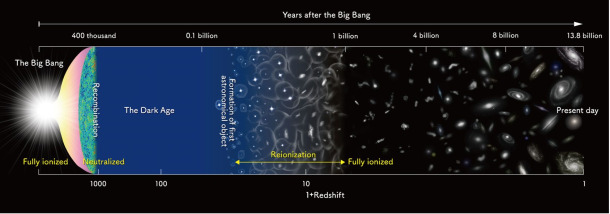
Figure 1:History of our Universe from the Big Bang to the current universe (NAOJ)
Astronomy as a Time Machine
Astronomical observations are often compared to traveling back in time. About a century ago, a US astronomer Edwin Hubble demonstrated that the Universe is expanding. This means that more distant celestial objects are receding from us at higher speeds, and the light they emit takes hundreds of millions or even billions of years to reach the Earth.
To understand the vast 13.8-billion-year history of the universe, astronomers therefore need to observe light coming from the most distant objects from the distant past. Alongside stars and galaxies, objects called “supermassive black holes” are often used to trace the cosmic history —- But what exactly are these black holes?
Black Holes as Cosmic Beacons
Black holes may sound like objects from science fiction, but they are in fact common in the real universe. Astronomers now know that black holes with masses ranging from one hundred thousand to ten billion times that of the Sun are ubiquitous and they are found at the centers of galaxies.
The closest example is found at the center of our own Milky Way galaxy. Two independent teams, led by Prof. Andrea Ghez (UCLA) using the Keck Telescope and Prof. Reinhard Genzel (MPE) using the Very Large Telescope, utilized adaptive optics to track the motion of stars orbiting the Galactic center for more than a decade. From these stellar orbits, they revealed the presence of a giant black hole with a mass about four million times that of the Sun. This groundbreaking work was recognized with the 2020 Nobel Prize in Physics.
Black holes are often imagined as objects that simply swallow everything around them. In reality, however, part of the gravitational energy of infalling matter is converted into intense radiation during the accretion process. Such luminous black holes are known as active galactic nuclei or quasars, and their brightness can exceed that of their host galaxies by orders of magnitude. Thanks to this extraordinary luminosity, black holes serve as cosmic “lighthouses,” allowing us to probe the distant universe.
Young Universe, Surprisingly Massive Black Holes
What were black holes like in the young universe, within the first billion years after the Big Bang, about 13 billion years ago? In such an early epoch, luminous black holes are extremely rare, meaning that astronomers need to observe enormous area of the sky, hundreds or even thousands of times larger than the apparent size of the Moon. These wide-area studies, known as survey observations, have been conducted since the 2000s, most notably by projects such as the Sloan Digital Sky Survey (SDSS).
These wide-field surveys revealed a profound mystery. Even when the universe was less than one billion years old, black holes with several billion times the mass of the Sun, among the most massive known in the entire cosmic history, already existed (Figure 2).
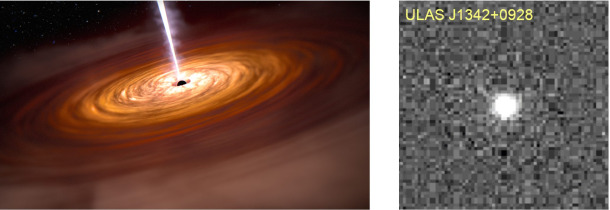
Figure 2: (Left) Illustration of an accreting supermassive black hole (NASA, ESA, CSA, Joseph Olmsted (STScI))
(Right) One of the most distant supermassive black holes currently known, ULAS J1342+0928 (Eduardo Bañados (MPIA), Xiaohui Fan (University of Arizona))
Why is this so puzzling? The growth of black holes is regulated by a balance between gravity pulling matter inward and radiation pressure pushing outward during accretion. This balance imposes a theoretical upper limit on the growth rate, known as the Eddington limit. If the initial “seed” black holes were small remnants left behind by massive stars, then even continuous growth at the Eddington limit would not be sufficient to reach the observed masses within such a short time.
To explain this mystery, two main scenarios have been proposed. One possibility is that early black holes accreted matter beyond the maximum (Eddington-limited) accretion rate, allowing them to grow extremely efficiently. The other is that the initial seeds were already very massive, formed not from stellar remnants but from the direct collapse of enormous gas clouds with masses exceeding one hundred thousand Suns. Current observations have not yet determined which scenario is correct, or whether other possibilities exist, and theoretical studies are actively exploring these questions. Observational astronomers like myself search for the hints of first black hole formation at the edge of the observable universe.
Searching for the First Black Holes — Farther and Fainter —
Directly observing the “seed” black holes in the early universe is extraordinarily challenging, given their faintness and extreme distance. Instead, astronomers aim to identify black holes as close as possible in time and mass to these seeds, in order to constrain their formation scenarios.
Since my graduate-student years, I have been involved in searches for distant black holes using the Subaru Telescope in Hawaii. By utilizing its 8.2-meter primary mirror for large-scale survey observations, our project has discovered around 200 distant black holes (Ref. 1). These data were obtained through an international collaboration involving Japan, Taiwan, and Princeton University as part of Subaru’s strategic survey programs.
The launch of the James Webb Space Telescope (JWST) at the end of 2021 marked a true game changer in this field. JWST’s unprecedented sensitivity allows us to detect objects more than one hundred times fainter than those accessible to ground-based telescopes, opening the door to the discovery of younger and smaller black holes. Using early JWST data, I was among the first to identify distant black holes in the early universe (Ref. 2).
Moreover, the JWST’s space-based observations, which are free from atmospheric turbulence of the Earth, have enabled us to directly detect the host galaxies of supermassive black holes. These observations are expected to greatly advance our understanding of another long-standing question in astronomy: did black holes grow first, or did galaxies form first? This cosmic-scale “chicken-and-egg” problem lies at the heart of the co-evolution of galaxies and their central black holes in the distant universe (Ref. 3, Ref. 4).
Astronomy is now entering a golden era of large survey projects. Over the next decade or two, JWST and the Subaru Telescope will be joined by new large projects such as the European Euclid space satellite, the Vera C. Rubin Observatory, and the Roman Space Telescope, which will provide powerful new tools to address the origin of supermassive black holes. In addition, a new infrared space telescope mission, GREX-PLUS, is currently being developed, where Waseda University playing a central role (Ref. 5).
The astronomers’ journey to uncover our cosmic origins has only just begun.