I want you to experience the scenery that can be seen on stage.
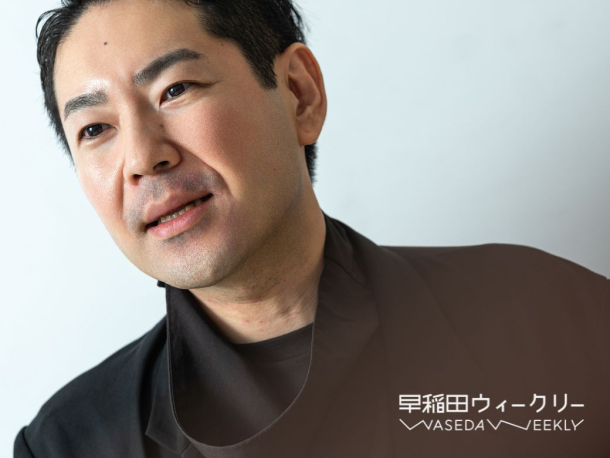
Junichi Tsukada, Producer, Theater Department, Toho Co., Ltd.
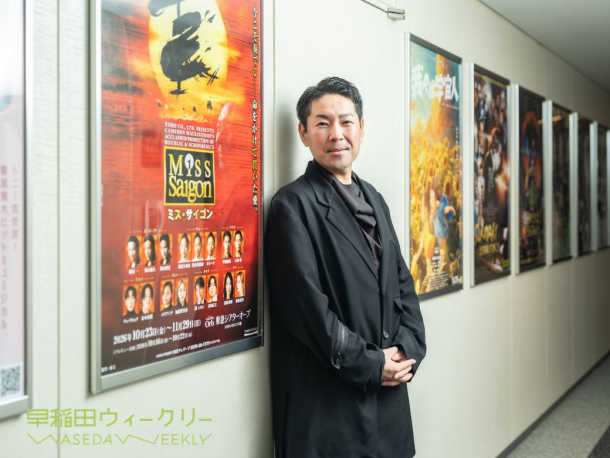
At Toho Co., Ltd.
The musical "Miss Saigon," which depicts a tragic love story at the end of the Vietnam War, has been a hit worldwide since its premiere in London's West End in 1989. Now, in October 2026, it is being performed in Japan for the first time in four years, and is playing to sold-out houses every day. The producer of "Miss Saigon" is Junichi Tsukada of Toho Co., Ltd.'s (hereinafter referred to as Toho) theater department. While attending Waseda University, he worked part-time at a movie theater and joined Toho with the desire to "work in a job that conveys movies." How did Tsukada become a musical producer from there?
The applause directed at the blank screen changed course.
Tsukada has a scene he can never forget. It was a scene he saw at the movie theater "Chante Cine" where he worked part-time during his university days.
"After the screening of 'Callas Forever,' a film about the legendary opera singer, the audience gave a standing ovation to the blank screen. I was surprised that it continued not just on the opening day, but for several days. I'd seen it in dramas and movies before, but that was the first time I'd seen it in real life. It was shocking."
How do you encounter something that moves people's hearts? And how do you share that emotion? These are things that Tsukada has been conscious of ever since he was in his hometown of Amakusa City, Kumamoto Prefecture.
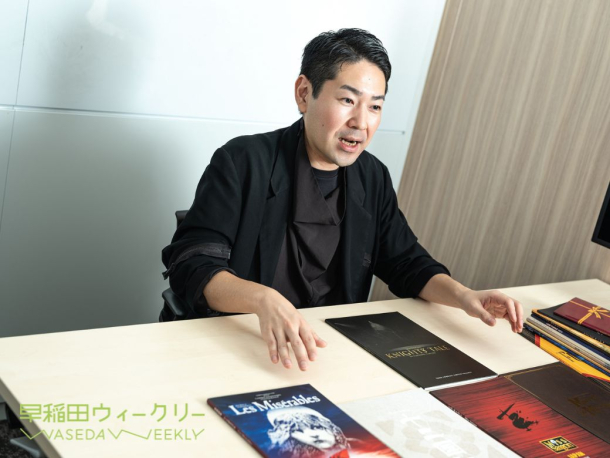
Pamphlets of the works he has been involved with so far
"Since I lived in the countryside, there was only one movie theater in my town. There was a time lag between movie screenings in the city and those in the countryside. Of course, streaming services didn't exist back then. If I didn't actively seek out information, I wouldn't encounter new and exciting experiences. From this experience, I learned the importance of information, and I began to think that one day I wanted to be on the side that shares that information."
Attracted by the idea of communication, he enrolled in the School of Political Science and Economics at Waseda University, seeking a place to learn about communication with various people. After entering university, he dedicated himself to a part-time job at a movie theater, wanting to immerse himself more in his favorite movies.
"I gained experience in various aspects of running a movie theater, including attracting customers, selling tickets, working at the concession stand, and doing the end-of-day tallying. I spent 10 months of the year working this part-time job, and with the money I saved, I spent two months in Italy studying the language. It was out of curiosity, wanting to learn more about the world of Italian films, which I loved."
During my job search, my themes were "communicating with people" and "moving people's hearts." That said, I mainly applied for MR (Medical Representative) positions at pharmaceutical companies.
"Because my father was often ill, I was interested in working in the medical field. I thought that the Medical Representative (MR) position, which requires accurately conveying pharmaceutical information, would be rewarding in terms of communicating something. In fact, I received several job offers."
Nevertheless, that scene he saw in the movie theater motivated Tsukada's life.
"I could never forget the impact of the standing ovation. The power of film is incredible in that it can move people's hearts. Because the Shante Cine where I worked part-time was affiliated with Toho, I only applied to Toho in the film industry. The employees I worked with even created a practice test for the entrance exam for me and gave me advice. I also had a strong desire to work with these people."
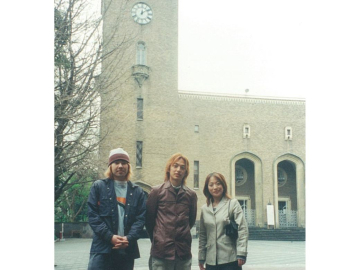
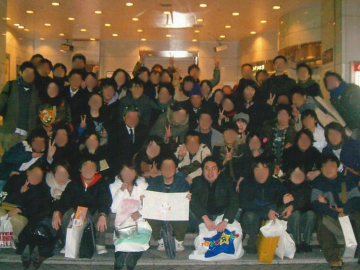
Photo on the left: With a friend in front of the Okuma Memorial Hall during university days (Tsukada is on the left). Prof. Keikichi Ohama (Professor Emeritus Faculty of Political Science and Economics) He belonged to a seminar and wrote Bachelor's Thesis on "Copyright Law Related to Entertainment."
Photo on the right: With fellow part-time staff from Chante Cine upon graduation (※ Renamed "TOHO Cinemas Chante" in 2009)
Tsukada's wishes were granted, and he received a job offer from Toho. Wanting to understand the audience better in order to convey the appeal of movies, he requested to work in a "theater" during his placement interview, intending to work in a movie theater. However, he was actually assigned to the drama department in charge of the Imperial Theatre, "the sacred ground of Japanese theater and musicals."
"The HR department told me, 'You mentioned a theater, so we've assigned you to the Imperial Theatre.'... My first experience with theater was the musical 'Miss Saigon,' which I saw when I was still a prospective employee, so I was completely clueless."
"Doing nothing" is the ideal: Creating a stage that brings out the best in professionals.
For Tsukada, the world of theater was unknown. However, encountering that scene again when he saw "Miss Saigon" before joining the company became a major realization for him.
"The standing ovation that led me to join the company was also present when I first saw 'Miss Saigon.' I realized that theater is an incredible medium, something I hadn't known before. The films, plays, and anime that Toho delivers all share the same fundamental principle: how to deliver something that resonates with the audience's hearts. It was inevitable that I, someone who aspired to work in film, would gradually become captivated by theater and musicals."
Of course, there were also difficulties in adapting to an unfamiliar world.
 "I couldn't understand a thing my seniors in the drama club were talking about. For example, 'kamite' (stage right) and 'shimote' (stage left). From the audience's perspective, the right side of the stage is called kamite, and the left side is called shimote, and I was completely lost when these terms were being used in normal conversation. Because of that embarrassment and frustration, I watched every single production that Toho was putting on. Furthermore, I read through past pamphlets and scripts to memorize each technical term one by one, and I desperately tried to remember the faces, names, and jobs of the actors and staff."
After working in theater sales for two years, then in the accounting department and the theater department's publicity office, Tsukada has been working as a "theater production producer" since 2015, handling various productions. When asked about the kind of producer he aspires to be, he replied, "Someone who does nothing."
"One of the producer's jobs is to cast the actors and decide which staff members to ask to work on the production once the play has been decided. That's about 150 people. This is just the number of people inside the theater; many more are involved behind the scenes. Since we're gathering professionals, if the set runs smoothly, the producer doesn't have to do anything. That being said, in reality, both the actors and staff are professionals, so they have their own particularities, and there will be times when they clash. So, the challenge is to talk things through, make adjustments, and find common ground to create an environment where everyone can work comfortably. Once that's done, all I have to do is watch the rehearsals while sipping tea. Enjoying myself is the first step to ensuring the audience enjoys themselves."
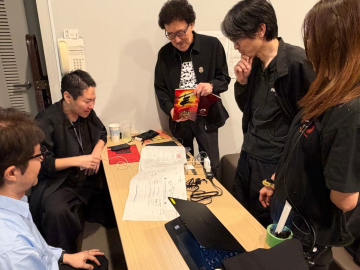
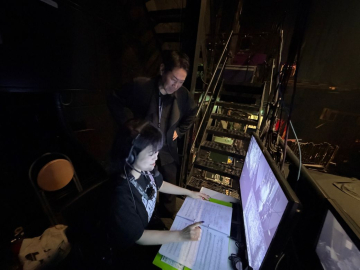
A scene from a meeting for the 2026 production of "Miss Saigon" (left). He and the cue caller (responsible for timing lighting, sound, scene changes, curtain operations, etc.) (right)
The role of a producer is not only to create works, but also to create new value.
"Once a film is completed and gains popularity, the number of theaters showing it can be steadily increased. Business schemes for secondary and tertiary uses, such as streaming and home video releases, are also well-established. On the other hand, 'theater,' which has limited performances and venues, faces many challenges from a business perspective. When staging overseas works, secondary use is sometimes not even permitted. I would like to see more stage adaptations of original Japanese works, as well as Japanese manga and novels."
One example of this is Tsukada's 2025 production of the musical "Tsuki no Kage Kage no Umi Jūni Kokuki" (The Twelve Kingdoms), based on Fuyumi Ono's novel series "Jūni Kokuki" (Shinchosha Bunko). An arena concert based on this musical is also scheduled for the summer of 2027. In his days of considering such new developments, he draws inspiration from experiences outside of theater. Now that theater occupies a large part of his life, he says he feels the importance of the interests he cultivated during his student days.
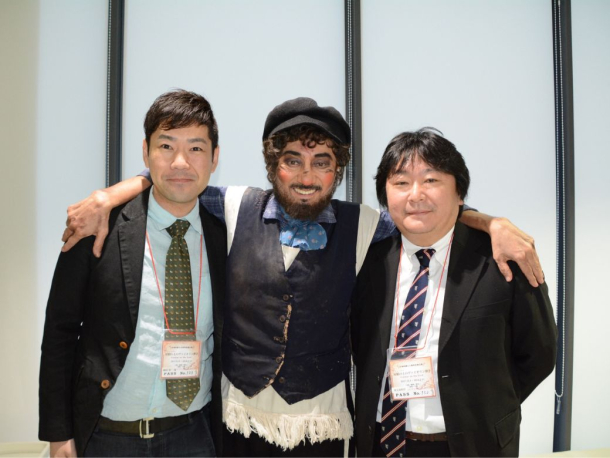
Pictured with Masachika Ichimura (center), the lead actor in the 2017 production of "Fiddler on the Roof" (Tsukada is on the left). He says he learns a lot from the actors.
"Even when I'm off duty, my mind is 'theater' 24/7. Even when I'm looking at natural scenery, I find myself thinking, 'How can I recreate this on stage?' It's definitely an occupational hazard. But to attract people who, like my former self, haven't had a theater background, you need 'ideas outside of theater.' That said, there's not much time to dedicate to things other than theater. That's where what you've experienced throughout your life becomes important. I'm diligently opening up all sorts of drawers in my mind, searching for some kind of seed. So, while it's important to immerse yourself in something, I want you to be interested in a variety of things. I don't think there's a single wasted experience during your student days."
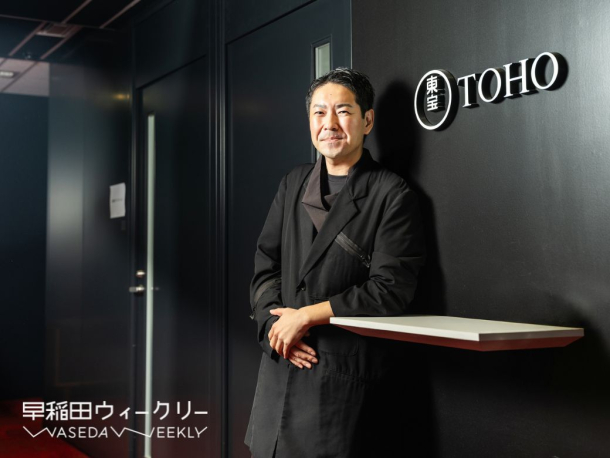
Interview and text:Naoto Oguma (Graduated from School of Letters, Arts and Sciences II in 2002)
Photography: Kota Nunokawa
【Profile】
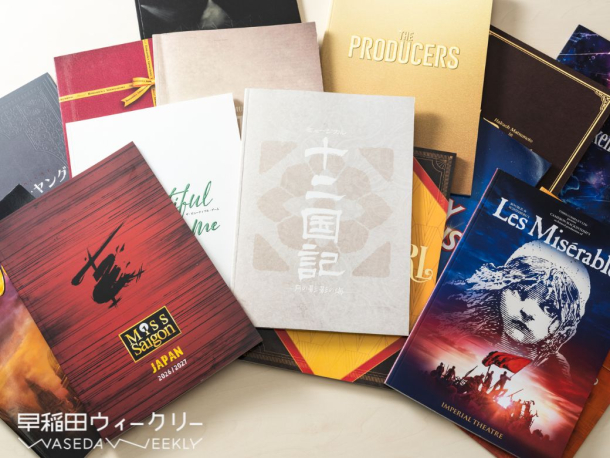
Pamphlets of works that Tsukada has been involved in so far
Born in Kumamoto Prefecture. Graduated from Waseda University's School School of Political Science and Economics in 2005 and joined Toho Co., Ltd. After working in the Imperial Theatre's sales department, accounting and Financial Affairs Division, the theater department's publicity office, and the theater department's planning office, he became a producer in 2015. In addition to "Miss Saigon," he has worked on a variety of productions including "Funny Girl," "The Twelve Kingdoms - Shadow of the Moon, Sea of Shadows," "Frankenstein," "The Producers," "Ragtime," "Man of La Mancha," "Fiddler on the Roof," "Knights' Tale," "Les Misérables," and "Mary Poppins." He loves to eat, and his favorite Waseda cuisine University foods include the beskara and nasu kara from "Waseben," as well as restaurants like "Merci," "Kitchen Otoboke," "Meiyau," "Sanpin Shokudo," and "Gonbee."