"I want to be someone who can selflessly dedicate themselves to others and society."
Risako Kikuchi, 3rd year student School of Sport Sciences
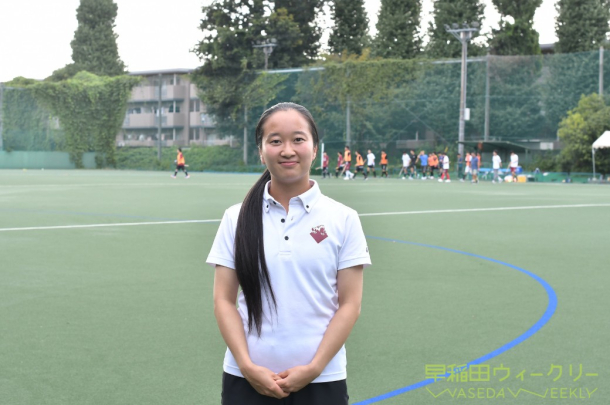
At Hockey Pitch on Higashifushimi Campus
Risako Kikuchi, a member of the Waseda University Women's Hockey Club, is also involved in activities that provide sports opportunities to children undergoing long-term medical treatment. "Is there anything I can do through sports?" With this in mind, in July 2026, as part of the TEAMMATES project of the NPO Being ALIVE Japan, which connects children with illnesses with sports, she realized a Waseda University first: an elementary school student undergoing long-term medical treatment was allowed to join the girls' hockey club. We spoke with her about her activities to date and the significance of athletes supporting children undergoing long-term medical treatment.
—Could you tell us what motivated you to participate in Being ALIVE Japan's (BAJ) leadership program and what activities you were involved in?
My grandmother ran a lodging facility for children and families requiring long-term care for over 20 years, and my mother also volunteered at the National Center for Child Health and Development. Because of this, children requiring long-term care were very familiar to me from a young age. During my first year of university, while studying in School of Sport Sciences I began to realize that "everyone has the right to participate in sports," and shortly after, I came across information about BAJ's leadership program. I decided to participate because I thought it was an activity that would connect the children requiring long-term care, who were so close to me, with the sports I love.
What I remember most vividly from this program is participating in the summit held in Boston, USA. There are many successful examples in the US, and through exchanging ideas with other participants, I was able to gain hints for further developing our own activities. I learned about the activities of students from all over the United States, and I worked tirelessly to provide sports opportunities for children undergoing long-term treatment by involving my hockey team in planning events for children with long-term illnesses. The experience at the summit has been a great support when I take action myself after returning to Japan.
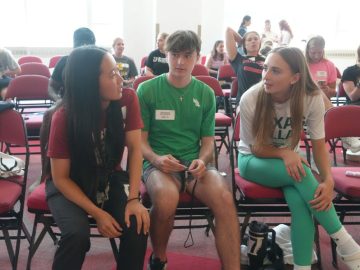
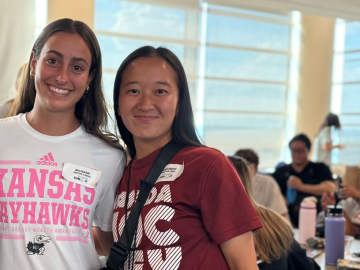
This photo shows a leadership summit hosted by the US non-profit organization "Team IMPACT" in 2025. Four students from Japan participated and interacted with American students.
—What do you keep in mind when interacting with children undergoing long-term medical treatment? Also, what have you learned from these children?
Our top priority is safety. Because many of our clients require medical care and special attention on a daily basis, we always keep in mind that events should be held without incident.
Another thing I value is building an equal relationship with the children. It's not about "doing something for them" or "letting them do something," but rather about sharing time and having fun together as teammates. I want them to forget about their illness and have fun, even if only while they're playing sports. To that end, I try to focus on "what each individual can do" rather than "what they can't do," and have fun together. For example, as a way to support movements tailored to each child's symptoms, during hockey shooting practice, I support their body so they can shoot while sitting, or I help them control the ball so they can shoot with one hand.
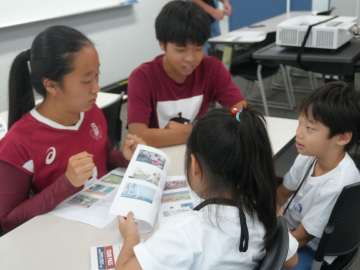
At the 2025 Waseda Sports Festa in Higashi-Fushimi, individualized tour programs tailored to each child's interests and physical condition were implemented. Participants enjoyed watching the cheerleading squad's dances and cheered on those trying fencing.
What I learned from the children undergoing long-term medical treatment is that being healthy and able to freely dedicate a lot of time to your favorite sports is not something to be taken for granted. I've come to appreciate the circumstances I currently have.
Furthermore, especially during difficult moments in matches or when fatigue is building up, the presence of children battling illness is always in my heart and gives us athletes strength. I believe this is the significance of athletes supporting children undergoing long-term treatment through sports.
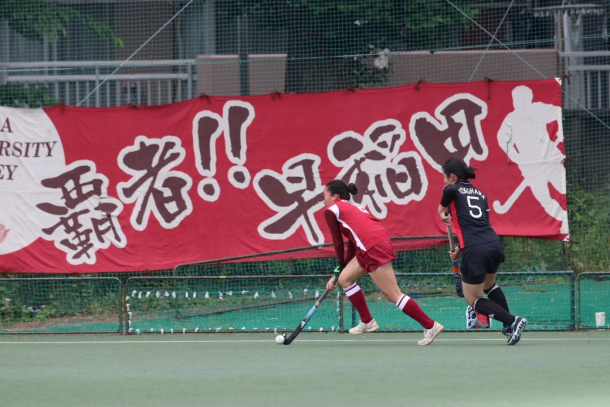
The photo on the left shows her playing in the 2025 Kanto Student Spring League. Although his position is midfielder, he is an all-rounder who can play from defense to forward.
--Could you tell us about the TEAMMATES project?
The TEAMMATES program is one of the programs developed by BAJ, in which children undergoing long-term medical treatment join a sports team as players for a certain period and participate in team activities such as practices and games. The aim is to encourage independence in children who require long-term medical treatment and to create a network of friends who will support them through the difficult life of treatment by having them regularly participate in team activities and interact with players and team staff.
This time, the Waseda University Women's Hockey Club welcomed Ruru Hoshi, an elementary school student who is undergoing long-term treatment for acute lymphoblastic leukemia (childhood cancer), as a team member.
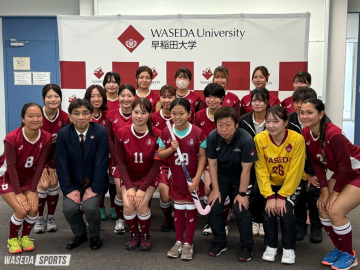
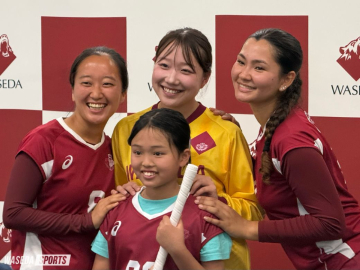
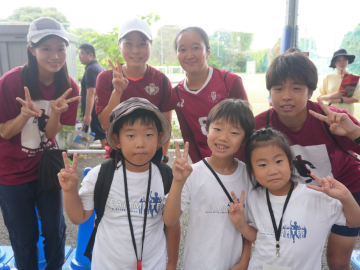
Photo on the left: A picture taken at the club induction ceremony to welcome Hoshi-san (center front row).
Photo on the right: She participates in team activities, including sharing meals after practice. Kikuchi is on the far left of the photo.
Because this was an unprecedented initiative at Waseda University, I struggled to get people around me, such as members of the hockey club, to have a concrete understanding of the project. I made it a point to use photos of previous projects to explain the project's content in a way that was easy for everyone to visualize. As a result, everyone took part in it positively.
—What are you studying at university?
I believe that sports have the power to motivate people, and I wanted to learn how to solve social problems through sports, so I enrolled in School of Sport Sciences. Currently, I belong to Professor Hirotaka Matsuoka 's seminar and am studying sports business and marketing. What made a strong impression on me was when Professor Matsuoka said shortly after I joined the seminar, "In this day and age, it's no longer acceptable for people involved in sports to only think about that sport." I deeply resonated with these words.
The best thing about Waseda University was meeting such diverse students. I've been able to dedicate myself to my sport while learning from and experimenting with peers who have various values and ways of thinking, and I've also been able to participate in the TEAMMATES project, so I'm truly having a fulfilling university life.
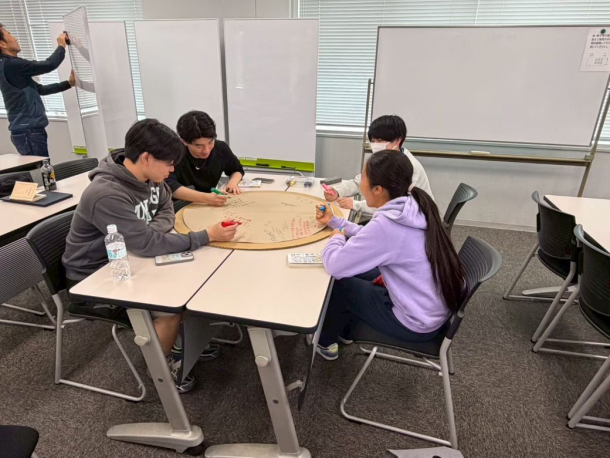
The students are reading and discussing the assigned book in their seminar.
--Please tell us your future goals.
I'm still in the planning stages, but I want to become someone who can contribute to solving environmental issues such as climate change and ethical consumption (*) through sports. As someone who loves sports, I want to believe in the power of sports that I've learned and use it to address environmental issues that interest me.
Through my work with BAJ, I've come to realize that I grew up in a truly privileged environment, lacking nothing. That's precisely why, from now on, I want to be someone who can selflessly dedicate myself to others and society, and that's the kind of work I want to do.
* Sustainable consumption behavior that takes into consideration people and the environment.
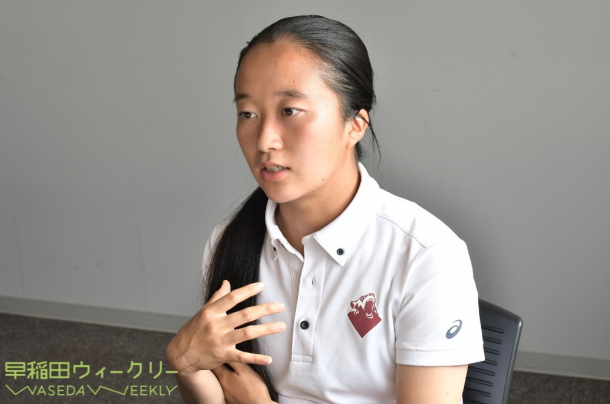
Kikuchi-san answering questions in an interview.
No. 935
Interview and text by: Waseda Weekly Reporter
Maho Asaba, 2nd year student School of Creative Science and Engineering
【Profile】
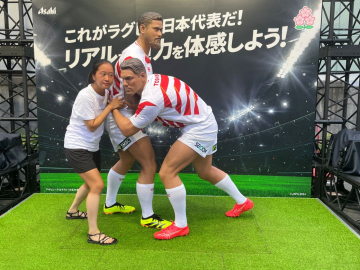
A photo taken when I went to Chichibunomiya Rugby Stadium to watch a Japan national rugby team match.
Born in Tokyo. Graduated from Seijo Gakuen High School. Her hobbies include walking her two dogs and watching rugby. On her days off, she often goes to a nearby cafe with the two rescue dogs she keeps at home. She loves children so much that she works part-time at a nursery school and an after-school club.

![[Save version] Map of the four main campuses](https://www.waseda.jp/inst/weekly/assets/uploads/2026/06/110d605cfac40346aad1d2df464a6586-940x705-1-1-610x457.jpg)