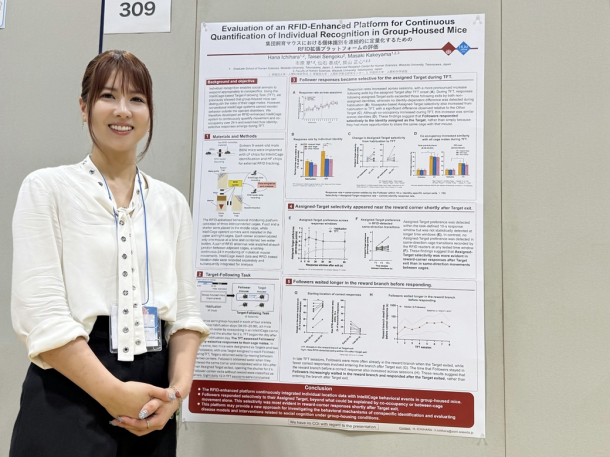
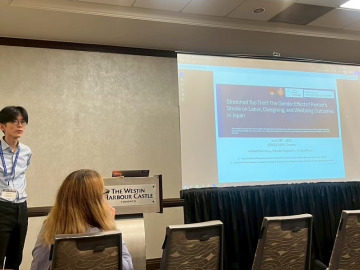
In July 2026, at a poster presentation at an academic conference
What's graduate school like? Waseda University currently has 21 graduate schools. This edition of "Graduate Student's Research!" introduces the campus life of Ichihara, who is diligently conducting research in Graduate School of Human Sciences. We'll share her reasons for pursuing graduate studies, the allure of academics, and even how she spends her days.
I want to explore, from a scientific perspective, how the "mind" is formed.
Hana Ichihara, 4th year doctoral student, Graduate School of Human Sciences; Research Associate Advanced Research Center for Human Sciences.
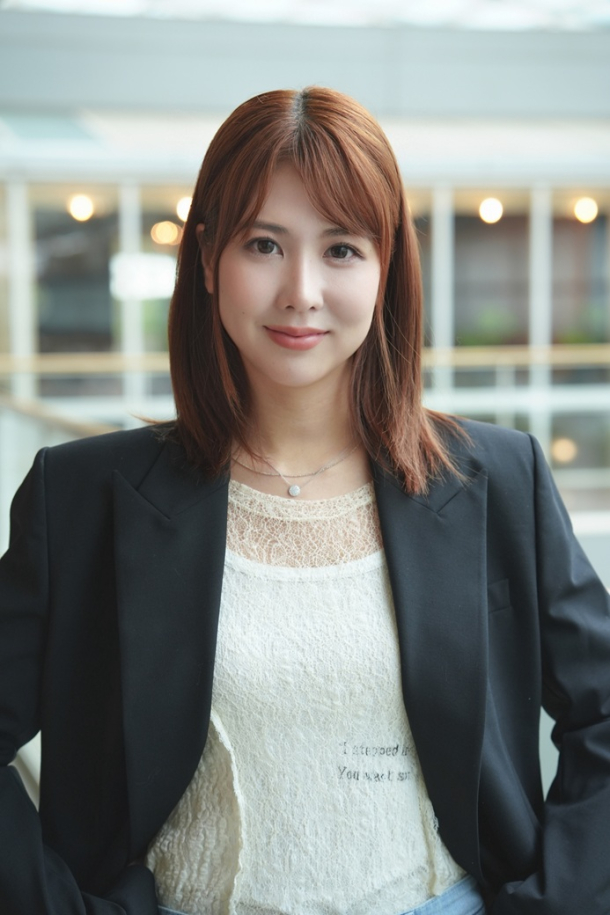 Do mice recognize their "companions"? Our research has shown that mice living in groups can distinguish between a dozen or so members of their own group and change their behavior depending on their relationship with each other. The Environmental Brain Science Laboratory (Professor Masaki Kakeyama, Faculty of Human Sciences) studies how the environment affects the brain, mind, and behavior.
I was born overseas and grew up surrounded by different cultures and environments. I love living things, science, and people, and I always dreamed of working in a field that involved interacting with people. As I learned more about "human beings" based on these interests, I began to wonder about many things. We recognize ourselves as "ourselves," we distinguish others, and we live our lives building relationships with family and friends. Yet, we still struggle with our relationships with others and sometimes experience emotional problems. This led me to wonder, what exactly is our "mind," which recognizes ourselves and others and interacts with people? This question led me to begin my research in Professor Kakeyama's laboratory.
For my undergraduate research in School of Human Sciences, I investigated the effects of antidepressants on cognitive function using mice. The results didn't match my hypothesis, but that was also an important finding. This "why?" question became the driving force behind my decision to pursue a master's degree.
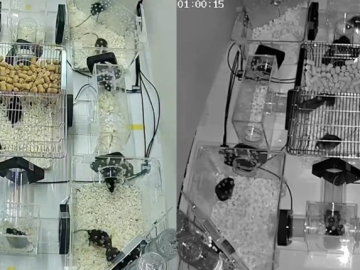
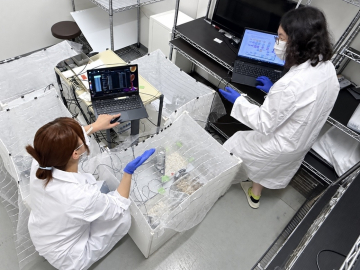
Photo on the left: The mouse behavior testing device that was developed. It is designed to evaluate the spontaneous behavior of mice under free movement conditions and acquires hundreds of thousands of behavioral data points per day.
Photo on the right: Experiment in progress. We value sharing the knowledge and skills necessary for research, such as handling mice and chemicals, creating experimental programs, and analyzing data, and conducting research in collaboration with other members of the lab.

In 2024, I visited Vienna for a conference presentation and saw the Plague Column. Visiting various places through research and experiencing their culture and history is one of the joys of attending conferences.
In my master's program, I developed experimental methods to investigate mice's ability to distinguish between their own kind, and studied the effects of perinatal exposure to environmental chemicals (*) on this ability. While many environmental factors overlap in humans, in mice, we can control the conditions to examine the effects of specific factors on the brain and behavior. I have come to find research fascinating in investigating the underlying mechanisms one by one in order to understand the complex human mind.
* Chemical exposure: This refers to the exposure of living organisms to chemical substances through inhalation, ingestion, etc.
I'm naturally someone who gets bored easily, but when things didn't work out, I rethought them and tried again, and before I knew it, I was pursuing a single question. This was the first time I'd ever dedicated myself so seriously to one thing, and meeting colleagues with whom I could discuss research and collaborate has been a great asset. These experiences are still supporting me as I work on my doctoral research today.
During my doctoral studies, I became more aware of the overall structure of my research, not just focusing on conducting the experiments at hand, but also considering how to interpret the results and how to connect them to future investigations. Furthermore, as I continued my research, I increasingly thought about what kind of expertise I wanted to build as a researcher and what kinds of questions I wanted to pursue.
Currently, I am researching the mechanisms of "recognizing others" in both mice and humans. In mice, I am investigating how they recognize their peers and build relationships within groups. In humans, I am focusing on "associative memory," which involves linking multiple pieces of information, such as faces and names, and conducting research using a cognitive test app that we developed in-house. Although the subjects and research methods differ, the underlying common question is, "How do we recognize others as 'this person'?"
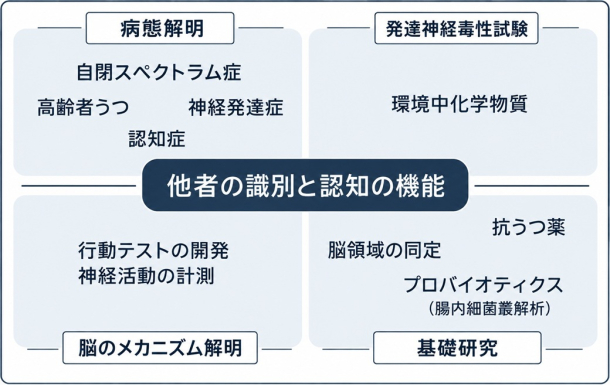
Research overview diagram
Outside of research, I am also involved in running community lectures as part of a university research project. I am working to create a space that connects university research with the local community by bringing the research of professors from Faculty of Human Sciences to people who live, work, or attend school in Tokorozawa City.
There are brain mechanisms that can only be studied in detail in mice, and complex cognitive processes and mental functions that can only be understood in humans. By building upon what we learn from each of these studies, I want to approach from a scientific perspective how our "minds," which recognize ourselves and others and interact with people, are made up. I once wanted to work in a job that involved interacting with people, and now I am doing so through research. I will continue to cherish my original desire to "understand people better" and give back the knowledge I gain from my research to people and society.
Daily Schedule
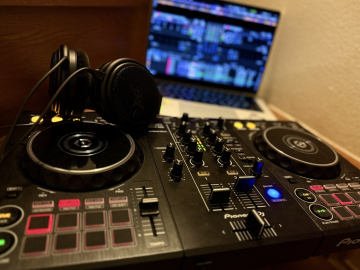
My hobby is DJing. I like a wide range of music genres, mainly R&B, but also Pop and Soul, and I choose and mix songs according to my mood at the time. I also enjoy experiencing expressions unique to other languages through lyrics.
- 09:00 Research work at home (remotely checking and manipulating experimental data, checking emails, etc.)
- 10:00 Move to Tokorozawa Campus (My recent enjoyment is listening to psychological novels on audiobook during my commute)
- 12:00 Lunch at the university (I often eat at the cafeteria with everyone from the research lab)
- 13:00 Journal Club (Graduate students and others share their research papers)
- 15:00 Experimental work (experiments, mouse care, cleaning, etc.)
- 19:00 Data analysis and paper writing (organizing daily data)
- 22:00 Arrive home and have dinner (listen to an audiobook again. I also try to cook my own meals).
- 23:00 Gym (I reluctantly go to get some exercise)
- 24:00 Hobby time (playing with dogs and cats, and engaging in creative activities)
- 25:00 Bedtime


![[Save version] Map of the four main campuses](https://www.waseda.jp/inst/weekly/assets/uploads/2026/06/110d605cfac40346aad1d2df464a6586-940x705-1-1-610x457.jpg)