"We want people to feel that traditional crafts are something familiar to them."
Tomoka Akiyama, 2nd year student, School of Social Sciences

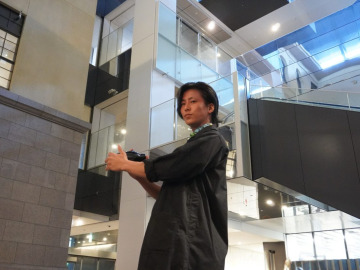
At Building 14 on Waseda Campus
When people hear the term "traditional crafts," many may have an image of them being "historical" or "inaccessible." However, there is a Waseda University student who is confronting the world of traditional crafts head-on, touching them with her own hands, and striving to connect them to the future. Akiyama was captivated by Isesaki-Gasuri, a silk fabric from her hometown of Isesaki, Gunma, which is designated as a national traditional craft, when she encountered it in junior high school. In high school, she studied under the only craftsman, Sadao Saito, to learn the techniques. Currently, she is focusing on archiving the production methods and techniques of Isesaki-Gasuri. We spoke with Akiyama about the origins of her activities, her current work, and her future prospects.
--Could you tell us how you first encountered Isesaki-Gasuri?
It all started when I went to an Isesaki-Gasuri exhibition after my third year of junior high school, when I had finished taking entrance exams. I had originally been interested in a type of textile called Isezaki-meisen and had been researching it, but I found that there were no longer any artisans or techniques left to make it. However, I learned that Sadao Saito is still active as an artisan of Isesaki-Gasuri.
Isesaki-Gasuri is dyed by tying the parts that are not to be dyed with a unique tape that shrinks with heat, then dipping them in dye, and weaving the threads together on a loom to create patterns, but all of this is done by hand. Saito's work is so intricately made that it's hard to imagine the time it takes to make, and I was immediately drawn to his passion as a craftsman and his playful spirit, so I called him right after the exhibition and asked if I could come to his workshop. I went to his workshop every day and, as I watched Saito at work, I realized that "this is something I won't understand unless I actually get my hands dirty." I was allowed to try it myself, and the more I did, the more I discovered things I didn't know, which I found fascinating, and before I knew it, I was completely hooked.


Photo on the left: Saito at work. He is separating a bundle of dyed and dried weft threads into individual threads.
Photo on the right: Akiyama weaving a bolt of cloth while being watched over by Saito.
--What were your reasons and motivations for continuing to visit the workshop to acquire skills throughout your high school years?
A major reason was that Saito said, "You can't talk about the real thing unless you actually know it yourself." Every time I went to the workshop, we would talk for about an hour, and I was able to hear not only about the technical aspects but also about his experience and way of thinking. I realized that I needed to put in more passion to be involved with Isesaki-Gasuri.
The most challenging aspect was that the techniques weren't clearly defined, and there was a huge amount to learn by observation. For example, I had to understand the intent behind each technique, such as "why this dyeing method is best," ask questions about anything I didn't understand, take notes, and then practice again—it was a constant cycle.
In addition, much of the work involved in making Isesaki-Gasuri is done outdoors, often in the morning when sunlight is evenly distributed. This presented a major challenge in figuring out how often I could go to the workshop while attending high school. As a result of continuing to go even during long holidays, I was able to achieve my goal of wearing a kimono I made myself at my high school graduation. My family and those around me were happy, and my continued efforts to share my work sparked interest in my friends, which was great because it introduced them to Isesaki-Gasuri.
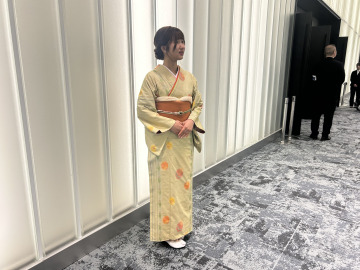
At her high school graduation
--What kind of activities are you currently involved in?
Since entering university, I've been focusing on creating an archive about Isesaki-Gasuri. I'm organizing the production processes I've witnessed, as well as the photos and audio recordings I've made during my four years working with Saito, with the aim of creating an environment where people can learn about the current state of Isesaki-Gasuri. There is a lot of information about Isesaki-Gasuri that you can only learn by going to the site. The tension of the threads, the subtle differences in dyeing, the order of work, and the criteria for judgment are things that can only be grasped through actual experience. I believe that by putting this information into words and leaving it as a record, it will serve as a clue for those who will learn about it in the future.
As part of this initiative, in March 2026, we held a fieldwork event in our hometown of Gunma Prefecture titled "Visualizing the Sensory Value Seen in Isesaki-Gasuri from Various Perspectives vol.1," which explored Isesaki-Gasuri from various angles. The event allowed participants to experience the current state of Isesaki-Gasuri with all their senses, including learning about Saito's thoughts and philosophy and participating in a hands-on workshop. Thanks to publicity on social media, we were able to attract people of all ages, including those from as far away as Yamaguchi Prefecture.
I still talk to Saito on the phone regularly, and whenever I go back to my hometown, I always make sure to visit his workshop. He always welcomes me so warmly, and it's become like a second home to me.
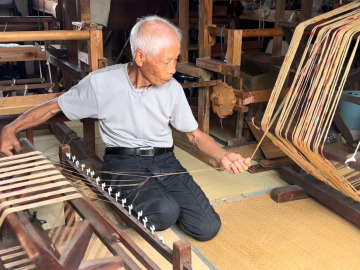

Photo on the left: Saito separates the bundled warp threads, which have been dyed and dried, for the next process.
Photo on the right: Scenes from the March event. The photo shows a lecture on "kukuri," the process of creating patterns, which is one of the highlights of Isesaki-Gasuri textiles.
--What do you think is important in passing on traditional crafts?
Throughout my interactions with Saito, I've been conscious of maintaining a perspective free from preconceived notions. However, over the past year, I've had more opportunities to brainstorm with various people, and I've realized that I'm bound by conservative views regarding Isesaki-Gasuri and Saito. So now, I'm going back to basics and prioritizing seeing things with my own eyes and understanding them as they are, rather than simply accepting them as a grand tradition. It's about observing and thinking about Isesaki-Gasuri from my own perspective, without over-filtering it as something "valuable," and creating my own definition of it.
--Could you tell us about your future plans?
We are planning an exhibition in Isesaki City in November 2026, and we are currently organizing our archives in preparation for it. This will be the first opportunity to present the experiences and records we have accumulated so far in a tangible form.
Also, in December I will be studying architecture in Denmark, where I hope to acquire techniques for "how to visualize culture and pass it on to the next generation" and apply them to Isesaki-Gasuri. From the perspective of architecture and design, I want to create a system that will allow the techniques and culture of Isesaki-Gasuri to continue to grow, attract the interest of many people, and get them involved. I also want to create an entry point that will excite people with the playfulness and wisdom found in Isesaki-Gasuri.
-- Do you have a message for Waseda University students?
I believe the best way to spend your university life is to follow your curiosity. If you find even one thing that you find interesting, going to the actual location or meeting the people involved will lead to more connections. Waseda provides an environment where you can connect with diverse people, so I hope you will take advantage of the university's network and pursue your interests.

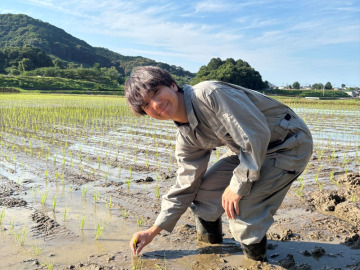
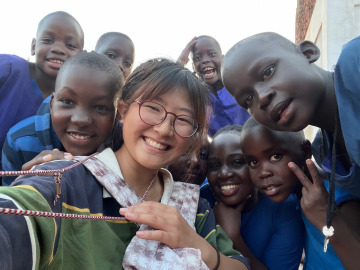
In December 2025, Akiyama helped Nokate cultivate Japanese daffodils in Fukui Prefecture. Driven by her curiosity, she says she will take action on anything that interests her, not just her work with Isesaki-Gasuri.
925th
Interview and text by: Waseda Weekly Reporter
Yuichiro Terui, 2nd year student School of Commerce
【Profile】

Born in Isesaki City, Gunma Prefecture. Graduated from Waseda University Honjo Senior High School. Hobbies include visiting production areas of various traditional crafts in Japan and around the world. Favorite Waseda cuisine is "Korean restaurant Dodam".

![[Save version] Map of the four main campuses](https://www.waseda.jp/inst/weekly/assets/uploads/2026/06/110d605cfac40346aad1d2df464a6586-940x705-1-1-610x457.jpg)