"The kendo I practiced for 10 years became the key to connecting with the world."
Koshi Ochi, 3rd year student, School of Political Science and Economics

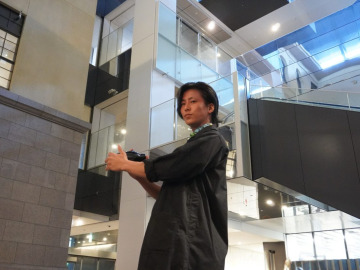
On the 2nd floor of Building 3 on Waseda Campus
The "JENESYS" program, sponsored by the Ministry of Foreign Affairs and implemented by the Japan International Cooperation Center (JICE), aims to deepen interest in and understanding of Japan in the Asia-Pacific region and expand the diplomatic base. Ochi participated in this program, engaging in a one-week exchange program in Brunei Darussalam (hereinafter referred to as Brunei) with a focus on martial arts. We asked him about his experiences there, his activities after returning to Japan, and his daily campus life, as well as what kind of future awaits Japan-Brunei exchange.
—Could you tell us what prompted you to go to Brunei and what you did there?
I learned that a friend who was taking the same class as me had participated in the program in the past, which was what initially motivated me to participate. What convinced me to join was the intensive nature of the program, which was organized by the Ministry of Foreign Affairs and offered more than just a simple trip abroad for cultural exchange. Recruitment and selection began about six months before the program started, and after pre-departure study sessions led by JETRO (Japan External Trade Organization) and the president of the Brunei Judo Federation, we participated in activities mainly in the capital, Bandar Seri Begawan, from January 28th to February 4th, 2026. Our experiences there were invaluable, starting with a courtesy visit to the Japanese Embassy, followed by a meeting with the head of the Ministry of Culture, Youth and Sports, a joint practice session with the local Kendo Federation, cultural exchange at a junior high school, and a final debriefing session with staff from the embassy and federation.


Photo on the left: Courtesy visit and exchange of views with the Ministry of Culture, Youth and Sports of Brunei.
Photo on the right: Courtesy visit to the Embassy of Japan in Brunei
Brunei is an Islamic country located in the northwestern part of Borneo, Southeast Asia. While its land area is only about the size of Mie Prefecture in Japan, and its population is only around 500,000, it is rich in oil resources, and its per capita Gross National Income (GNI) exceeds that of Japan. Thanks to its oil revenues, Brunei has no income tax or consumption tax, education is free, its cities and infrastructure are well-developed, and it enjoys good public safety. Women's participation in society is also relatively advanced.
JENESYS offers programs in various countries, but I chose Brunei because I knew about its characteristics and had been interested in it for some time. In addition, the theme of this program being "martial arts exchange" was the deciding factor. I have been practicing kendo for about 10 years, and I thought I could make use of my experience and strengths.

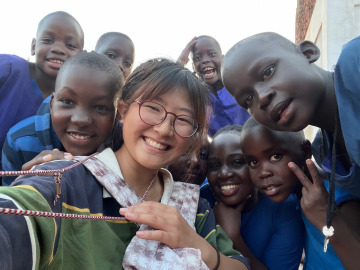
A photo taken at the debriefing session on the final day of the JENESYS program, with the people who helped us out locally. Six students participated from Japan, with two each having experience in kendo, judo, and karate.
—How has Japanese kendo been received in Brunei?
At the time of my visit, there were only about 50 kendo practitioners in Brunei, so I participated in the program because I wanted to help the Brunei Kendo Federation join the International Kendo Federation (FIK) in order to promote the sport. Through joint training with the local kendo federation, I exchanged opinions with people of a wide age range, from 8 to 40 years old, and as a result, I found out the challenges facing the Brunei Kendo Federation, such as the lack of a decision-making body, a shortage of instructors, and a lack of protective equipment, and it became clear what is necessary for them to join the FIK.


A scene of teaching Kendo as part of the JENESYS program.
On the other hand, I've heard that the number of kendo club members has increased fivefold thanks to cultural and martial arts exchanges with local junior high schools, which have helped junior high school students feel closer to Japan and kendo. I feel a real sense of accomplishment in this regard. A major factor behind this is the presence of "Pencak Silat," a martial art that is popular in Brunei and other parts of Southeast Asia. It feels like a more intense martial art than Japanese karate, and it is rooted in a spirit that is in common with various Japanese martial arts, such as respect and discipline.
Furthermore, Japanese culture is generally well-known in Brunei, with most cars being Toyotas, and I saw Doraemon and Pokemon everywhere. Demon Slayer and Rurouni Kenshin are also famous, and many people are already familiar with kendo, so I was impressed by the influence of Japanese manga.
—What kind of activities have you been involved in since returning to Japan?
To share the knowledge gained during this stay, we are holding debriefing sessions in various locations. First, we held one in Yusui, Kagoshima, the hometown of one of the project members, for elementary and junior high school students and guardians. We were worried whether the participants would enjoy it, as their awareness of Brunei was low and almost none had experience traveling abroad. However, we focused on conveying the fun of international exchange without being limited to Brunei alone, and on providing a reciprocal experience, which was well received.
At the end of April, we expanded the content to include university students and gave a lecture at Tsuda University. Eventually, we would like to invite the Brunei Ambassador to Japan to Waseda University and hold an event that goes beyond a simple introduction to Brunei, delving deeper into the history of bilateral exchanges, the current energy situation, and how to break away from an economy dependent on oil.


Photo on the left: A scene from a lecture in Yusui, Kagoshima (March 2026). Ochi is the second person from the right.
Photo on the right: Visiting the Brunei Embassy in Japan and reporting on activities to the ambassador.
Additionally, two JENESYS members and a JICE staff member visited the Brunei Embassy in Japan to meet with the ambassador and report on our activities, requesting his cooperation in organizing future intercultural exchange events. Embassies in various countries often hold events such as bazaars to introduce their own culture, and we hope that Brunei will also have such opportunities.
It would be great if there were opportunities in Japan to easily experience traditional percussion instruments like the gerintangan and local cuisine like ambuyat (a starchy food made from sago palm), and I would like to help people feel more familiar with Brunei. I would also be happy if opportunities were created in Brunei to introduce Japanese culture, including kendo.


Photo on the left: Local people wearing traditional Bruneian clothing.
Photo on the right: Grintangan, a traditional Bruneian percussion instrument. Eight copper gongs are lined up.
—What kind of future do you envision for the revitalization of exchanges between Japan and Brunei through your activities?
Brunei exports the majority of its oil and liquefied natural gas to Japan. Deepening relations with Brunei, a vital energy supplier for Japan, is important. On the other hand, like many oil-producing countries, further diversification of its economic base, which is supported by the oil and gas industry, is a key theme with an eye on future sustainability, and tourism is seen as a promising breakthrough. Brunei has many tourist attractions, such as beautiful mosques, rainforests, and the world-famous luxury hotel "The Empire Brunei," and since the country is not that large, it can be explored in a short period of time. There are also direct flights from Japan, so I hope it will become a popular travel option for Japanese people in Southeast Asia.


Photo on the left: Kampong Ayer, one of the world's largest floating villages, located in the capital city of Bandar Seri Begawan, which I visited during my stay in the area.
Photo on the right: A photo taken with the members of JENESYS at the tourist attraction "Old Mosque (Sultan Omar Ali Saifuddin Mosque)".
—How do you envision your future involvement with Brunei and the world?
While I'm a student, I want to continue planning and participating in cultural exchange activities with Brunei. Through my lecture in Yusui, I realized that there is a difference in access to information about international exchange between urban and rural areas. There are many programs, including JENESYS, that allow students to get involved in international exchange, but I felt that these opportunities are not necessarily widely known.
Based on this experience, I would like to go beyond simply sharing information about Japan-Brunei relations and also be involved in creating opportunities for students to become interested in international exchange. I will continue to learn myself and strive to help more students turn their attention to opportunities for international exchange.
Although my future career path is still unclear, I aspire to work in a field that bridges Japan and the world, utilizing the global knowledge I gained at university to engage in international business, promote Japanese culture to the world, or import lesser-known cultures from around the globe. I am also looking forward to visiting acquaintances I have made abroad, which will be a result of these activities.
924th
Interview, text, and photography by: Waseda Weekly Reporter
Suhon Kanai, 3rd year, School of Law
【Profile】

A photo taken with Atami at sunset in the background.
Born in Ehime Prefecture. Graduated from Aiko High School. Member of the Kendo Club (officially recognized student club). School of Political Science and Economics. He is deepening his interest in international relations by studying Russian language in the Foreign Language Area Minor Program at the Foreign Languages Area Minor Program of the Russian Academy of Sciences, and Japanese-Soviet and Japanese-Russian relations in Professor Shuratov Yaroslav's (Faculty of Political Science and Economics). Early morning or late night walks and coffee are part of his daily routine. His favorite Waseda cuisine is "Ineya" and his favorite menu is Karaage bento.
![[Save version] Map of the four main campuses](https://www.waseda.jp/inst/weekly/assets/uploads/2026/06/110d605cfac40346aad1d2df464a6586-940x705-1-1-610x457.jpg)