"I realized where I lack experience, and I'll use that disappointing first performance as motivation."
Shunsuke Sasaki, 4th year student, School of Humanities and Social Sciences
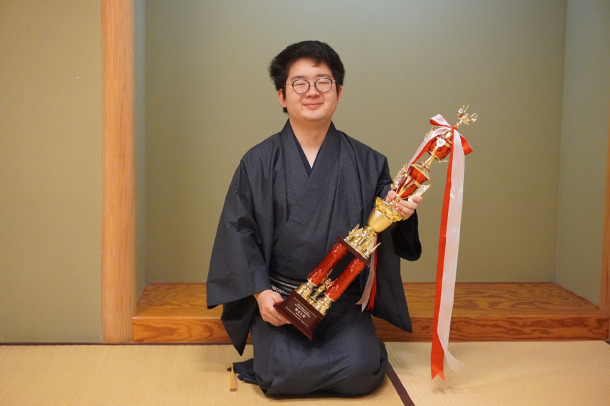
In the tea room at the Waseda University Student Center, a place frequently used for practice by the Waseda University Rakugo Club, to which he belongs. Holding the trophy after winning the "Sakuden Grand Prize," he is wearing a kimono he purchased in Asakusa.
Rakugo (traditional Japanese comic storytelling) is truly the ultimate one-man art, where the performer is solely responsible for the script, direction, and acting. It requires not only a vast memory to handle a huge number of lines, but also the expressive power to paint scenes with just a fan, and the conversational skills to change the atmosphere with just a touch of timing... In this demanding world of rakugo, in February 2026, Shunsuke Sasaki, a fourth-year in the School of Humanities and Social Sciences, won the "23rd All Japan Student Rakugo Championship - Sakuden Grand Prize" (hereinafter, Sakuden Grand Prize), which determines the top of approximately 300 university student rakugo performers gathered from all over Japan. Surprisingly, Sasaki only started rakugo after entering university. We delved into the driving force that allowed him to reach the top in just three years and his passion for rakugo.
—What inspired you to start performing rakugo?
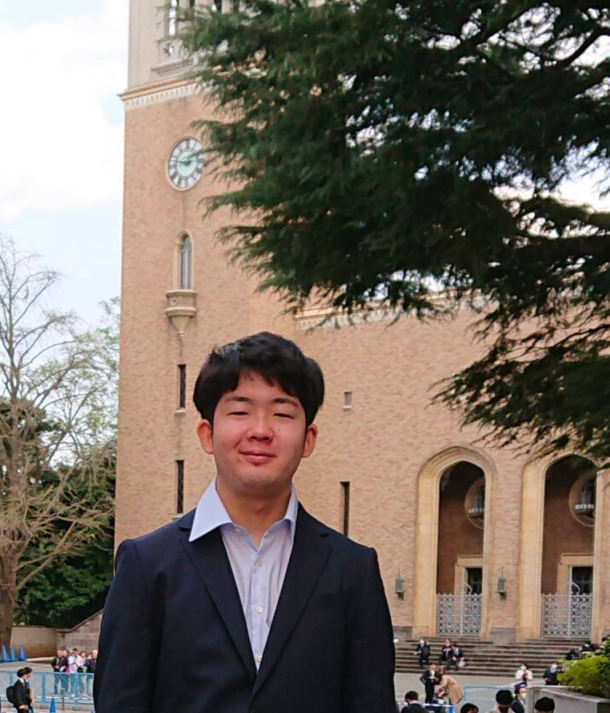
A photo from the Entrance Ceremony
It was when I was in high school that I came across a radio program hosted by Kanda Hakuzan, a renowned rakugo storyteller. I was a fan of the Chunichi Dragons baseball team and studied for my university entrance exams while listening to baseball games on the radio. After the baseball games, Hakuzan's program was broadcast. I found Hakuzan's stories incredibly entertaining, and that's when I became interested in rakugo. Later, I entered Waseda University and joined the Rakugo Research Club (an officially recognized student club; hereafter referred to as "Rakken"). Seeing the senior members freely and vividly performing everything from classical rakugo to modern adaptations, I remember being strongly drawn to it, thinking, "I want to try that too," and "I want to try performing it in this way."
In addition to my interest in rakugo, I also wanted to improve my communication skills. I was attending a correspondence high school, so I didn't have many opportunities to talk to people. Therefore, the desire to overcome my weaknesses by challenging myself to perform rakugo in front of a large audience also became a driving force for me.
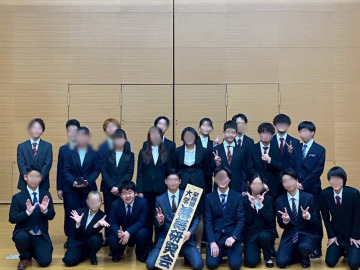
This photo was taken at the "Waseda Rakugo" event, where professional performers were invited to perform. It was taken at Ono Auditorium when Sasaki was a third-year university student. Sasaki is the third person from the left in the front row.
—When did you make your debut on stage?
In a performance held within our student club in July of my first year. The piece I chose was "Shinigami" (The Grim Reaper), a representative work of classic rakugo that deals with fundamental human desires such as life & death and money. Looking back now, it was a rather challenging piece for a beginner (laughs). "Shinigami" is more of a ghost story than a comedy, so it was difficult to gauge the audience's reaction through laughter... more than anything, I lacked the technical skills to express "fear" at the time.
Although the audience watched with kind eyes, I wasn't satisfied with my own performance. Some of my peers had experience from high school, while others were beginners but were incredibly skilled from the start. It was that first performance that made me realize my own inexperience, and I was left with a lot of regret.
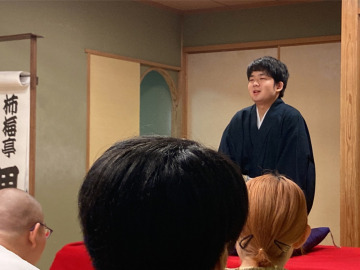
Sasaki performing rakugo for the first time on stage. His stage name, Shibaitei Kudasai, was inspired by persimmons and plums, specialties of Wakayama Prefecture where he used to live, and was something he came up with himself when he was a first-year university student.
—Using that frustration as motivation, you went on to win the "Sakuden Grand Prize" in February 2026. What kind of competition is this?
The "Sakuden Grand Prize" is a prestigious annual competition held in Gifu City, the birthplace of Anrakuan Sakuden, considered the founder of rakugo. It is one of the largest and most historically significant competitions, and the judging criteria are diverse. It tests not only speaking technique and tempo, but also the ability to structure and adapt within a limited time, and above all, the overall ability to "elicit laughter and captivate the audience." I was the first student from Waseda University to win it.
—Please tell us honestly how you felt when you won the championship.
To put it simply, I was really happy. However, when the spotlight shone on me to announce my win, I was so surprised that it didn't really sink in. Actually, this time, I took a gamble by suddenly changing my performance just one week before the deadline for submitting the video for the first round of judging. Up until the deadline, I was desperately trying to memorize the script, but after passing the video screening, I focused on my acting. For the performance I presented, "Tokuchan." I practiced focusing on how to portray the oiran (courtesan), a particularly important character, in a way that made her seem "country bumpkin-like and somewhat strange."
During the final round's commentary, judge Katsura Bunshi praised me, saying, "Your voice and tone are excellent." Actually, my voice changed early when I was in elementary school, so I was self-conscious about my low voice. But through rakugo, I was able to have people acknowledge that "that low voice is actually good." It was the moment when a complex I'd carried for so long transformed into my greatest strength in the world of rakugo.
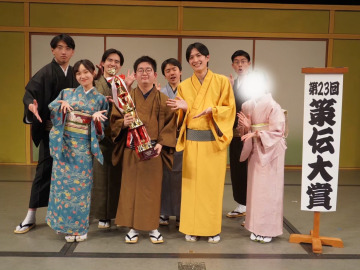
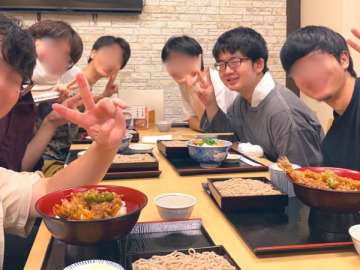
Photo on the left: A commemorative photo taken with the finalists after winning the "Sakuden Grand Prize." Sasaki is the one in the center holding the trophy.
Photo on the right: With fellow club members from Rakken. Sasaki is the second person from the right.
-What are you studying at university?
I'm majoring in Japanese history in the School of Humanities and Social Sciences, and I plan to write my bachelor's thesis on the Edo period. My studies at university have been a great help in performing rakugo. By learning about the historical background of the Edo and Meiji periods, which are often the settings for rakugo, I've been able to visualize the subtle nuances of the words in the script, as well as the lives of the people and the scenes of the towns of that time, with much greater clarity.
--Please tell us your future goals.
For the remainder of my university life, I want to actively challenge myself with longer rakugo performances. These types of performances require different skills and abilities than short stories. I want to acquire the sense of tempo, the ability to vary the pace, and the concentration to keep the audience engaged for a long time. I won the "11th Amagasaki Rakugo Championship" held in 2025, so it would be amazing if I could also win the "Katsura Fukumaru Cup" held in Fukui Prefecture in the summer and achieve a triple crown.
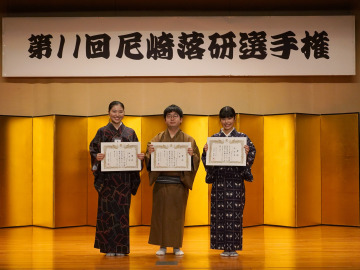
This photo was taken when he won the grand prize at the 11th Amagasaki Rakugo Club Championship held in December 2025. Sasaki is in the center of the photo.
Scenes from the final round of the 23rd All Japan Student Rakugo Championship "Sakuden Grand Prize," in which Sasaki won first place.
923rd
Interview, text, and photography by: Waseda Weekly Reporter (SJC Student Staff)
Nanami Yoneda, 4th year student School of Social Sciences
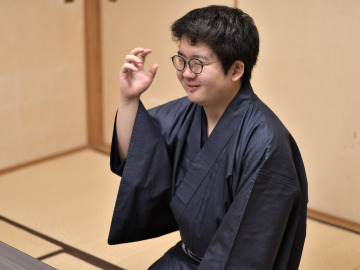
Sasaki's appeal of rakugo lies in the joy of imagining endless scenes from empty space through the performer's gestures alone. Even with the same story, it becomes something completely different depending on who performs it. He says that paying attention to these differences in individuality is the real pleasure.
【Profile】
Born in Gifu Prefecture. Graduated from Clark International High School. Spends holidays watching game commentary videos on YouTube and movies. Favorite rakugo storyteller is Master Yanagiya Korin, and favorite performance is "Akegarasu" by Master Katsura Bunraku VIII. Recommended lecture is Professor Ryuichi Kodama 's (Faculty of Letters, Arts and Sciences) "Introduction to Theatre Studies".
Official X: @waseda_rakugo
Official Instagram: @waseda_rakken

![[Save version] Map of the four main campuses](https://www.waseda.jp/inst/weekly/assets/uploads/2026/06/110d605cfac40346aad1d2df464a6586-940x705-1-1-610x457.jpg)