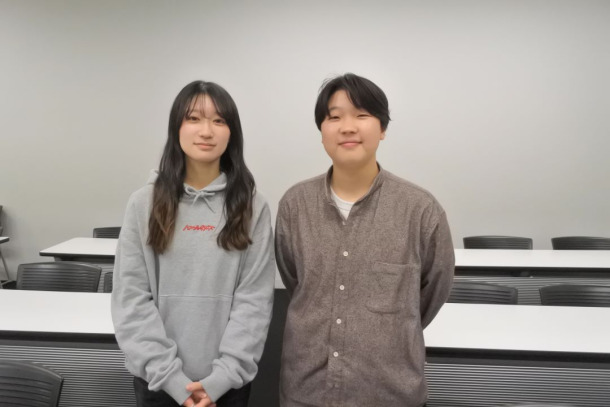
From left: Kitamura and Yamaguchi
Waseda University has 13 faculties and educates students in a wide range of academic fields. In "Interesting Lectures and Seminars", students who have taken such classes will introduce what classes and seminars are available and what you can learn from them.
Thanatology and Medicine [Subject offered in the School of Human Sciences]
Sakura Kitamura, 3rd-year student, School of Human Sciences
Waka Yamaguchi, 3rd-year student School of Human Sciences
How do you feel when asked, "Can we choose how we live and die?" Some people may think that it's obvious that we can choose, while others may question whether we really can. However, even when we think we are choosing, sometimes it is being chosen for us. Depending on the environment and circumstances into which we were born, some people's life choices may be very different from the start.
The question at the beginning is unavoidable when considering life and death for anyone, and this class is designed to help students think about how to face this question. This is "Thanatology and Medicine" by Professor Momoko Sasazuki (Faculty of Human Sciences).
In this class, we first learn through lectures about the current situation of people who are extremely vulnerable in modern society, such as children receiving intensive care, people with severe physical and mental disabilities, and people nearing the end of their lives, and the issues surrounding them. Prof. Sasazuki has worked as a pediatrician in hospitals for approximately 30 years, and the greatest appeal of this class is that it allows us to learn about the real-life situations she experienced in the medical field. We then share our thoughts, and the professor responds to them, leading to an ongoing exchange of ideas.
Throughout the lecture, the professor repeatedly emphasized the importance of distinguishing between "facts" and "values."
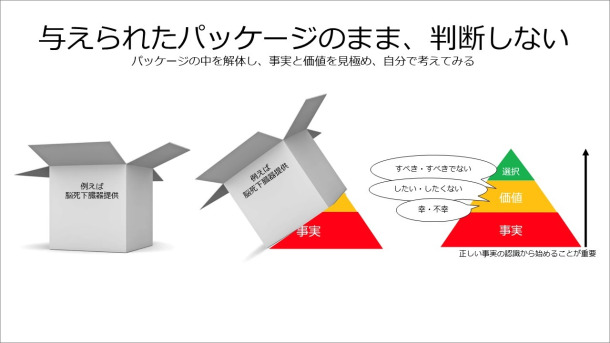
Distinguishing between "facts" and "values"
For example, one lesson that left a lasting impression on us was when we learned about brain death. Influenced by medical dramas, we had the impression that brain death equals organ donation, a "beautiful story in which people are saved." However, in the lecture, we carefully learned about the conditions and determination of brain death, as well as the process leading up to organ donation, and learned the complexity of the issue. What particularly surprised us was that in Japan, brain death is considered "conditional death" in the sense that "brain death is only considered in the case of organ donation."
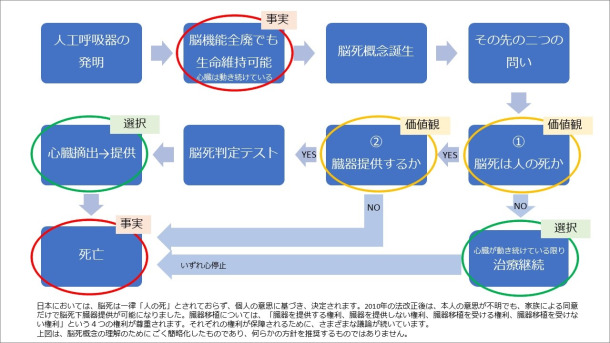
Example: Facts and values surrounding the concept of "brain death"
We learned that the fact that all brain function has been lost and the value of whether or not this should be considered "human death" are separate issues, and that it is important to have an attitude of discussing them separately. There are many things in the world that are valued, not just in the field of bioethics. Through this lecture, we gained a new perspective on how to approach things, and we were able to express our thoughts about life, in particular, in words with a slightly higher resolution than before.
Every person is born, lives, and dies. That is why thanatology(the study of death and practices associated with it) is a field that concerns all of us, not just anyone in particular. Thinking about "living" and "dying" not only helps us respect the lives of our loved ones, but may also lead us to "live today better."



![[Save version] Map of the four main campuses](https://www.waseda.jp/inst/weekly/assets/uploads/2026/06/110d605cfac40346aad1d2df464a6586-940x705-1-1-610x457.jpg)