Career Center provides information on career development and answers questions from students. It helps students to choose for themselves where they can play an active role and make their mark in society and in the organization they belong to. In addition, Career Center has Student Career Volunteers (SCV) who provide career-related information from a student perspective and plan and manage events.
This time, SCV's Yamamori Namika (3rd year, School of Culture, Media and Society) and Murakami Aika (4th year, School of Humanities and Social Sciences), who are considering going on to graduate school, interviewed Osawa Hotaka, who completed Graduate School of Letters, Arts and Sciences at the Graduate School of Letters and joined NHK. Osawa said, "I want students in the humanities to consider going on to graduate school as one of their options," and we asked him about juggling research and job hunting, and the connection between studying at graduate school and work.
I realized that even after I got a job, I could use the experience I gained through research.
Graduate School Graduate School of Letters, Arts and Sciences 's Program, March 2023 Graduate, Hotaka Osawa
--Please tell us why and when you decided to go to graduate school.
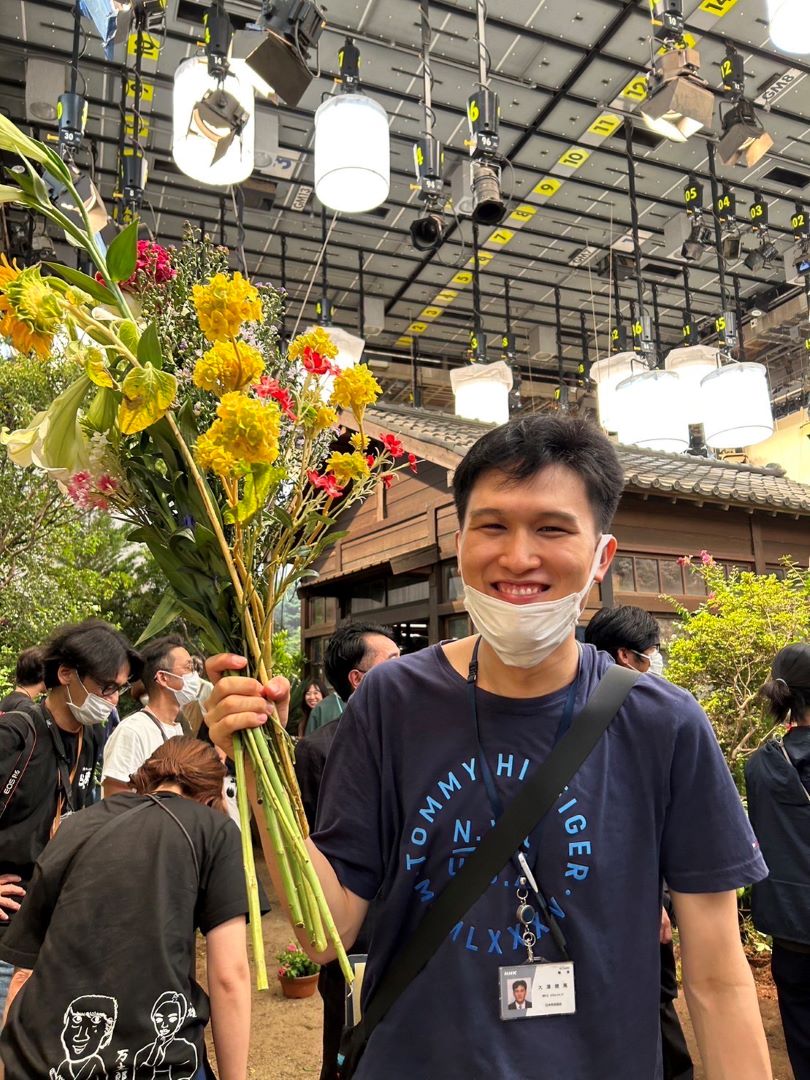
Graduated from School of Humanities and Social Sciences and completed a master's course at the Graduate Graduate School of Letters, Arts and Sciences. Joined NHK (Japan Broadcasting Corporation) as a director and was assigned to the drama department. Osawa is in charge of assistant directing TV dramas and planning radio dramas (pictured is during the filming of the TV series "Ranman").
When I was in elementary school, I watched "Ryomaden" (NHK's historical drama) and became interested in history, which led me to want to go to graduate school to specialize in Japanese history and become a researcher or Faculty in the future. The reason I aimed for graduate school from the beginning was because I felt that researchers need expertise and that we were entering an era in which highly specialized personnel were required for Faculty as well.
--What made you decide to pursue a career after completing your master's degree, rather than becoming an academic or Faculty?
For two years, from the winter of my third year of undergraduate studies to the winter of my first year of master's studies, I had the opportunity to work as a research and investigation staff member on the then-produced NHK Taiga drama "Seiten wo Tsuke" through the introduction of a researcher I met at an academic conference. As I worked with producers and directors, I was impressed by how everyone seemed to enjoy their work, and I wanted to work for NHK. I thought that even if I wasn't a researcher, I could make use of the experience I gained studying Japanese history by working on the production of Taiga dramas and educational programs. So I think I started my job search with the feeling that I wanted to join NHK from the very beginning.
-- Are there any skills that you gained by going to graduate school?
I guess it's the ability to back up your thoughts in order to convey them. In graduate school, I had many opportunities to write papers and often read old documents, so I think I also gained the ability to accurately read historical documents. In my job search, in addition to NHK, I also looked at companies where I would have a chance to use what I learned in research, such as educational publishers that deal with history books, and because I liked university, I even considered working as a university employee. However, while I was a student, I didn't particularly have the mindset of "gaining some skills for job hunting," so I just devoted myself to research, and I feel that what I learned in graduate school ended up being useful in my job search.
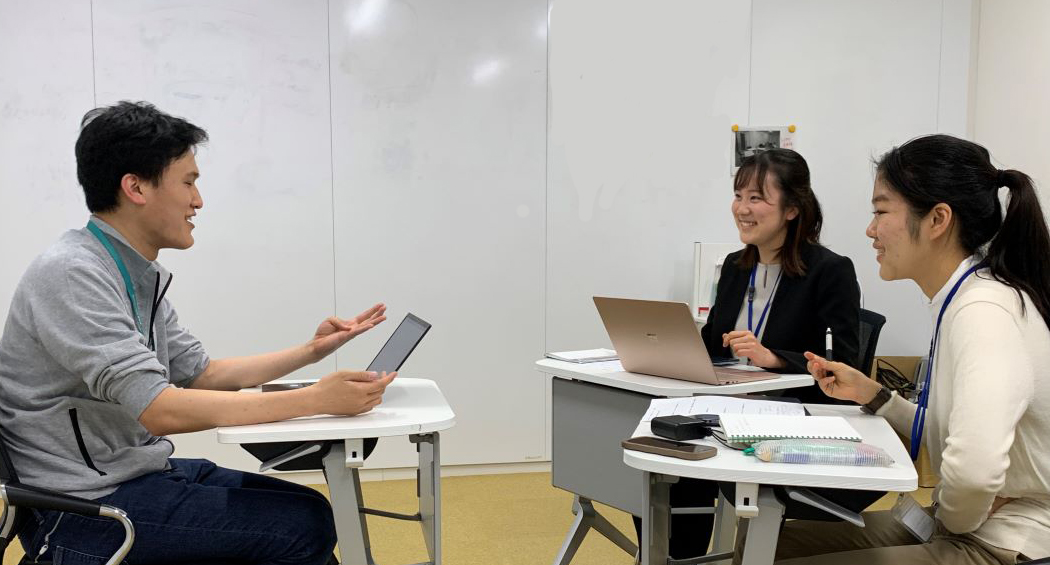
During the interview. (From left) Osawa, Murakami, and Yamamori
How did you balance your research and job hunting?
I decided to go to graduate school early on, and started preparing from my undergraduate years. Therefore, by the time I advanced to the master's course, I had gathered a certain amount of materials to write Master's Thesis, and I was able to balance my job hunting with my studies from the summer of my first year of master's studies. It was certainly difficult to do both at the same time, but I planned ahead, setting a numerical goal of "writing a certain number of pages of resume per day" before the seminar presentation, and I think it is very important to make progress on your research when you can.
--How do you feel that what you learned in graduate school is being put to use in your current job?
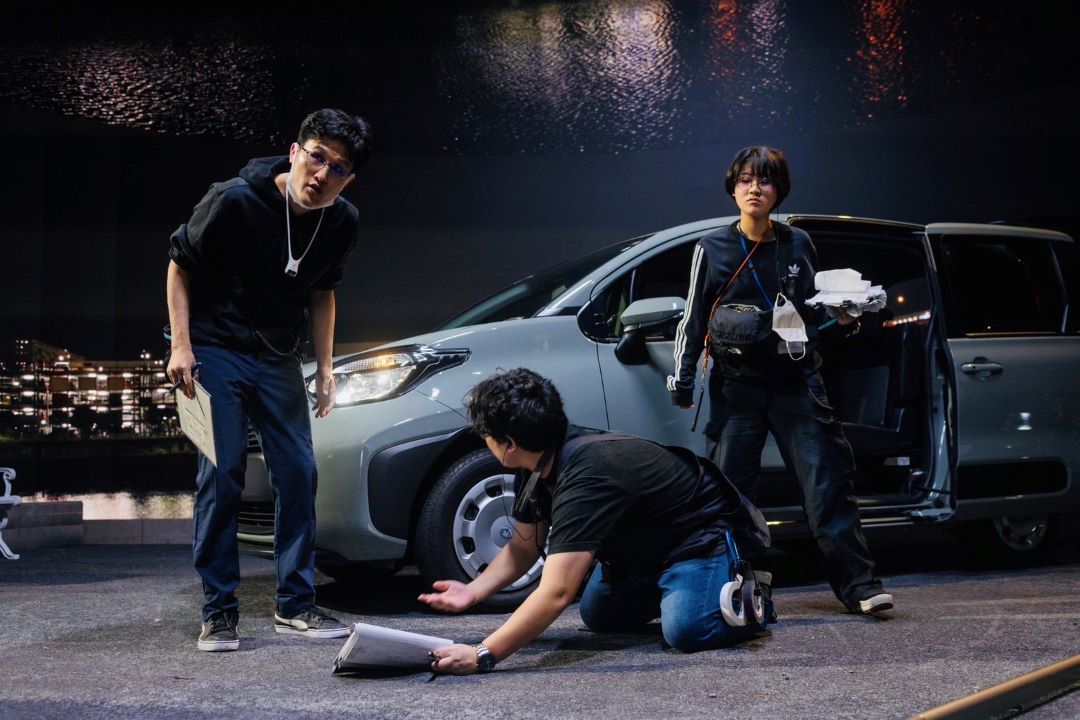
Osawa (far left) at work, checking the standing positions of the cast members on set of a drama, at a studio in Tokyo in the fall of 2023.
Rather than being passive and wondering "how can I use what I learned in graduate school?", it is important to approach your work with an attitude of "how can I use it?", and I am currently trying to put this into practice.
I believe that the role of history is to put modern society into perspective and find optimal solutions to the question of what society should be like in the future. The skills I gain from studying history do not always directly relate to my work, but I try to reflect the way of thinking I have acquired through my research. Someday, I would like to produce a drama that allows people to reexamine modern society from my own perspective as someone interested in history.
--What is something that you should do while you're a graduate student?
A graduate student's main duty is to conduct research, so you should pursue your research to the fullest. If you neglect your research, even if you are job hunting, you may not know why you went to graduate school. I would like you to gain academic experience that is unique to graduate students, such as presenting at conferences and writing papers, and devote yourself to your research.
--Please give a message to undergraduate students who are thinking about going to graduate school and to those currently enrolled in graduate school!
I think it's great to do research at a graduate school. Many students in liberal arts faculties go straight into the workforce, but I don't think there are any drawbacks to going to graduate school, so I personally think it's better to go if your circumstances allow. And if you go to graduate school, think of yourself as standing at the entrance to becoming a researcher, and try to approach it with a sense of purpose, thinking about why you are doing your research and how you will give back to society what you have learned through your research.
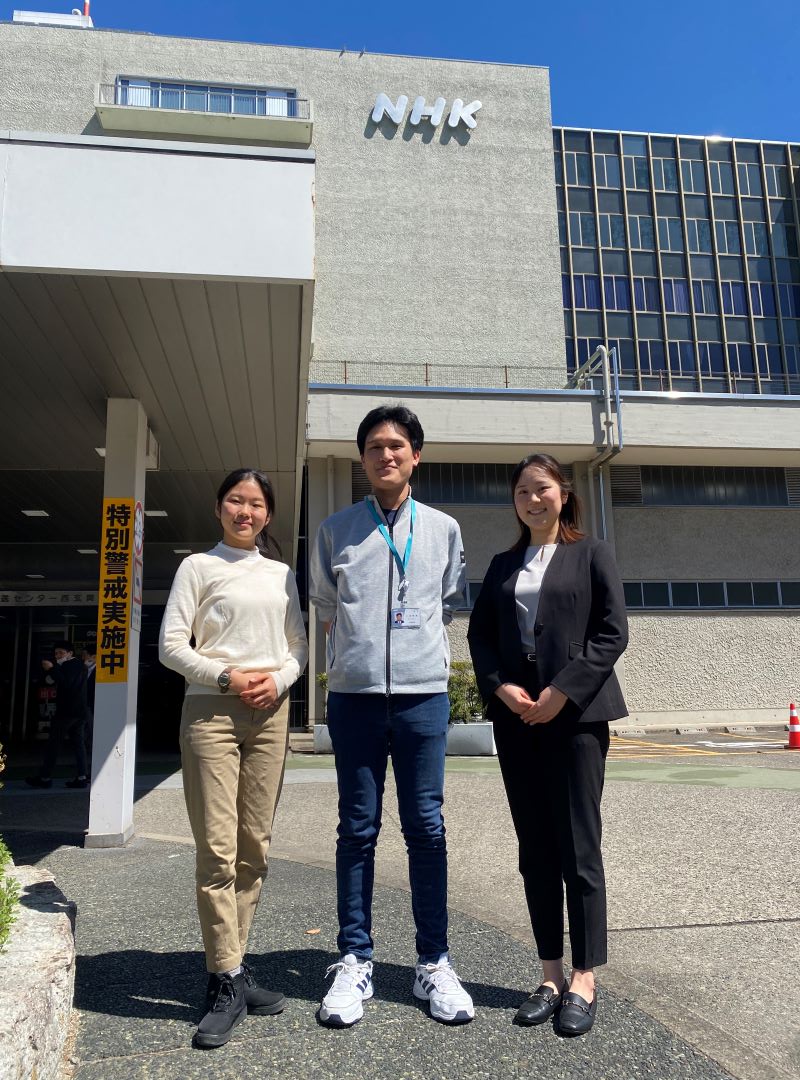
At the entrance to the NHK Broadcasting Center in March 2024. (From left) Yamamori, Osawa, and Murakami
After the interview
SCV Namika Yamamori
I was impressed by Osawa's attitude that "Since I went to graduate school, I will devote myself to my research and concentrate on what I need to do at hand." I often feel anxious when considering a choice that is not common, such as going to graduate school, but I felt that by staying true to my roots and facing what I need to do now and accumulating experience, I will shape who I will be in the future.
SCV Aika Murakami
I decided to go to graduate school when I was in my second year of university, but in my third year, many of my classmates started to look for jobs in earnest, and I felt anxious. After hearing Mr. Osawa's words, I reexamined my purpose in going to graduate school and my research, and was able to get my feet on the ground and start walking again toward going to graduate school. I was also exposed to a change of mindset, from "how can I use what I have learned, rather than how it can be used," and I was able to see things from my own perspective, realizing that what I have learned can be used in infinite ways if it is up to me.
SCV Instagram: @waseda_scv.career
About Career Center
Career Center provides support for job hunting regardless of faculty, graduate school, or year, as well as career support for first- and second-year undergraduate students. Please feel free to take advantage of the individual consultations and events for specific targets regarding careers and job hunting.
■ Usage Guide
https://www.waseda.jp/inst/career/students/guide/
■Before using Career Center
Please register your career aspirations through MyWaseda “Career Compass” in the following order.
1. After logging in to MyWaseda, click on "Student Life" → "Career Compass" → "Company and Job Information Inquiry"
②When using for the first time, enter information in the following order: "Initial registration screen" → "Student information registration" → "Career aspirations registration"
*You can change your registered desired course at any time.
■Event details
In June and July, there will be a lot of events for those graduating in 2025, 2026, first and second year undergraduate students, international students, and those aspiring to become civil servants! Event information will be posted from time to time, so please check it out. Details can be found here.
![[Save version] Map of the four main campuses](https://www.waseda.jp/inst/weekly/assets/uploads/2026/06/110d605cfac40346aad1d2df464a6586-940x705-1-1-610x457.jpg)