- Featured Article
Waseda Alumni & Students in North America — Jim Mockford
Fri 17 Jul 26
Fri 17 Jul 26
Waseda University, which upholds the goal of achieving a 100% study abroad rate among its students, has maintained an exchange program with North America for over sixty years, and in that time has welcomed more than 6,000 North American students to study in its halls. Many of these students have then gone on to draw on their study abroad experience to excel in various fields around the world.
One such individual is Jim Mockford, who studied at Waseda Kokusaibu in 1974-1975. Here, he shares memories of studying abroad at Waseda University, where his 50-year journey with Japan began.
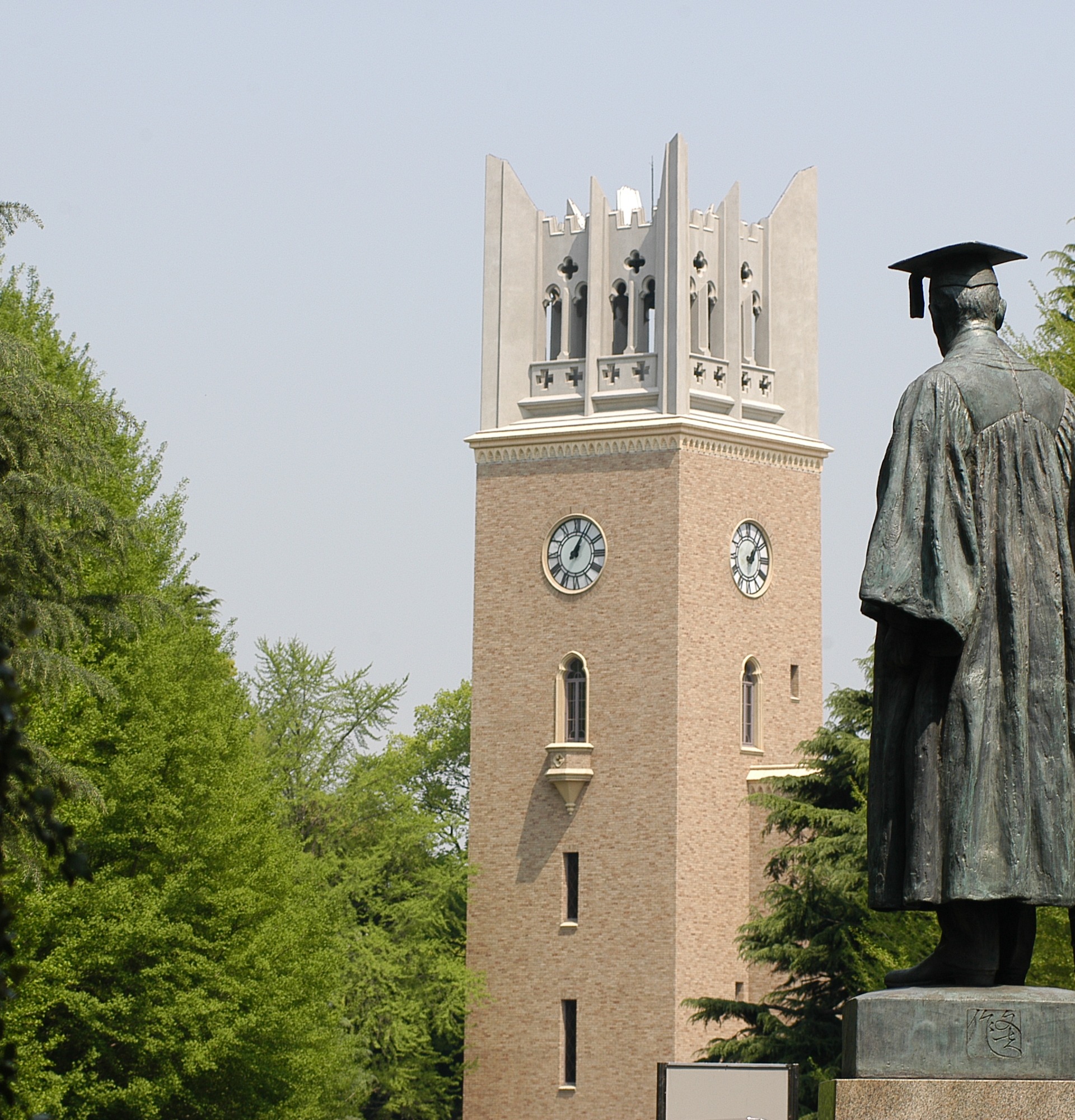
50 Years of Memories
June 13, 2026 marks 50 years since my graduation from the University of Oregon with a Bachelor of Arts Degree Honors College having majored in Asian Studies and Japanese. As I look back on my college years the most impactful experience was my junior year abroad in 1974-75 at Waseda University in Tokyo. It was unusual in the 1970s to study Japanese in the USA and there were only 15 students in second year Japanese at UO and only five students in 3rd year Japanese my senior year. We did not know at the time how timely the decision to study in Japan would be for a career going forward when just a few years later there was a “Japan Boom” in Japanese studies around the world.
While studying Japanese at Waseda, in Mrs. Sugiyama’s class, I made progress in language learning because she was a lively, positive, and enjoyable instructor who could not help laughing when we made some very amusing mistakes in class. We laughed too when we understood our mistakes. She reminded me of Professor Yoko McClain at the University of Oregon who later wrote a book, “Sōseki no mago no Amerika” (The America of Soseki’s grandchild). Natsume Soseki was a famous novelist of the Meiji Period and we read many of his works in translation. Professor McClain along with Professor Stephen Kohl who was our resident director in Japan helped prepare us to embark on the adventure as exchange students. But the 1970s were a time long before the internet and so much could only be learned by “being there.” I believe that is the case today that a student needs to be “in Japan” to really learn about Japan.
Homestay with the Tanakas - where the real learning took place
The real learning for me took place in my Japanese home and the daily experience of a homestay with a Japanese family who did not speak much English was both a challenge and wonderful opportunity. I am deeply grateful to the Tanaka family who kindly hosted me that year and have been lifelong friends. In 2025 my wife Cheryl and I visited their home once again to see Mrs. Fumiko Tanaka at the age of 92 and her son Shinya.
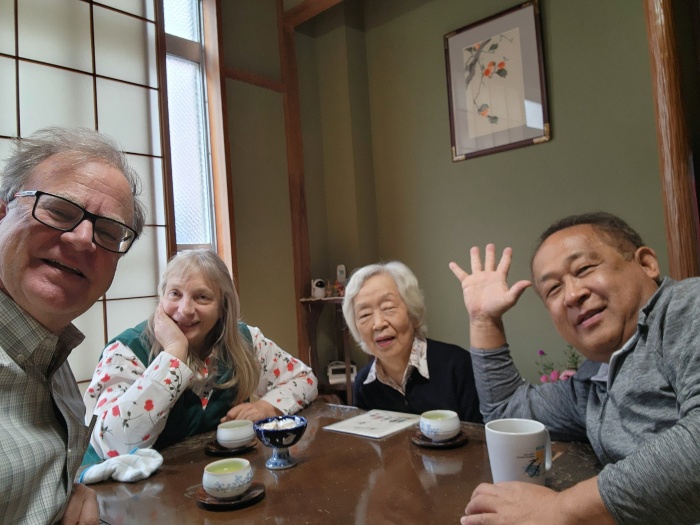
Mrs. Fumiko Tanaka and son Shinya with Jim and Cheryl Mockford - 2025
I was the first foreign student that the Tanaka’s hosted but they would go on to provide homestays to Waseda students for many years. As their first exchange student I pioneered the Japanese breakfast experience which as a very traditional family was of course a very traditional Japanese breakfast in a house that had NO COFFEE. I like Japanese food but to go without coffee in a country that at that time had no Starbucks and a city that had only one or two MacDonalds was going to be initially a trying experience. So, we tried instant coffee, then a fancy European glass percolator, then drip coffee as Mrs. Tanaka became interested in all the various ways that foreigners make coffee. By the time that future exchange students came to stay at the Tanaka house the breakfast experience could be both Japanese breakfast and selections from the international world. I was impressed with restaurant delivery service by bicyclists or scooter with boxes piled high with everything from ramen to sushi but mostly we had home made dishes by Mrs. Tanaka with very fresh rice selected from their rice store.
Mr. Tanaka was the owner of an “Okomeya” Rice Store that had been in his family for generations and he witnessed the horrific firebombing of Tokyo in 1945 that destroyed vast areas of the city including most of their neighborhood that was renamed in 1961, ”Heiwajima” meaning Peace Island. Today the waterfront area is nicely redeveloped with parks and a beach at Omori Furusato no Hamabe Park. After the war the Tanakas built a new rice store and building which housed the business on the first floor next to the “Genkan” entrance area to their home with Japanese style living room and western style dining and kitchen area and stairs to bedrooms on the second floor, and several apartments with separate entrance on the third floor. It was a short walk to the Heiwajima train station and then an hour or so ride to Waseda campus with a couple of transfers to be made on the way. Students had train passes issued for our commute to school but needed to pay for extra trips beyond the route if we ventured to other places in the city such as the Ginza. Tokyo was often smoggy in those days and there were stlll many industrial areas that contributed to Japan’s “economic miracle” of the 1960s and 1970s that today have been rebuilt into parks and shopping or residential areas.
In Economics class at Waseda I learned from Professor Wada all about the economic trajectory of Japan’s recovery from World War II, the success of industrial strategies and international trade, and the expected continuation of Japan’s “economic miracle” in the years ahead. It turned out that he was very correct as just a few years later in 1979 the book, “Japan As Number One: Lessons for America” by Ezra Vogel became at top seller in the USA. I took courses in Japanese literature from Professor Takeda and poetry from Professor Mori Joji the grandson of famous Meiji period novelist Mori Ogai. As students we attended “big culture” experiences such as Kabuki Theater, Noh and Kyogen drama, and Sumo Wrestling. I also learned a great deal from “small culture” experiences when Mrs. Tanaka took me to her favorite department store Takashimaya, and I attended tea ceremony class with her daughter Kozue, and visited the son’s school on sports day for the “Undokai” athletics events.
During school vacations between semesters, I visited each of Japan’s four major islands and traveled all across Honshu and to Shikoku and Kyushu with other students and to Hokkaido with Shinya Tanaka staying at youth hostels.
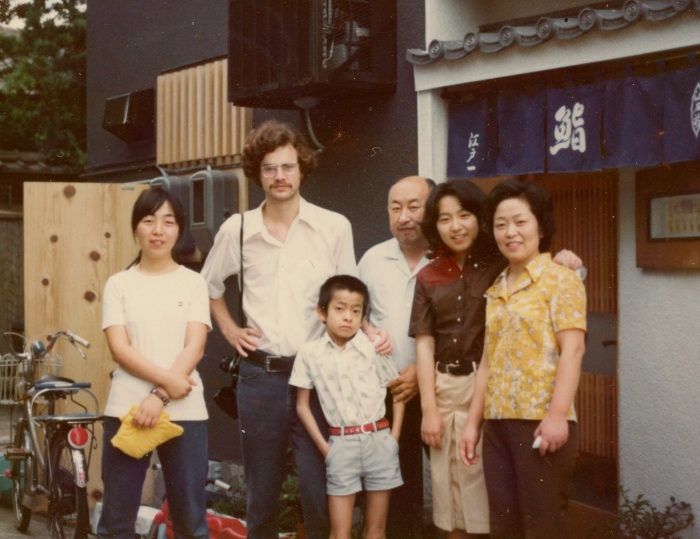
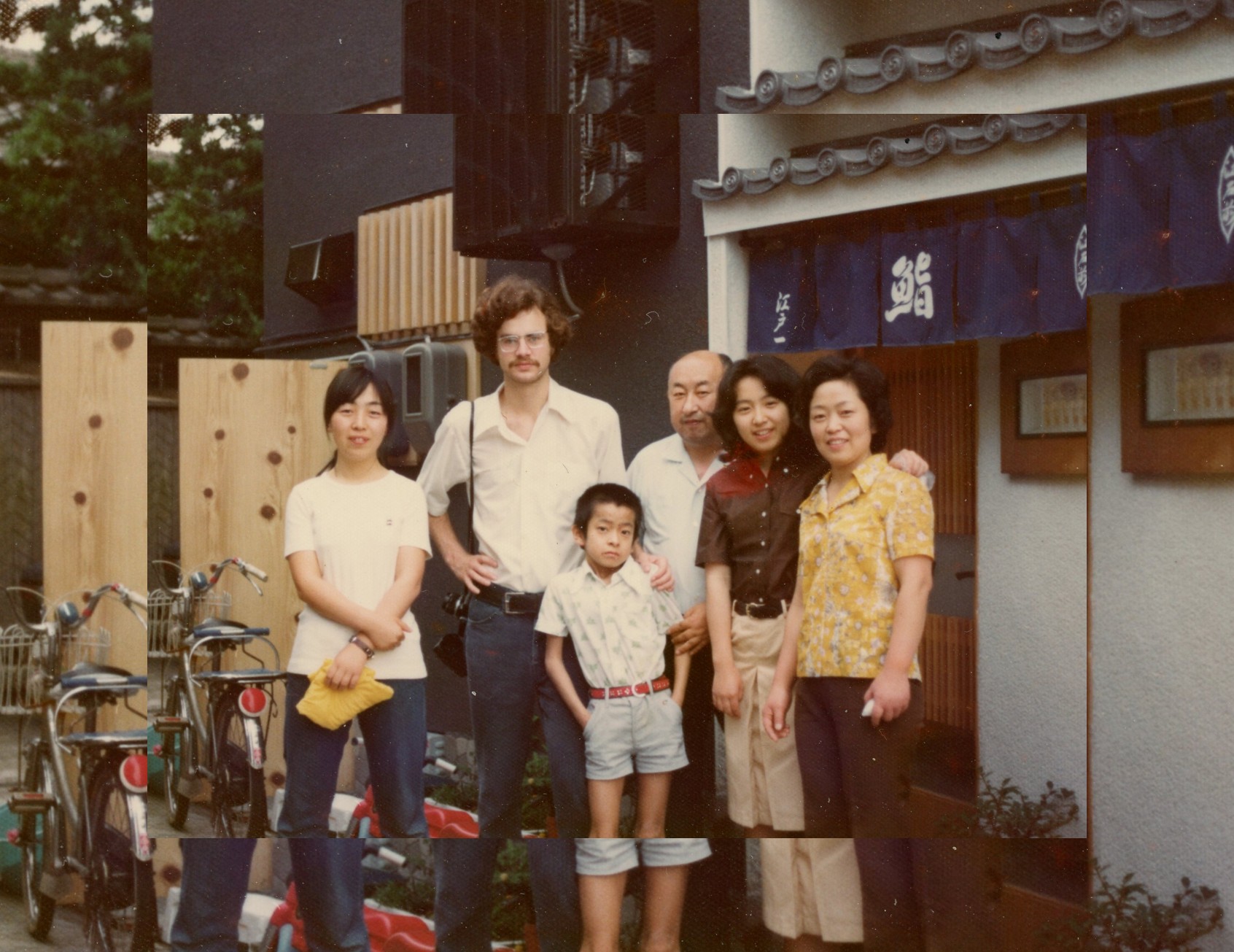
Tanakas and niece Michi in front of restaurant - 1974
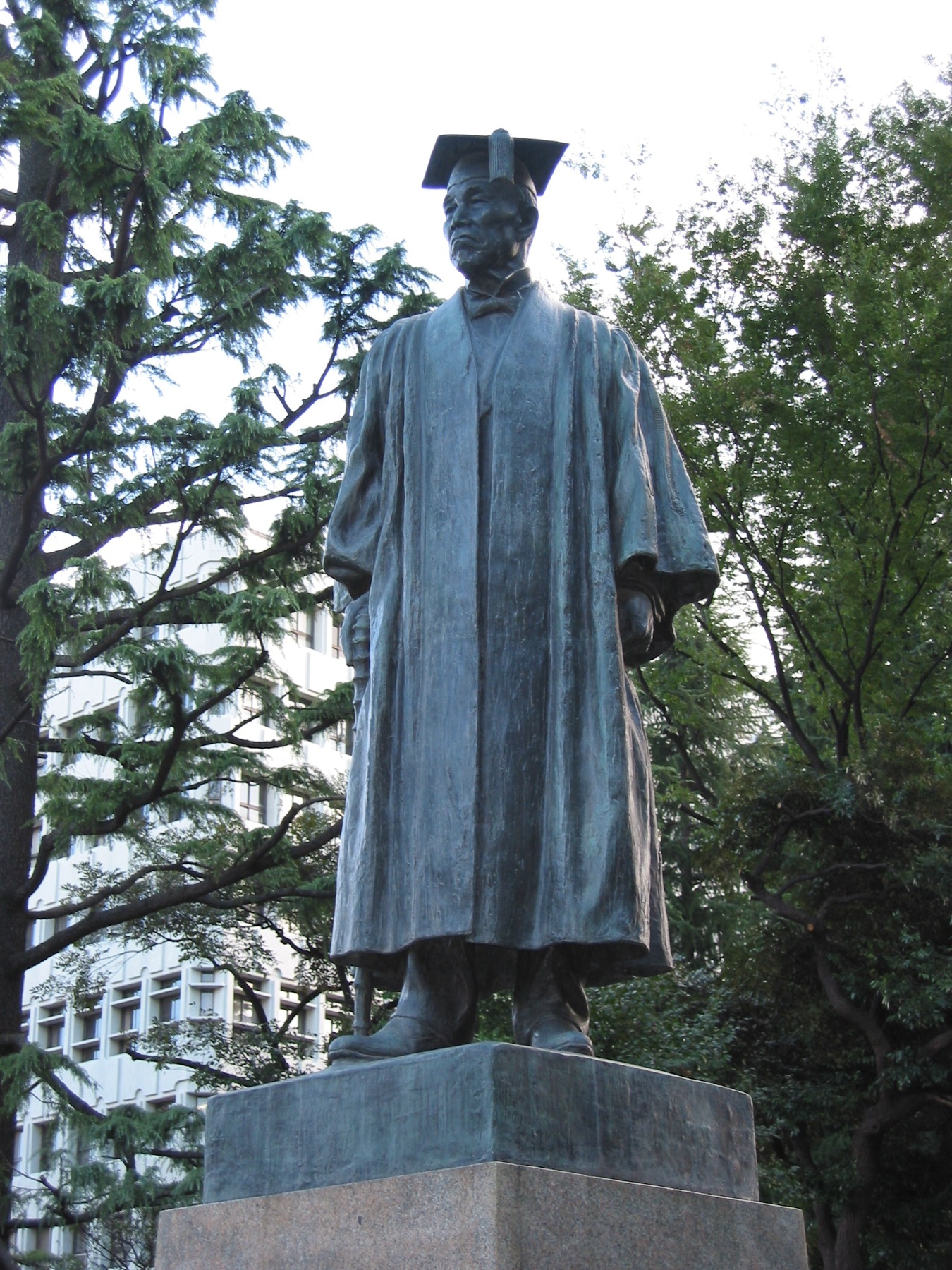
The reentry experience of seeing one's own country with a new perspective
Returning to Oregon in June of 1975 I experienced “reverse culture shock” as part of the reentry experience of seeing one’s own country with a new perspective and the unexpected missing of things Japanese that became part of my life while in Japan. I immersed myself in my senior year studies at the University of Oregon, and in the spring of 1976, I entered the only Japanese language speech contest on the west coast which was held in San Francisco by the Japanese Language Speaking Society of America. I did not win the contest but came home with a dictionary inscribed with words in Japanese “Makeru wa Kachi, Shippai was Seiko no Haha” meaning “to lose is to win, failure is the mother of success.’
Upon graduation from University of Oregon I returned to work in Japan, then traveled around the world, and a few years later while attending graduate school at the University of Washington I was hired to become the first executive director of the Japan-America Society of the State of Washington in 1981. I organized public affairs lectures by author Ezra Vogel and other eminent Japan scholars, participated in the Seattle Kobe Sister City exchanges, supported the annual Seattle Cherry Blossom and Japanese Cultural Festival and in 1983 accompanied five US Congressmen and a delegation of 20 business participants on the Congressional Goodwill Friendship Mission organized by the Japan-America Society of the State of Washington and chaired by the late David Enroth and Tomio Moriguchi who both served as presidents of the Society.
In 1983 I joined Tomio Moriguchi as an observer to the International Conference of Overseas Japanese held in Tokyo and met Prime Minister Nakasone at a reception held at the official residence of the Prime Minister. We also met with former Prime Minster Takeo Miki who had given Seattle 1,000 cherry trees as a bicentennial gift in 1976 the year that I graduated from college. Little did I imagine at that time that less than ten years after my year at Waseda that I would meet two Prime Ministers of Japan on more than one occasion.
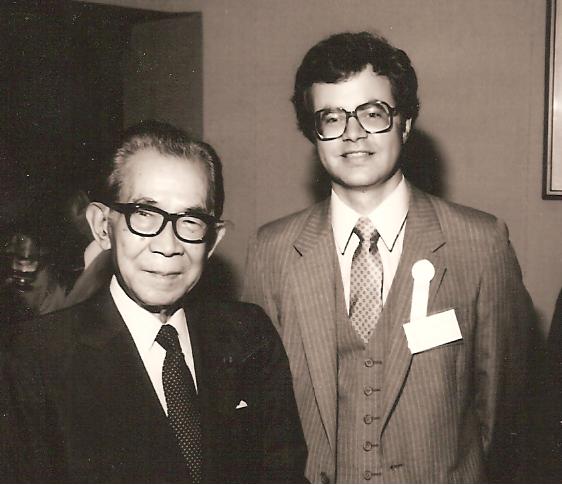
With Prime Minister Takeo Miki – 1983
In August 1983 the Congressional Mission to Japan was organized to tour the country including farms in Aichi Prefecture, officials in Seattle’s sister city Kobe and Washington State’s sister prefecture Hyogo, and a very meaningful visit to Hiroshima where we met with Mayor Araki thanks to the assistance of Seattle atomic bomb survivor Ken Nakano and where we presented 1000 paper cranes at the Hiroshima Children’s memorial known as the Sadako Statue.
Just near the end of our trip on September 1, 1983 the Korean Airlines Flight 007 was shot down by Soviet aircraft over Sakhalin Island and our wonderful tour was now in the midst of an international crisis. Ambassador Mike Mansfield organized a briefing for our delegation by General Barker at the US Embassy where a confidential update of the situation was received and we then visited Prime Minster Nakasone at the official residence. Washington State Congressman Joel Pritchard a member of the House Foreign Relations Committee and the senior member of our delegation thanked the Prime Minister for meeting us, the first American group for him to meet on the day after the incident and US-Japan ties were reaffirmed by both sides in the midst of the crisis.
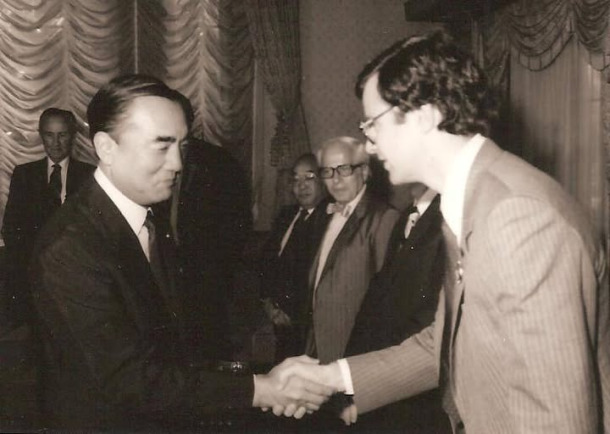
With Prime Minister Yasuhiro Nakasone – 1983
Later that day at the Foreign Correspondents Club Congressman Pritchard received a phone call informing him that Senator Henry Jackson had died from a heart attack and Congressman Pritchard relayed that news at the press club. Our congressional mission that had so many positive meetings during the week before felt the burden of a very serious situation but a closer relationship to Japan accompanied that situation that we all considered on the flight back to Seattle later that week.
Indeed the "Torch Has Been Passed"
I returned to Japan several times on happier occasions in the 1980s and I attended Prime Minister Miki’s recognition ceremony at the National Diet for 50 years of public service at the event in 1987. After his death in 1988 I visited the Miki home in Nampeidai during the time of mourning and continued my friendship with the family that had started when Seattle welcomed First Lady Mutsuko Miki and the Awa Odori Dances from their home town of Tokushima to the Seattle Cherry Blossom and Japanese Cultural Festival. The Miki’s daughter Kiseko Takahashi, became a close friend over the years whom we took to the opera and sailing on tall ship Lady Washington in Seattle. She later represented Tokushima in the Diet and passed away in 2020.
My experience as executive director of the Japan-America Society from 1981 to 1985 took me much farther in a Japan related career than I imagined when I attended Waseda and graduated from college 50 years ago. I continued Japan related work as a consultant, Japanese language teacher, and work in the software industry for the last 25 years before I retired in 2021. I have been involved in community organizations that promote US-Japan relations including serving as Chairman of Friends of MacDonald from 1998-2008 which is a historical and educational group that remembers Japan’s first teacher of English Ranald MacDonald and I published essays such as “The Friends in Friends of MacDonald” in Oregon Historical Quarterly (2018), and “The Lady Washington at Kushimoto, Japan in 1791” in the anthology “The Early Republic and the Sea” (2001). Surprisingly, I appeared as a character (me) in the 2022 manga “Mamiya’s Maps: A Samurai Explores Sakhalin (Sean Michael Wilson and Akiko Shimojima).
Although I have visited Japan several times in recent years, I have not been to the Waseda campus since 2015 when I attended “The Torch Has Been Passed: JFK’s Legacy Today” Symposium at Okuma Kaikan at which Prime Minister Shinzo Abe, Ambassador Caroline Kennedy and her son Jack Schlossberg (the only grandson of President John F. Kennedy) and Former President Bill Clinton, and many other dignitaries gathered to speak at the symposium.
Waseda University President Kaoru Kamata presided at the symposium in 2015 and he was succeeded by President Aiji Tanaka in 2018 who is leading the Waseda 150th Anniversary Project in 2026. Because of the pandemic I did not meet President Tanaka in person but I attended the first US-Waseda Friends Online Reunion, held in September 2020 on Zoom Webinar and I also enjoyed talking to President Tanaka on Spatial Chat a new networking application that Waseda pioneered as a virtual venue during the pandemic while we began a new decade of alumni activities. It does indeed seem like the “Torch Has Been Passed” to a new post pandemic generation and I was very happy to see that the Waseda alumni gathering in Portland in 2026 was well attended by many young people of the new generation with stories of their own to share in the years ahead.
PROFILE
Jim Mockford is an American now retired from a career that spanned roles in the tech industry, education, and public affairs. He served as executive director of the Japan-America Society of the State of Washington in the 1980s, Japanese teacher in the 1990s, followed by 25 years in software development that bridged engagement with China, Japan, and the USA. He has served on the Advisory Board of the Center for Japanese Studies Portland State University, Board President of the Northwest China Council, and as a published author he has focused on Asian and Pacific studies, maritime history and children’s books.