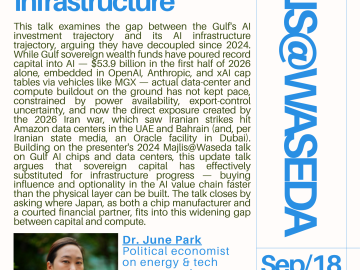
Waseda University Qatar Chair team welcomed researchers from the Centre of Islamic Studies at the University of Cambridge on April 18 and 19.
The conference, “Cambridge in Japan at Waseda – Conference on Middle Eastern and Islamic Studies,” was successfully held over the two days, bringing together scholars for discussions on a wide range of topics related to Middle Eastern and Islamic studies.

The Chair’s Reflection on the Event

Abdullah Baabood(Chair Professor)
The “Cambridge in Japan” initiative appears to be far more than a standalone academic conference. Rather, it reflects the emergence of a strategic academic triangle linking Waseda University, the Centre of Islamic Studies at the University of Cambridge, the Chair of the State of Qatar for Islamic Area Studies at Waseda University, and Qatar University within a longer-term research and intellectual partnership focused on Middle Eastern, Gulf, Asian, and Islamic Studies.
One of the most important objectives of the Chair of the State of Qatar for Islamic Area Studies at Waseda University is to foster multidisciplinary and interdisciplinary research through institutional cooperation with leading global universities, research centres, and think tanks. In this context, collaboration with the University of Cambridge is highly strategic. Cambridge brings global scholarly prestige, internationally recognized expertise in Islamic and Middle Eastern Studies, access to extensive European and international research ecosystems, and a strong comparative intellectual tradition that complements Waseda’s Asia-focused strengths and global outlook.
This partnership advances several key objectives of the Qatar Chair simultaneously, including:
- The internationalization of Islamic Area Studies in Japan;
- The development of transregional research networks linking Asia, the Gulf, Europe, and Africa;
- The promotion of comparative and cross-disciplinary research;
- The production of globally visible scholarship and policy-relevant research outputs; and
- The positioning of Waseda University as a major hub for Gulf and Islamic Studies in East Asia.
From a broader institutional perspective, this collaboration also aligns closely with Waseda University’s wider international research strategy, which increasingly emphasizes global partnerships, interdisciplinary research, international academic visibility, and collaborative knowledge production across regions.
The Qatar Chair provides Waseda with a unique platform in Japan for advancing research on a wide range of themes, including:
- Gulf–Asia relations,
- energy and maritime security,
- Islamic civilization and thought,
- global governance,
- regional geopolitics,
- migration and transnationalism,
- and inter-civilizational dialogue.
The “Cambridge in Japan” event is also likely to encourage future institutional collaboration between Waseda University and the University of Cambridge. The proposed follow-up initiative, “Waseda in Cambridge,” could further deepen this partnership through joint research clusters, co-authored publications and edited volumes, faculty and student exchanges, collaborative grant applications, policy dialogue initiatives, and future conferences and workshops hosted between Tokyo and Cambridge.
The significance of this initiative is therefore not only academic. It also contributes to soft power, intellectual diplomacy, and long-term Japan-Qatar-Europe engagement. The Qatar Chair acts as an important bridge between regions that are increasingly interconnected economically and strategically, yet remain insufficiently connected intellectually and institutionally.
In many ways, “Cambridge in Japan” may be viewed as an early institutional model for a broader transregional research ecosystem centred around Waseda University and the Qatar Chair -one that positions Tokyo as an increasingly important global node for Middle Eastern and Islamic Studies in the Indo-Pacific era.