Interviewee:
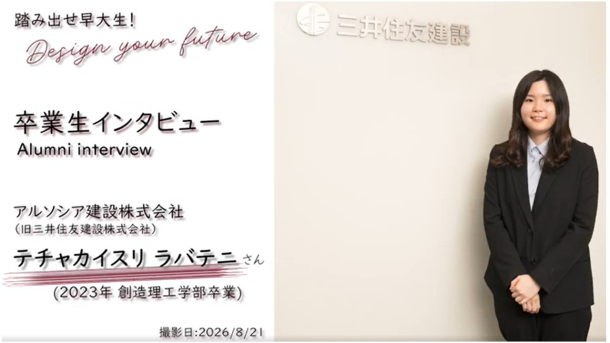
Techakaisri Ravathinee (Jasmine) now with Arsocia Construction Co., Ltd. (formerly Sumitomo Mitsui Construction Co., Ltd.)
Graduated from the School of Creative Science and Engineering in 2023
Developing practical communication skills through activities outside the university
I enrolled at Waseda University in 2019. I had long been interested in Japan, both because of my interest in Japanese culture and technologies such as seismic design for buildings, and because my father had studied in Japan. While considering several universities, I decided to attend Waseda University because I felt it offered a particularly international environment, with a large number of international students and opportunities to study in English. I also thought that being located in Tokyo would make it easier to engage with a variety of companies when I eventually began looking for a job in Japan.
At university, I majored in civil engineering and conducted research on concrete. I also started a part-time job because I wanted to increase my opportunities to communicate in Japanese. For the first six months or so, I worked at a convenience store, followed by about two years at the front desk of a hotel in Ueno. Because the hotel welcomed guests of many different nationalities, I gained experience serving them in multiple languages, not just Japanese. What I found particularly valuable was the opportunity to learn how to use keigo in practice. At university, I mostly talked with friends, so I didn’t have many opportunities to use keigo. At the hotel, however, interacting with guests gave me firsthand experience of how professionals communicate in the workplace. The communication skills I developed during this time proved to be a great asset when I later began looking for a job.
After coming to Japan, I also went to see a Waseda-Keio baseball game, which inspired me to join a baseball circle for about a year. I think that interacting with a wide range of people, not only through my studies but also through part-time work and circle activities, gave me experiences that I could later draw on when presenting my strengths during my job search.
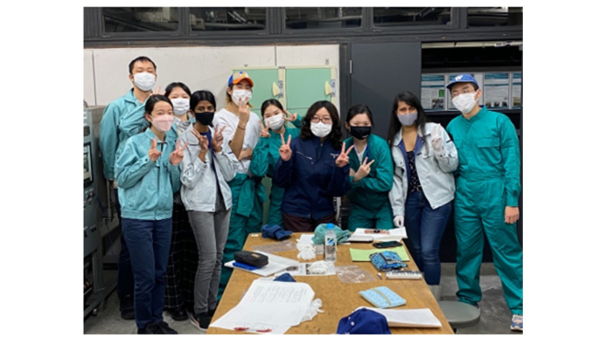
(cap) Conducting an experiment at university
Get to know the people you will work with through internships and alumni visits
From the moment I started my job search, I wanted to work as an engineer, particularly in a design-related role. I therefore focused my job search on general contractors and construction consulting firms. I started participating in internships in earnest during the latter half of my third year of university. Some of the students around me had started as early as their second year. Looking back, I think I could have acted sooner if I had some idea of the kind of work I wanted to do.
During my job search, I made a conscious effort to speak directly with people from companies whenever possible. When I met a Waseda University graduate at a company information session, I would sometimes email them myself and ask if I could meet with them to learn more about the company. I also actively made use of my network, asking university professors to introduce me to people at companies and seeking advice from senior peers who were already working as construction consultants.
Visiting companies in person allowed me to learn things that I could not find out from their websites or information materials alone. When choosing a company, what I particularly valued was not just the work itself, but also what kind of company culture it had and what kind of people I would be working with. When you visit a company, some people take the time to answer your questions, while others enthusiastically talk about what makes their work interesting and rewarding. Through these interactions, I was able to get a feel for the atmosphere within the company and imagine myself working there.
During the recruitment process, I struggled with preparing for aptitude tests such as the SPI, as well as interviews. For the SPI, you need to read, understand, and answer questions written in Japanese within a limited amount of time. For about three to four months, I practiced with questions from past tests for around three hours every day. I also recommend studying in a café, where you can relax while you work. Ultimately, there aren’t any shortcuts to the SPI; it’s important to keep practicing until you become familiar with the questions. Additionally, some companies allow applicants to take the SPI in English, so it’s important to research this in advance.
For interviews, I practiced many times with senior students and friends and also made use of the university’s Career Center. I made a particular effort not to hold back when presenting my strengths. In my case, I highlighted my ability to speak multiple languages, my potential to work on overseas projects in the future, and the communication and teamwork skills I had developed through my part-time job at a hotel and circle activities. I presented these as strengths that set me apart. In job hunting, I think it’s important to consider not only what you can do, but also what you have experienced and what you have gained from those experiences.
Growing as an engineer by taking on new fields
There are three main reasons why I ultimately chose my current company. The first was the people and the company culture. The second reason was the opportunity to grow in an environment with a high level of technical expertise. The third was the possibility of working not only on domestic projects but also on overseas projects in the future.
I currently belong to the project design group, where I am mainly involved in technology development and design in the energy sector. Specifically, I work on technology development related to ammonia tanks, analysis related to offshore solar power, and joint research with other companies. At university, I mainly studied civil engineering, including areas such as bridge engineering. In contrast, my current work requires knowledge in areas different from those I studied at university, such as energy-related facilities.
Looking back, ever since I was a child, I’ve enjoyed building things with LEGO and wanted to become an engineer. In my current job, I also work with my team to design structures from scratch, dividing up responsibilities as we bring them to life. My biggest goal now is to one day see something we’ve designed actually built with my own eyes.
In the future, I would like to work not only on the domestic projects I am currently involved in, but also on overseas projects. I also hope to gain experience in design and technology development across a wide range of fields, rather than limiting myself to solar power and ammonia, and expand what I can do as an engineer.
Message to current students: You don’t have to be perfect. Just have the courage to speak up.
To international students hoping to find a job in Japan, I would say, “Don’t be afraid of failure. Try as many things as you can.”
As a foreigner, I naturally felt anxious about looking for a job in a country other than my own. I wasn’t confident in my Japanese, and it took courage to approach people I didn’t know at internships and company information sessions. But if you don’t talk to people, you won’t make connections or have opportunities to learn about companies. Even if your Japanese isn’t perfect, it’s important to take the initiative and talk to people.
Once you’ve gotten to know someone a little through an alumni visit or a similar opportunity, I think it’s a good idea to talk about casual topics such as hobbies and travel, rather than just asking questions about work. Talking about things outside of work can help you get to know the other person better and lead to more natural communication.
What I learned through my own job search is that there are many things you won’t know unless you give them a try. Don’t hold back just because your Japanese isn’t perfect. Take the initiative and showcase your strengths. I believe that taking action without being afraid of failure will also serve you well in your future career.
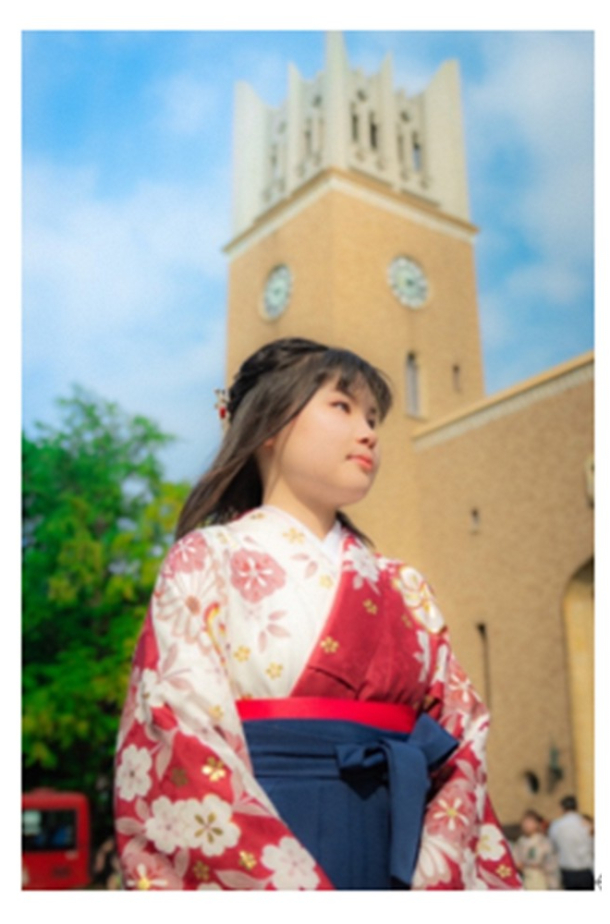
(cap) In front of Okuma Auditorium on graduation day