Interviewee:
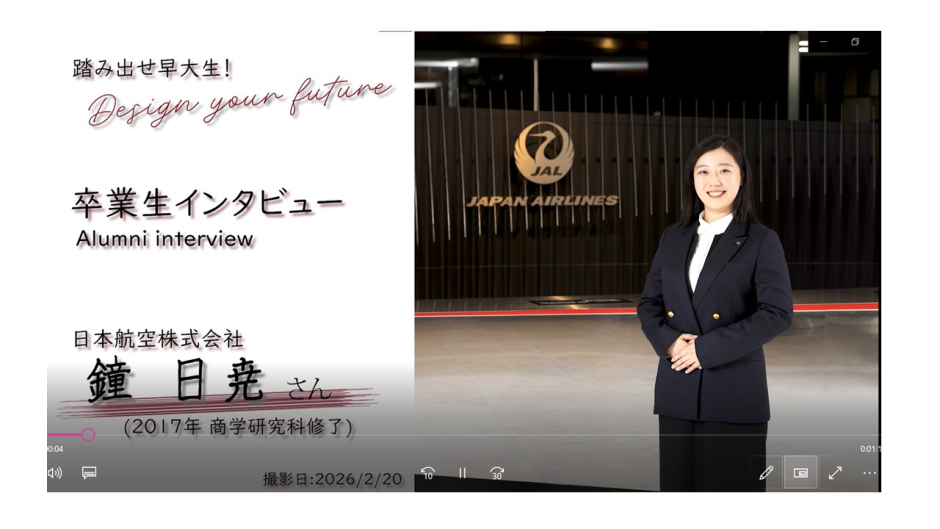
Zhong Riyao now with JAL Aviofuture Lab Co., Ltd., Graduated from the Graduate School of Commerce in 2017.
Building up a wealth of experience, both through research and extracurricular activities, with an eye toward international exchange.
I entered the Waseda University School of Commerce in 2010 and went on to get my master’s in the graduate school. The reason I chose to go to Waseda University was that I’d been studying Japanese as a second language since my first year in junior high school. I struggled a bit with the choice of French or Japanese, but my father had studied Japanese when he was in university, too, and that was one of the factors that led me to choose Japanese. In high school, through the priority admission school system, I had the chance to take the Waseda University entrance exam from China. I saw this as an opportunity to use my Japanese knowledge to broaden my horizons, so I made the decision to apply.
In the School of Commerce, I studied finance, macroeconomics, and the like, with a focus on international finance. Originally, I’d been planning to go into the sciences. But then, when the global financial crisis hit in 2008, I saw the influence that finance and economics had on the world, and I wanted to study these areas. In graduate school, I chose the EU as the topic of my master’s thesis. Through an exchange program, I was able to visit countries like France and Germany, and also the European UN headquarters. This was right when a major change was taking place: the UK was about to leave the EU. Being able to feel firsthand the atmosphere where it was actually happening was a profound experience for me.
In addition to my research, I also dedicated myself to extracurricular activities involving international exchange, which I’d always been interested in. This included helping Japanese people who wanted to learn Chinese and serving as a test proctor for a Chinese proficiency exam. In the private sector, I also have some experience as a Chinese-Japanese interpreter. I think this experience of acting as a bridge between these two different cultures has helped shape the foundation of my job-hunting activities and my current work.
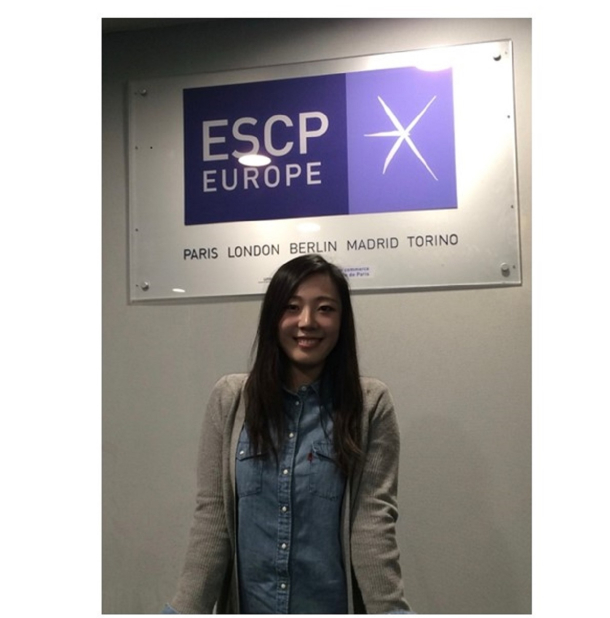
Visiting Europe as an exchange student
Job hunting presented me with a major opportunity to define my core.
I struggled with the overlap between my job-hunting and overseas study schedules. Job hunting in Japan usually starts in the fall and lasts until the summer of the following year. I left for France in January 2016 and came back in May of the same year. By the time I got back, a lot of my classmates were already in internships or deep into the selection process. Some had even already gotten informal job offers. I’m sure that a lot of the students who study overseas do so to delve even deeper into their research. When you do that, I think it’s important to plan in advance so that job hunting and research both go smoothly. As for my overall job-hunting process, I checked the Career Center’s website, made a list of companies I was interested in, and organized their selection process schedule information.
For me, another big challenge was deciding on what direction to take with my job hunting. In China, your university major and research focus directly link to your future career, but to me, it feels like in Japan there are a lot more options open to you. This has its advantages, like letting you try your hand at industries you’re interested in, but on the flip side, there are so many choices that deciding what to do can be a real struggle. To develop a career direction that you can be satisfied with, you need to have a “core.” I think it’s important to shape that core, little by little, while looking at the missions, cultures, and systems of various companies. If you suddenly leap to “What kind of life do I want to lead” or “What’s truly important to me,” you’re probably not going to be able to come up with good answers. You should start off by looking at job hunting as an opportunity to reappraise your own career and values, without really squaring yourself off. Then you should make your way forward, feeling things out as you go along. I think this approach will play an important role in the future direction of your life.
In my actual job hunting selection process, I used the language skills I developed through my extracurricular activities. When you’re looking for work, Japanese pronunciation is important, of course, but being able to speak like a future member of the workforce is also important. When I was a student, I talked with people outside the university and I did interpretation work. My experience in official settings helped me out a lot in job-hunting interviews and group work. I also got my seminar professor to help out by providing advice.
A position that provides a window on both the present and the future of the airline industry.
I’m now working for JAL Aviofuture Lab. Due to my parents’ work, I did a lot of flying as a child, so I’ve always been attracted to aviation work. That’s why I decided to look for a job in the airline industry. As a foreigner trying to get a job in one of Japan’s leading companies, I felt a lot of pressure, but this had been my childhood dream, which helped me keep pushing forward. I was a bit nervous about moving away from finance, which I’d majored in in graduate school, but my seminar teacher encouraged me with this advice: “You should try out different things while you’re young, and then if something isn’t a good fit, you can just change course. But take on those new challenges.”
After being hired by Japan Airlines, I got a national certification and became a dispatcher. I was responsible for maintaining the safety of the skies from on land, by creating flight schedules, monitoring flights, and the like. Last year, I was transferred to JAL Aviofuture Lab, which is where I work now, investigating global airline industry trends and analyzing data. Specifically, I attend overseas conferences to investigate the latest trends in individual global airlines, along with changes in the policies of international organizations. In my data analysis work, I’ve created a new airline demand model that reflects post-pandemic changes in flight demand. The work I’m doing now consists of using objective data and analysis to predict global changes and determine how modern airlines should grow.
I feel really lucky that, through this work, I can see both the present state of the airline industry and its future. I find it so rewarding to help protect the precious lives of air travelers and plan the future of the airline industry from its front lines. Going forward, I want to figure out what I can do as part of Japan’s airline industry and to use my knowledge and vision to contribute to the development of the JAL Group.
Message to current students: What you’ve nurtured through the years won’t go to waste! Take on new challenges, led by your own core.
One thing I feel in my work now is how closely linked it is to my experience as a student. I use what I learned about macroeconomics and statistics in my current research and investigation. You may feel like you won’t have opportunities to use this kind of knowledge out in the real world, but the ability to tightly focus and research something, and to think logically, will reappear at unexpected times and be invaluable. During your job hunt, you may find yourself feeling blue because you haven’t been able to fully leverage what you’ve learned, but never take the abilities you have for granted. Don’t get too hung up on your specific major, but instead focus on identifying what you truly want to do and take on the challenge of achieving it.