Hiroaki Yanagi, Part-time Consultant Waseda University History Museum
Prefectural Banna Park is located on Ishigaki Island in Okinawa Prefecture. At the park’s south entrance, there are numerous stone monuments that do not appear in tourist guides. Two of these monuments, which serve as memorials to the war, bear the name “alumni” from Waseda University.
One is Nobumoto Ohama (born School of Law 1918), whose name is inscribed on the ' Tower of Yaemori' (Yaemori no Tō) built in 1967. Born on Ishigaki Island, he served as the 7th President of Waseda University (1954–1966) and later became a key figure in the reversion of Okinawa as a special advisor to former Prime Minister Eisaku Sato. The other is Masahide Ota (graduated School of Education 1954), who signed the explanatory text for the 'Yaeyama War Malaria Victims Memorial Monument' erected in 1997. After working as a sociologist at the University of the Ryukyus, he served as the 4th Governor of Okinawa Prefecture from 1990, clashing with the government over the base issue.
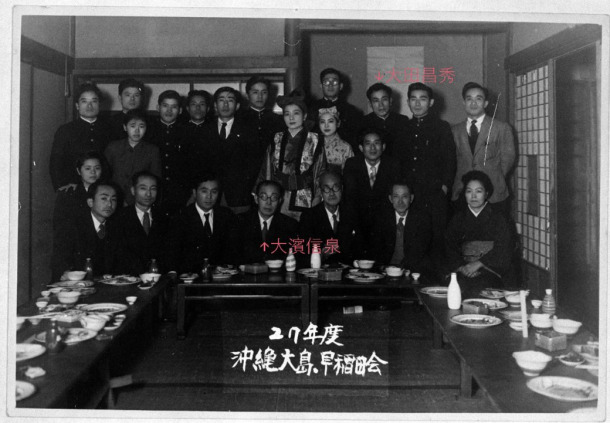
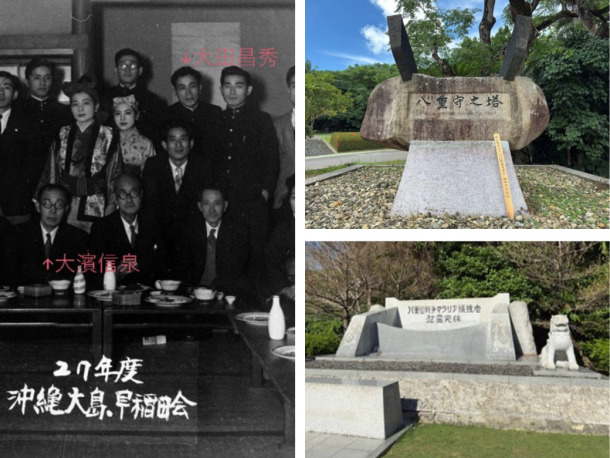
A photograph featuring Ohama and Ota. Taken at the 1952 Okinawa Oshima Waseda Alumni Association gathering (Courtesy of Waseda University History Museum)
Ohama served as a mentor to the “international students” from Okinawa attending Waseda University, and he was also a figure who embodied the pride of his hometown.Ota enrolled in 1950 as one of those students. He spent his college years during the period following the signing of the San Francisco Peace Treaty the following year, a time when Okinawa was becoming permanently placed under U.S. administration.
Born in 1934, these two individuals are separated by a 30-year gap in the dates their names were inscribed on the monuments. Nevertheless, on “Memorial Day” on June 23, these two monuments have long served as the primary sites of remembrance on Ishigaki Island. Why are there two? Tracing the background of each reveals different aspects of the “postwar” era.
The Postwar Era Under the Cold War: On the Path to “Return”—Nobumoto Ohama and the Tower of Yaemori
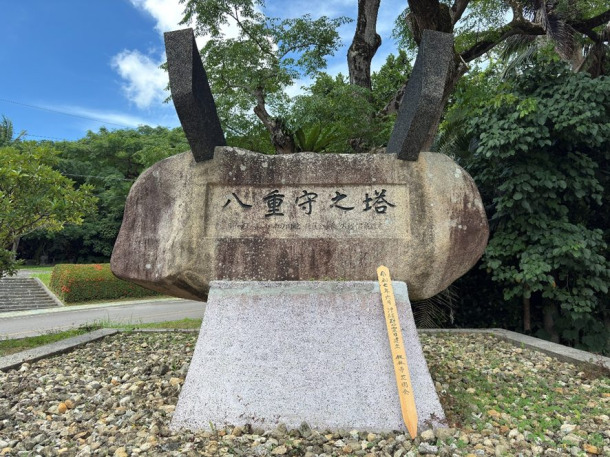
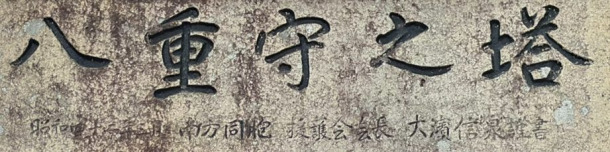
Tower of Yaemori (Photo taken by the author on June 28, 2025)
The inscription on the Tower of Yaemori fort the spirits of the 670 brave warriors who fell while the 45th Independent Mixed Brigade and the Naval Security Force ‘joined hands with their fellow citizens of the Yaeyama Islands’ to prepare for the U.S. military invasion.”In 1969, the “heroic spirits” of military personnel and civilian employees who died in service since the Russo-Japanese War were also enshrined here. This monument honors primarily military personnel and civilian employees, emphasizing the cooperative relationship between residents and soldiers.
This was set against the backdrop of an era in which Japan and the United States were moving toward the return of Okinawa. In January 1965, as the Vietnam War was intensifying, Prime Minister Sato visited the United States and held talks with President Johnson.They reaffirmed the importance of military facilities in Okinawa and the Ogasawara Islands, and Prime Minister Sato’s desire for their early return was incorporated into a joint statement. In August of that same year, he became the first postwar prime minister to visit Okinawa, traveling as far as Ishigaki Island. Ohama accompanied him on the trip as a special advisor.
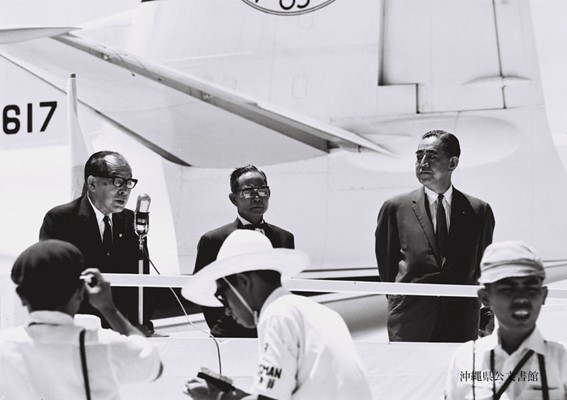
Ohama (far left) greeting people at Ishigaki Airport. On the far right is Prime Minister Eisaku Sato (Courtesy of the Okinawa Prefectural Archives)
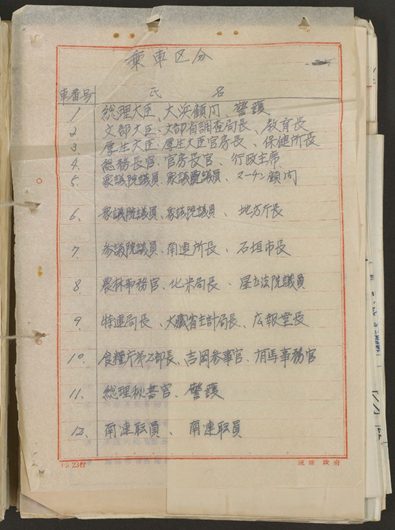
Passenger list from a trip to Ishigaki Island. It shows that Prime Minister Sato and Ohama were traveling together (Okinawa Prefectural Archives, “Miscellaneous Documents Related to Prime Minister Sato and Minister of Agriculture and Forestry Sakata, 1965”) *Click to enlarge
The Tower of Yaemori was erected with financial assistance from the Association for the Support of Southern Compatriots, which was leading a government-sponsored repatriation project, and with the approval and signature of Ohama, who was the association’s chairman at the time. It is believed to be a memorial built during the Cold War, as the Japanese government’s efforts toward “reversion” were taking concrete shape.
The Postwar Era That Continues to Raise Questions: Masahide Ota and the Memorial Monument for the Victims of Malaria During the Yaeyama War
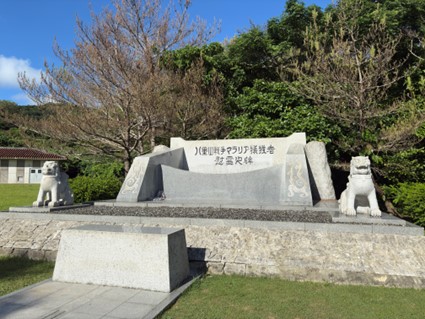
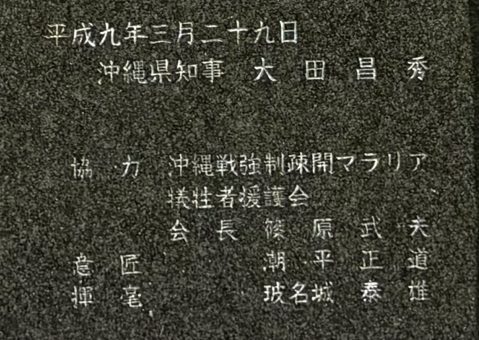
Memorial Monument for the Victims of Malaria During the Yaeyama War (Photo taken by the author on June 29, 2025)
The Yaeyama War Malaria Victims’ Memorial, on the other hand, was erected after a campaign by the bereaved families demanding state compensation was resolved politically as a “consolation project” funded by the national treasury, rather than through individual compensation.The explanatory text signed by Ota states that residents were forced to evacuate to malaria-endemic areas to facilitate military operations, and that more than 3,000 people lost their lives to malaria around the time of Japan’s surrender.
Unlike Okinawa Island, the Yaeyama Islands did not experience ground combat; the majority of the casualties were due to malaria contracted during forced relocation. This monument is the result of a movement to uncover the unique wartime experiences of the Yaeyama Islands—experiences often overlooked in the conventional narrative of the “Battle of Okinawa”—and to hold the Japanese military accountable for its wartime responsibilities.The bereaved families’ association requested that the words “military orders” be included in the explanatory text, but this was not implemented; local newspapers reported on the complex feelings of the bereaved families.
The year 1995, when the policy for the monument’s construction was finalized, was also the year in which a large-scale protest demanding the downsizing of U.S. military bases in Okinawa erupted following the September rape of a Japanese girl by a U.S. soldier—a year in which Governor Ota sharply questioned U.S.-Japan relations. It was also a period when a series of lawsuits were filed in Japan by individuals from various Asian countries seeking compensation for wartime damages.Ota’s signature is a trace of “politics” left behind amid a reexamination of the memory of the war, 50 years after its end.
The War Experiences of Two People Whose Paths Crossed at Waseda and the Postwar Era in the Yaeyama Islands
Ota survived the Battle of Okinawa as a member of the Iron Blood Loyalist Corps (*), and he made that experience the foundation of his postwar research and political career. Ohama, on the other hand, served as a university Faculty during the war and was in a position to send students to the front lines; after the war, he devoted himself to supporting students from Okinawa, including Ota.
* All male and female secondary school students in Okinawa Prefecture were mobilized, with upperclassmen organized into the "Iron and Blood Loyalty Corps" and lowerclassmen into the "Communications Corps." The Iron and Blood Loyalty Corps was responsible for transporting military supplies and repairing bridges destroyed by bombing. At the boys' division of Okinawa Normal School, to which Ota belonged, 386 students and 24 teachers were mobilized, and 226 students and 9 teachers were killed in action.
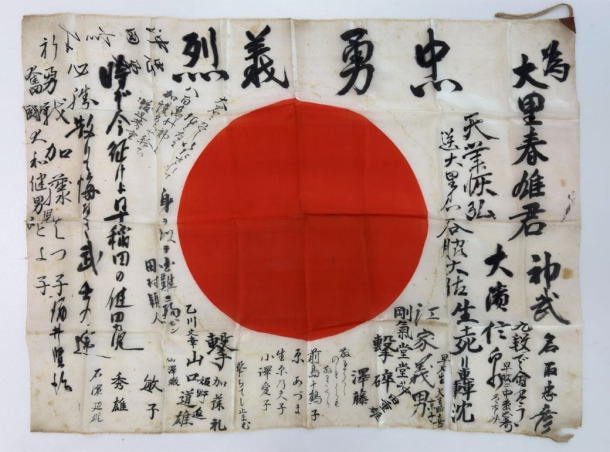
A Waseda University student’s deployment flag. The name “Nobumoto Ohama” appears in the lower right corner (from the collection of Waseda University History Museum)
The two men, who had different wartime experiences, crossed paths at Waseda University and, as postwar leaders, each played a role in preserving the memories of the war in the Yaeyama Islands. The two stone monuments in Banna Park convey a chapter of postwar history marked by political tensions surrounding the memory of the war and how it should be preserved.
[References]
Aiko Utsumi, *Japan and Asia: A Perspective from Postwar Reparations* (Yamakawa Publishing, 2002)
Shizuo Ota, *The War in the Yaeyama Islands* (Nanzan-sha, 1996)
Shizuo Ota, *1945 in the Yaeyama Islands* (Misuzu Shobo, 2025)
Masahide Ota, “What Was Atoned for with Blood,” in *The Okinawa Kenji Corps* (Nippon Shuppan Kyodo, 1953), pp. 1–121
Masahide Ota, “Life as a ‘Hiryu’ Under U.S. Military Administration,” *Waseda University Bulletin*, Vol. 19 (Waseda University Office of University History, 1987), pp. 166–177
Daiki Kishaba (Hub Create Co., Ltd., Designated Manager of the Ohama Shinzen Memorial Museum), ed.,Ishigaki City (Supervising), *—Special Commemorative Booklet for the 130th Anniversary of Nobumoto Ohama’s Birth— Shinzen and Reintegration: Hoping for the Future Development of Okinawa in a Changing World* (Ryukyu Kikaku, 2024)
Fumiaki Nozoe, *Masahide Ota: A Scholar and Politician Who Embodied Okinawa’s Agony* (Chuko Shinsho, 2025)
Okinawa Prefectural Peace Memorial Museum (ed.), *Okinawa Prefectural Peace Memorial Museum Annual Report*, No. 19 (Okinawa Prefectural Peace Memorial Museum, 2019)
Edited by the Taketomi Town History Editorial Committee, *History of Taketomi Town, Volume 11: Source Materials—Newspaper Compilation 7* (Taketomi Town Hall, 2019)
Kiyoshi Makino, *New History of the Yaeyama Islands* (Kiyoshi Makino, 1972)
Okinawa Times, March 29, 1997, Morning Edition, p. 25: “Memorial Service Today / Families of War Malaria Victims Have Mixed Feelings / The Grief Never Ends / A New Starting Point / ‘I Want to Build the Memorial with My Own Hands’ / Moriyasu Hoku, a Native of Hateruma Island”
Okinawa Times, April 18, 1997, Morning Edition, p. 5: “War Malaria Memorial Service / An Unsatisfactory, Ambiguous Resolution / Evacuated to Malaria-Infested Areas by Military Order / Zenhiro Gushiken”
Okinawa Prefecture, “Okinawa Battle Heritage Project: Student Corps from 21 Schools Mobilized to the Battlefield” (Verified June 9, 2026)
Hiroaki Yanagi / Waseda University History Museum Part-time Contract Employee
He withdrew from the Doctoral Program at the Graduate School of Sociology, Hosei University, after completing all required credits. His area of expertise is the modern and contemporary history of the Ryukyu and Yaeyama regions. He concurrently serves as a researcher, director, and secretary-general at the Institute for Political and Economic Research (a public interest incorporated foundation), where he promotes projects such as the development of regional archives in collaboration with universities, local governments, and civic organizations.


![[Save version] Map of the four main campuses](https://www.waseda.jp/inst/weekly/assets/uploads/2026/06/110d605cfac40346aad1d2df464a6586-940x705-1-1-610x457.jpg)