Once you take that step, the door will open.
Shoko Tsuji, Secretary General FIFPRO Asia/Oceania
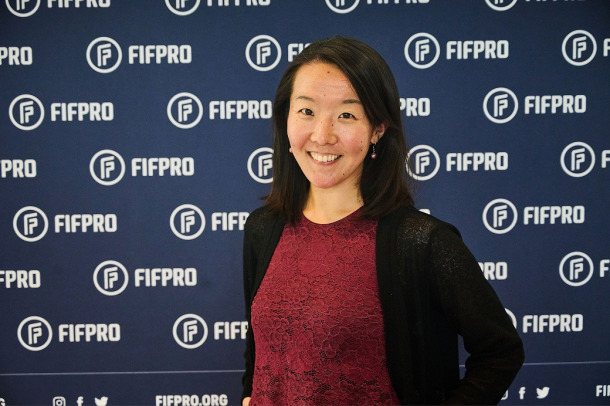
At FIFPRO
The quadrennial spectacle, the FIFA World Cup 2026, is finally about to begin. While the world is in a frenzy, the International Federation of Professional Footballers (Fédération Internationale des Associations de Footballeurs Professionnels, hereafter FIFPRO) is calmly working to protect the rights and improve the treatment of professional footballers. In October 2024, Shoko Tsuji, a graduate of Waseda University's School of Sport Sciences, became the first Asian woman to be appointed President of FIFPRO for Asia and Oceania. How did this person, who had wished to "work on the global football scene" even before entering Waseda, make that dream a reality?
All my experiences are for my work in "Football x World".
The turning point that changed Tsuji's outlook on life was the 2002 FIFA World Cup, which was held in Japan while she was a junior high school student.
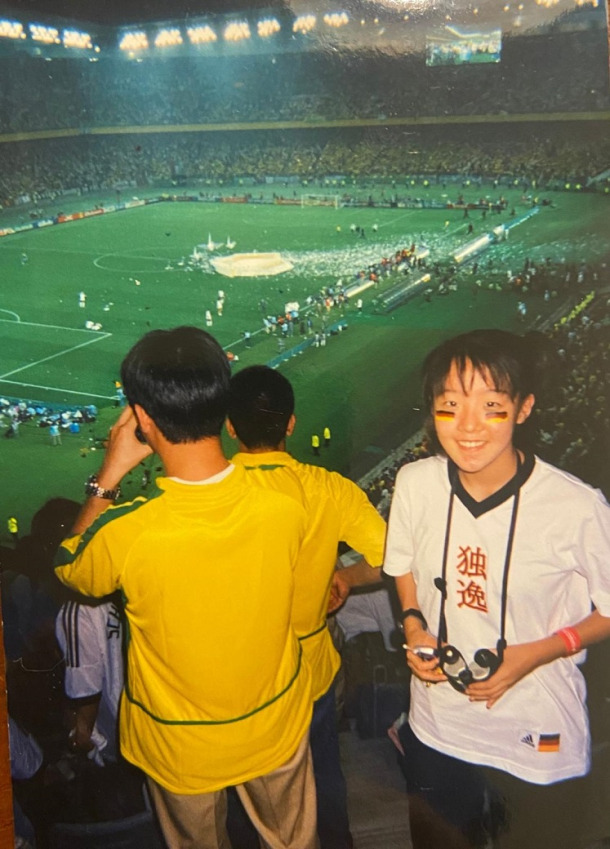
In 2002, at the Japan-Korea World Cup final at Yokohama International Stadium
"I was lucky enough to watch the final match in my hometown of Yokohama. At that moment, I felt like the world had become closer. People from all over the world come together through football, and even if you don't speak the same language, you can all get excited together. That's what inspired me to want to work in the field of 'football x the world' someday."
Tsuji is someone who acts on impulse. Even as a middle school student, she immediately began studying Spanish, which is considered the main language of the football world. Furthermore, wanting to acquire specialized knowledge in sports, she chose to attend the School of Sport Sciences at Waseda University.
"Exploring sports from various angles and perspectives—in relation to culture, education, and society—has undoubtedly formed the foundation of who I am today. Furthermore, the lectures by Takeshi Chonan and Kenta Tasaki, who are active in the world of sports nonfiction and documentaries (*), were inspiring, and I learned the importance of 'going to the actual locations.'"
* "Practical Sports Journalism Workshop" (established in 2010). Instructors: Takeshi Chonan (freelance director, School of Commerce graduate), Kenta Tasaki (non-fiction writer, Faculty School of Law graduate)
In particular, Professor Masayuki Ishii (Faculty of Sport Sciences), who specialized in International Sports Culture in his seminar, gave Tsuji specific advice that influenced her life afterward.
"Whenever Professor Ishii found interesting overseas literature or news, he would always introduce it to me. When he learned about the existence of a graduate program called 'FIFA Master' in the UK, he even went out of his way to contact me and say, 'I think it would be perfect for you, Shoko.'"
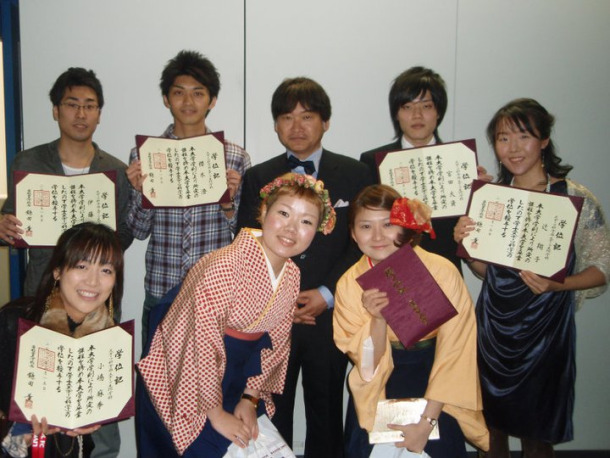
March 2011, on graduation day. With her seminar classmates, Professor Ishii (center back row), and Tsuji (far right back row).
The FIFA Master is a postgraduate sports science program established in 2000 with the aim of training individuals to work for international sports organizations. It is based in the UK, Italy, and Switzerland. In Japan, it became known when Tsuneyasu Miyamoto (current president of the Japan Football Association), who also served as captain of the Japanese national soccer team, enrolled in 2012, but Tsuji had been aware of its existence much earlier.
"I now had a future goal: to one day study at the FIFA Masters. At Waseda, I also took courses in various languages, including Spanish, Italian, and Basque, and I was fortunate enough to have opportunities to interact with universities abroad through online meetings. Nowadays, online communication using Zoom and the like is commonplace, but I believe that being able to have such experiences around 2010 was only possible because I studied at Waseda."
While diligently pursuing her studies, she also joined the Waseda University Association Football Club's women's team, leading a busy life with practices and matches.
"I started playing football competitively relatively late, in high school, so I initially had no intention of joining Waseda, a university with national team players at various age levels, as I didn't think I could possibly make it. But, as it turned out, I was completely immersed in football. When I think back on my time at university, all I remember are the everyday conversations in the locker room and during ball passing drills before practice. I was truly blessed with wonderful teammates during those four years."
Tsuji, who completed four years with the women's football team, including experiencing consecutive victories at the Intercollegiate Championships in her third and fourth years, says she has many memories from off the field as well.
"There were opportunities for international students to participate as trainees, and at those times, I was in charge of supporting them because I could speak English. Looking back now, I realize that even back then, I was playing a role as a bridge for cross-border exchange."
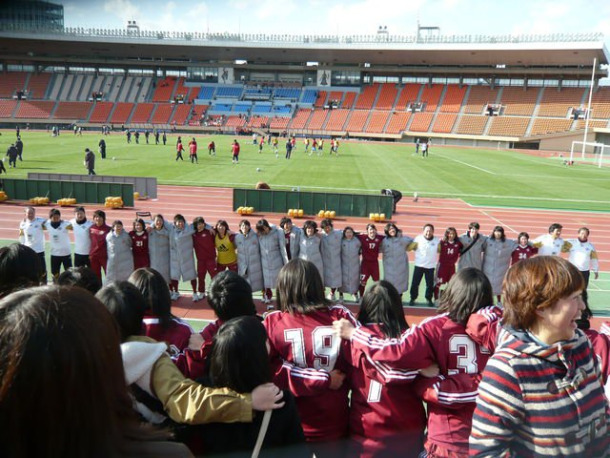
In the January 2011 final, when Waseda University Association Football Club women's team achieved their second consecutive Intercollegiate Championship victory, Tsuji was apparently in the stands.
At turning points in life, it's especially important to "go and seek help when you're in trouble. Just take action."
Tsuji wanted to work in the world of football. To fulfill that dream, she didn't look for a job and instead enrolled in a graduate program in Spain where she could major in sports journalism. She thought she could make full use of the Spanish she had been learning since middle school... but a harsh reality awaited her.
"The first few months were incredibly tough. We were given assignments in Spanish that were difficult even in Japanese, such as 'watch a Real Madrid match and write an article within 20 minutes' or 'provide commentary and analysis.' I recorded all the classes and listened to them over and over again at home just to be able to understand them."

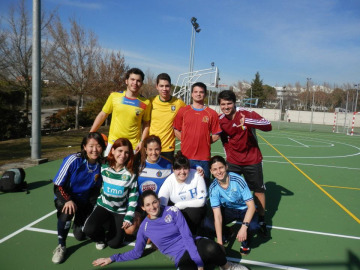
Photo on the left: A well-worn Spanish dictionary.
Photo on the right: A picture taken during graduate school in Spain, when playing football with classmates from all over the world. Tsuji is at the far left of the front row.
Her struggles weren't limited to academics. At the time, Spain had a youth unemployment rate of over 50%. Finding a job was no easy task, but a chance encounter and her proactive approach helped her overcome the obstacles.
"When I was traveling in Barcelona, I happened to go into a hair salon and found a job posting for a 'sports journalist with experience who can speak Japanese, Spanish, and English.' I knew I had to apply! So I immediately sent an email. I really felt the importance of 'going out and seeing things for yourself,' something I learned in college."
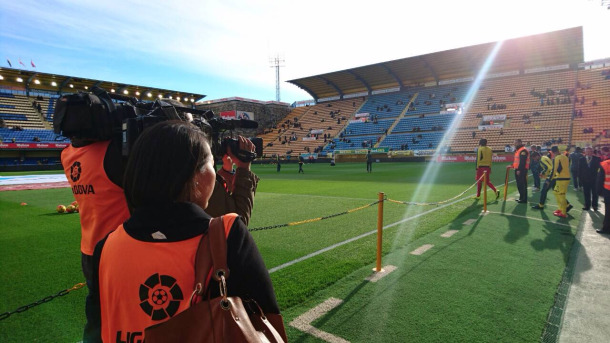
A scene from her time as a coordinator. At the Villarreal CF broadcast site in Spain.
Thus, Tsuji got a job at a sports media coordination company in Barcelona. After spending about four years gaining valuable experience negotiating with Japanese broadcasters, producing documentaries and conducting interviews with Spanish national football team players, she finally enrolled in the FIFA Master's program in 2016.
"Just when I was thinking I needed to start thinking about my next step, I had the opportunity to work with Tsuneyasu Miyamoto, who had just graduated from the FIFA Master's program. He encouraged me, saying, 'If you're interested, you should definitely apply,' and that's when I decided to enroll. It was a physically demanding program, involving traveling to three countries—England, Italy, and Switzerland—for a year to learn about football in action, but compared to the hardships I faced during graduate school, it was a very fulfilling experience."
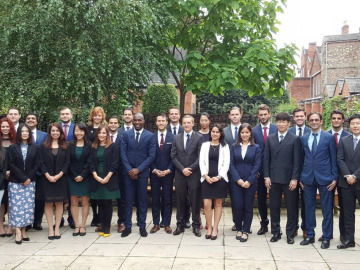
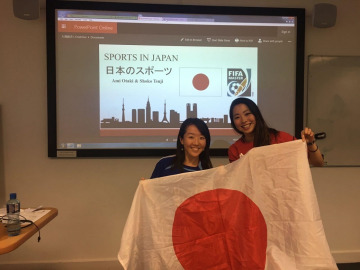
Photo on the left: FIFA Masters Entrance Ceremony, Tsuji is the fourth person from the left in the front row. She reportedly gave the valedictory address as the class representative at graduation.
Photo on the right: With Asami Otaki (former Japan women's national football team player, current director of the Japan Women's Professional Football League, and graduate School of Sport Sciences), who was in the same class as me at the FIFA Masters and also in the women's football club.
Drawing on her experience at the FIFA Masters, Tsuji moved to FIFPRO in 2022 to pursue her career.
"Since my time at Waseda University, I've been surrounded by top athletes, and having interviewed over 100 athletes, I knew that even those who appear glamorous have various struggles and worries behind the scenes. That's why, when I saw the job posting for FIFPRO, I immediately decided I had to apply!"


Photo on the left: At the 2022 FIFPRO Women's Football Summit. Current Japan national team player Saki Kumagai (second from the right) and Tsuji (second from the left).
Photo on the right: A scene from the FIFPRO podcast recording in London in 2025. Former England international player Joe Hart (left) and current Australia international player Jackson Irvine (right)
In 2024, she was appointed Secretary General of FIFPRO Asia/Oceania. She says that the challenge is all the more rewarding because it is a region where athletes' rights are still underdeveloped.
"Japan and Australia are developed countries, but in other countries, there are still issues like unpaid wages. In some regions, there is no culture of players' associations or labor unions at all, or they are prohibited. However, at this year's Women's Asian Cup, we negotiated to increase the prize money for female players. We are also creating new awards for players, and we are making reforms wherever we can. The fact that there are many challenges is proof that there is also a lot of room for growth."
Having overcome various difficulties, Tsuji is now active on the global stage. Based on her experiences, what message would she like to convey to students?
"The attitude I learned in college—'If you're in trouble, go and see for yourself. Just take action'—has opened doors for me countless times. Seniors and mentors have also encouraged me. If you're stuck on something, just take action. It could be something as simple as listening to a senior's advice or taking a popular class. You'll find the key to overcoming your challenges by taking action."
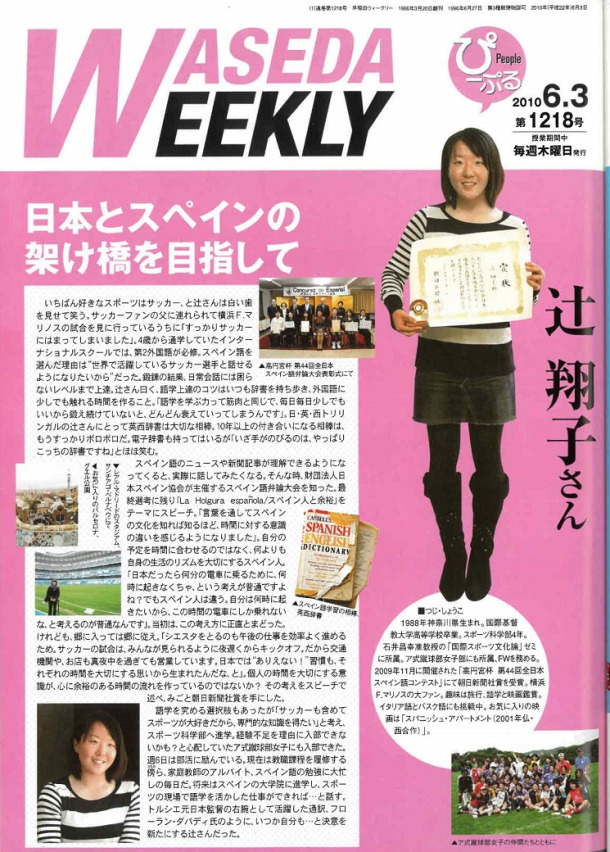
This photo of Tsuji, then a fourth-year university student, was published in the print magazine "Waseda Weekly" (June 2010 issue). She won the Asahi Shimbun Award at the "44th Prince Takamadonomiya Cup All Japan Spanish Contest." Even back then, she said she wanted to "use her language skills in a job related to sports."
Interview and text: Naoto Oguma (2002 graduate School of Letters, Arts and Sciences II)
【Profile】
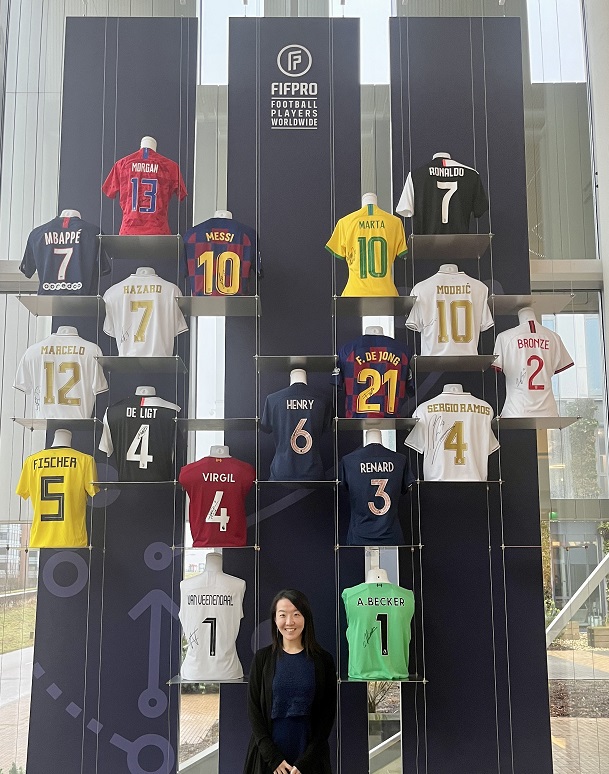
At FIFPRO
Born in Kanagawa Prefecture in 1988. After graduating from Waseda University's School of Sport Sciences in March 2011, she moved to Spain and enrolled in graduate school in Madrid (majoring in sports journalism). After that, she worked for a coordination company in Barcelona. In September 2016, she enrolled in the FIFA Master's program, run by the International Federation of Association Football (FIFA). She has been active in FIFPRO since 2022 and was appointed Secretary General of FIFPRO Asia/Oceania. She currently resides in Amsterdam, Netherlands.



![[Save version] Map of the four main campuses](https://www.waseda.jp/inst/weekly/assets/uploads/2026/06/110d605cfac40346aad1d2df464a6586-940x705-1-1-610x457.jpg)